Say No to Executing Palestinian Detainees in Israeli Prisons
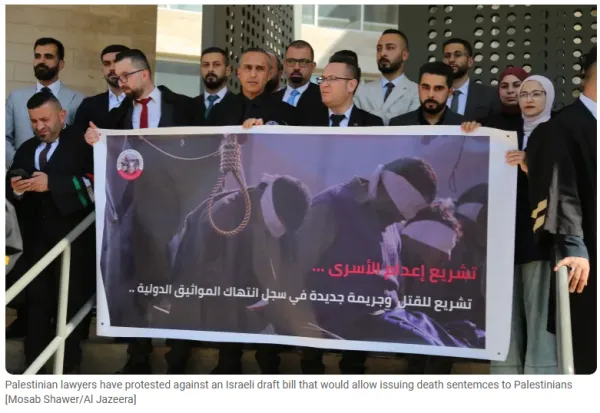
Image credit embedded
A new Israeli law seeks to authorize the execution of Palestinian detainees—Muslims and Christians alike—and the world’s response has been disturbingly muted. Nearly 10,000 Palestinians held in Israeli prisons need global attention now more than ever.
The legislation would apply the death penalty exclusively to Palestinians convicted in Israeli military courts, while exempting Jewish Israelis who commit politically motivated killings against Palestinians. Human rights organizations inside and outside Israel have condemned the bill as discriminatory and dangerous.
The legal disparity is stark. Palestinians in the occupied West Bank are tried under military law, while Israeli settlers living in the same territory are subject to civilian law. The bill would allow military judges to impose the death penalty without unanimous agreement, and executions would be carried out within 90 days with no possibility of appeal. Methods include hanging or lethal injection.
Many Palestinian detainees are held for years without charge, trial, or access to legal counsel. They are our Muslim and Christian brethren, and it is our moral responsibility to stand with them and pray for their safety.
Several Israeli political figures have openly advocated extreme measures. Finance Minister Bezalel Smotrich has repeatedly called for dismantling the Palestinian Authority and annexing the entire West Bank—statements widely criticized as endorsing ethnic cleansing. National Security Minister Itamar Ben‑Gvir recently boasted on live television that he has ordered red uniforms and is constructing a death‑row wing specifically for Palestinian prisoners.
Other far‑right figures have made similarly alarming remarks. Moshe Feiglin, leader of the Zehut party, has publicly argued for the eradication of Gaza’s population. Limor Son Har‑Melech, Deputy Speaker of the Knesset, was photographed holding a noose and syringe while celebrating the proposed death‑penalty law. Such rhetoric reflects a political climate in which dehumanization of Palestinians has become normalized.
https://x.com/aapayes/status/2039096893213389210?s=20
Protests took place in front of the Knesset, where participants expressed their opposition
to the bill on the death penalty for Palestinians detainees and to the continuation of the war.
The bill’s passage sparked protests outside the Knesset, where demonstrators denounced both the legislation and the ongoing war. Similar protests have erupted in Syria, Jordan, and across Europe. A general strike recently brought much of the West Bank and East Jerusalem to a halt in response to the law.
Critics inside Israel have also spoken out. A Jewish human rights activist in Berlin, known publicly as “German Thomas,” condemned the bill as discriminatory before being detained by police during a demonstration. His family’s history—relatives murdered in Auschwitz—underscores the painful resonance of state‑sanctioned executions based on ethnicity.
Human rights groups report that dozens of Palestinian detainees have died in Israeli custody in recent years, citing torture and medical neglect. The new law raises fears that executions could soon become widespread.
“This law practically aims to execute prisoners simply for their struggle for their people’s freedom and their right to self‑determination,” said Farid al‑Atrash, director of the Independent Commission for Human Rights in the West Bank. Legal scholars have similarly warned that the bill constitutes apartheid legislation because it applies only to Palestinians. As Professor Ramzi Odeh noted, Israeli settlers or soldiers who kill Palestinians would not be subject to the law.
The contrast in global reaction is striking. When Hamas captured 251 Israelis and sought a prisoner exchange, Western leaders demanded the immediate release of all Israeli captives and provided round‑the‑clock media coverage for years. Yet the thousands of Palestinians held by Israel—many without charge—rarely receive even a fraction of that attention.
Israel now stands poised to become the first state since Nazi Germany to implement a death‑penalty system that applies to one ethnic group but not another. The international community must not ignore this moment. Silence in the face of such legislation risks normalizing a system that many legal experts and human rights advocates view as a pathway to further atrocities.
The world must speak clearly: executing prisoners based on their identity is unacceptable. Justice cannot be selective, and human rights cannot be conditional.
Mahmoud El‑Yousseph is a Palestinian freelance writer and retired U.S. Air Force veteran. He writes on U.S. foreign policy, Middle East affairs, and justice. Email: elyousseph6@yahoo.com
Caption for image below: After more than two years in detention, the body of Palestinian child Wadi’ Alian was buried in numbered graves on October 29, 2025, without informing his family or their lawyer, even though the burial order had been issued on October 22. X Quds News Netwark