
She Went to Syria to Save Lives. Who Will Fight for Justice for Her?
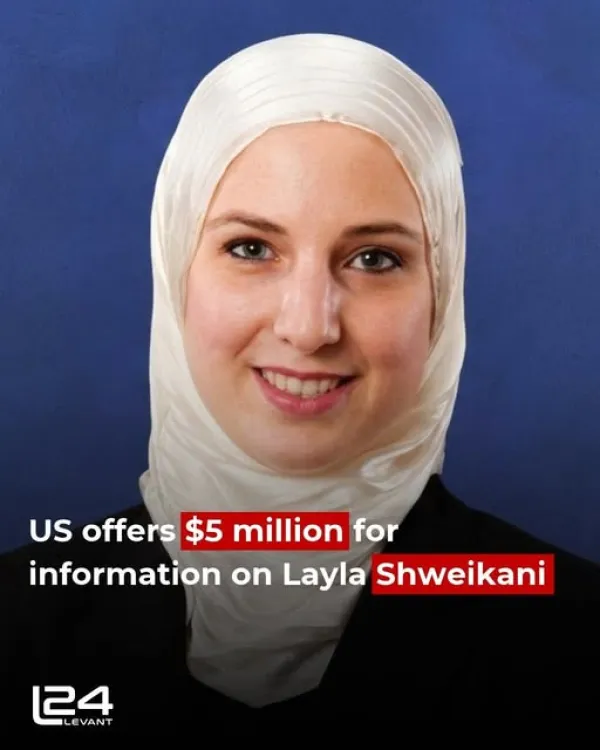
The U.S. State Department is offering up to $5 million for information about Layla Shweikani, a Syrian American aid worker who returned to Damascus in 2015 to help civilians during the Syrian Revolution. Photo credit: Social media.
A young American woman traveled to Syria to save lives, only to disappear into a notorious prison system and reportedly be executed by the Assad regime. Today, the U.S. government is offering a reward of up to $5 million for information about her abduction and unlawful detention.
Her name was Layla Shweikani. Born in Chicago in 1990, Layla was a computer engineer and American citizen who became involved in humanitarian work in Eastern Ghouta, rural Damascus, following the outbreak of the Syrian revolution in 2011.
In 2015, driven by humanitarian concerns, Layla left the safety of the United States and traveled to Syria to provide relief to civilians trapped in Eastern Ghouta.
In February 2016, Syrian regime forces arrested her. She spent approximately ten months in the custody of Air Force Intelligence, where she was reportedly subjected to torture and physical and psychological abuse.
In December 2016, a diplomat representing U.S. interests was permitted to visit her at Adra Prison. According to accounts of her detention, Layla was threatened with harm to her family and coerced into confessing to fabricated charges. She was subsequently referred to a field military court and transferred to the notorious Saydnaya Prison.
Human rights reports indicate that Layla was executed there on December 28, 2016. Two years later, in November 2018, her family received notification from Syria's Civil Registry confirming her death. However, her remains were never returned, and her family was given no reliable information about her burial place.
The U.S. Department of State's Rewards for Justice program is now offering up to $5 million for information concerning her abduction and unlawful detention. The department identifies two former Assad regime officials as individuals who may possess critical information: Jamil Hassan, former director of Air Force Intelligence, and Brigadier General Abdul Salam Fajr Mahmoud, a former prison official. Both remain at large.
Imagine a young woman leaving her home in America to help people she barely knew, only to disappear behind prison walls. Her family has spent years seeking answers about what happened to her and where her remains might be.
The passage of ten years has not erased the obligation to seek justice for Layla. Her family deserves the truth, and those responsible for her disappearance, torture, and death must be held accountable.
But Layla's case is not the only unresolved act of violence against an Arab American whose family continues to wait for justice.
In 1996, the FBI announced a $1 million reward for information leading to the arrest and conviction of those responsible for the 1985 assassination of Alex Odeh, a Palestinian American activist and Western regional director of the American-Arab Anti-Discrimination Committee.
Alex was a friend of mine. I met him in Washington, D.C., one day before his assassination on October 11, 1985. He was killed when a bomb exploded as he opened the door to his office in Santa Ana, California.
The FBI investigation examined possible links to members of the Jewish Defense League (JDL). Although investigators have pursued leads involving former JDL members, no one has been charged with Odeh's murder. The FBI continues to offer the $1 million reward, and the case remains open.
Layla Shweikani, a Chicagoan who traveled to Syria to help internally displaced people, was executed by the Assad regime in 2016. Layla’s family was informed of her death two years later, but her remains were never delivered and her family is still looking for closure. https://www.facebook.com/share/v/1CwR47G226/
Two cases. Two families still seeking answers. Two demands for justice that should not be forgotten.
The United States has offered substantial rewards in both cases. But rewards alone are not enough. Washington should use every appropriate diplomatic and legal avenue to press for cooperation, obtain information about Layla's fate, and bring those responsible for Alex Odeh's murder to justice.
Is that too much to ask?
Mahmoud El-Yousseph is a Palestinian freelance writer and retired U.S. Air Force veteran. He writes about U.S. foreign policy, Middle Eastern affairs, and justice.