
SIGN & VOTE (We Hope!)
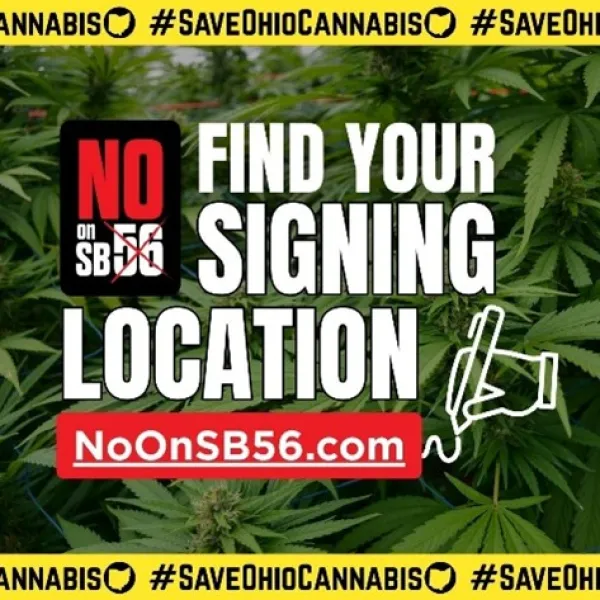
FIRST!! Help restore Issue 2/Regulate Marijuana Like Alcohol! The Ohio General Assembly butchered critical clauses in Issue 2, which voters passed overwhelmingly in 2023. As citizens, we can change it back to what it was. Here’s how:
We’re intent on sending Issue 2 back to the voters by a citizen-led referendum (for a definition, read below). However, like other citizen-led initiatives, almost 250,000 signatures must be collected by mid-March. Please sign a petition TODAY. Here’s how:
- Check your voter registrationHERE. Only registered voters can sign petitions. If you’re not registered to vote, click here. Once you register, you can cast your ballot in future elections.
- Find a signing location. Click here. Like other citizen-led efforts, you must pen your name and address information on an official petition. (This is a State of Ohio process that must follow specific steps in detail.) If you know someone who has a petition, you can sign it. But, be careful. It must be an official petition issued by this campaign. Otherwise, visit a signing location.
- Sign the petition. Petitions are printed on paper only. Circulating them is a legal process that must be conducted in person. You cannot sign online. The only info you need for signing is your name and address. No personal information is required.
- Commit to sign. And do sign! The campaign needs numbers to show how it’s doing. Click here and let them know that you intend to sign the petition. Signing locations can be found here.
- Get involved. If you just oppose what legislators have done to the RMLA/Issue 2, please sign the petition. But, you can, also get involved by collecting signatures on your own and/or making a generous donation.
Again, click here to sign up!!
WHAT IS A CITIZEN-LED VETO REFERENDUM?
“It is a process that stalls the General Assembly’s enactment of a recently passed law until the bill can be submitted to voters in a general election for approval or rejection.”
In a political environment that echoes today, the Progressive Movement arose in the early of the early 1900s. One hundred years ago, Ohioans became fed up with a political machine characterized by billionaires, oligarchs, and monopolies. Complaints included the lack of power accorded the middle class, labor, and underprivileged. To circumvent the political machine, they held a Constitutional Convention in 1912 and shortly thereafter amended the Ohio Constitution to include constitutional amendments, citizen initiated statues, and referendums. Today, each continues to exist and is overseen by the Ohio Secretary of State.
The effort to nix S.B. 56 is called a Veto Referendum. It asks voters to repeal an already enacted law. According to Ballotpedia, in Ohio, “a 'YES' or 'for' vote means that the challenged legislation should be upheld. Conversely, a 'NO' or 'against' vote means the law should be repealed.”
The path to enact S.B. 56 became so laden with proverbial “landmines” that a referendum seemed to be the only option for the General Assembly to finally understand what voters wanted. Ohio Senator Bill DeMora called Senate Bill 56, “yet another assault on the will of Ohio voters and a direct threat to the success of Ohio’s adult-use marijuana program.” He further asserted that “S.B. 56 is a clear attempt to crack down on a market that is already thriving.” He summarized, saying:
“Issue 2 was a broad, bipartisan effort supported by urban, suburban, and rural Ohioans. S.B. 56, however, strays so far from the voters’ intent that it raises the question: who is this bill really for? Is it for the large, out-of-state corporations that control most of Ohio’s marijuana industry while sidelining local businesses and consumers? Or is it for the governor and the legislative leaders who have made it clear that they hate marijuana and have no issues ignoring the will of the people to get rid of it? One thing is for sure: It’s not for the majority of Ohioans.”
WHAT ARE THE STEPS TO CONDUCTING A REFERENDUM?
- Form a Committee to Represent Petitioners on all matters relating to the petition: 3-5 individuals.
- Create a petition in a specified format. Petition signing is limited to registered Ohio voters. Only black or blue ink can be used. Each petition should only hold signatures from one county.
- Circulate an initial petition with full text and summary. Collect 1,000 signatures of registered Ohio voters and submit them to Ohio Secretary of State (SoS).
- SoS verifies signatures, compares full text of the law with the law itself. If correct, he or she certifies the petition.
- On the same date or within one business day of the petition’s filing with SoS, a copy must be sent to the Ohio Attorney General (OAG), who will certify its summary as a “fair and truthful statement” of the law. If it is, OAG certifies it. If not, the committee must recollect the 1,000 initial signatures.
- Form a statewide ballot issue political action committee. The PAC must designate a treasurer and file Form 3-D with the SoS. Reports are filed before and after elections, semiannually, and annually if contributions have been received and expenditures made.
- Fill out Form 15. This form is required if any person has received compensation for supervising, managing, or otherwise organizing the effort to obtain signatures.
- After the end of the collection period, all petitions, even if incomplete (part), must be submitted to the SoS as one instrument. Committee must verify that an electronic copy of the petition is a true representation of the original.
- If signature count falls short of the required number, the SoS will notify the Committee and provide it with unique form on which to collect remaining supplemental signatures.
- The SoS passes referendum to Ballot Board that prescribes ballot language.
- The Committee to Represent prepares 300-word argument/explanation in favor of referendum (repeal the law).
- Governor or General Assembly must name someone to argue in favor of keeping the law intact. If no one steps forward, the Ballot Board or its appointee will prepare the arguments.
- The referendum would appear on the ballot during the next general election.
- Signature requirement: 6% of the vote in the last gubernatorial election: 248,092 registered Ohio voters. (Note: total petition numbers often double the requirement in order to account for mistakes and incorrect information. The actual count could be closer to 500,000.) 3% of signatures must come from 44 of 88 Ohio counties.
HAS THERE EVER BEEN A SUCCESSFUL REFERENDUM?
Yes! Famously, voters overrode S.B. 5 / Ohio Issue 2 in 2011. Enacted by the Ohio General Assembly on March 24, 2011, this bill restricted the collective bargaining rights of state employees, which left them in proverbial shock. A campaign called We Are Ohio was consequently formed to field a referendum to nix S.B. 5 and restore those rights. Initial signatures were submitted to the Ohio Attorney General on April 4, 2011, and 90 days later on June 29, 2011, petitioners submitted a record breaking 1,298,301 signatures to the Ohio Secretary of State, which certified the petition on July 21, 2011. On election day November 8, 2011, S.B. 5 was repealed with a total vote of 2.2 million or 61.6% of the electorate who voted no. Firefighters, police officers, teachers, and other state employees retained their collective bargaining rights.
WHAT IS MARY JANE’S OBJECTION TO S.B. 56?
As you may (or may not) know, I have been involved in Ohio’s cannabis movement for literal decades. I remember lobbying for S.B. 343 in 2007. I worked with newly minted Representative Kenny Yuko on H.B. 478 and H.B. 214 in 2010 and 2012. Ten years ago, I championed the Ohio Cannabis Rights Amendment (OCRA) and helped pass H.B. 523 that legalized medical marijuana for patients in Ohio. You can review some of my work with Issue 2 and S.B. 56 below.
Through the years, my mission has been to “take patients off the battlefield of the drug war.” Legalizing medical marijuana – eliminating arrests, prosecution, and incarceration for possession – was among the tools. In other words, NO ONE should go to jail for cannabis. With the success of the medical program, this seemed to work.
However, my first reading of S.B. 56 and its twin H.B. 160 sent me reeling. Earlier versions of the bills had five large paragraphs in Sec. 3796.99 that detailed escalating offences for just being a passenger in a vehicle with cannabis in it, even if the car wasn’t running. That measure invented a number of punishable crimes. These clauses never appeared in the RMLA/Issue 2.
Angered, I crafted and widely circulated two memes: “Just Say No to Mandatory Minimum Sentences” and “No Prison for Patients.” Over the course of the summer and fall of 2025, it appeared that lawmakers couldn’t concur on anything in S.B. 56. In November, they had to refer the bill to conference committee and where they apparently found some agreement.
I reviewed (what I thought was) the current and final version of S.B. 56. Ah ha! I said. Section 3796.99 is much shorter. Lawmakers must have modified, lightened, or even eliminated jail time. Maybe they saw the light: mandatory minimum sentencing has no place in cannabis policy. Boy, was I wrong! The General Assembly simply tried to pull the wool over our eyes. They cross referenced “violations” with other sections of the Revised Code to make the clauses look smaller. This table tells the story. Mandatory minimum sentencing and jail time for marijuana possession remain.
Given this, I cannot, and will not, support S.B.56. The RMLA/Issue 2 must be returned to its original version in the Ohio Revised Code.
MARY JANE’S GUIDE: ARTICLES AND MEMES PERTAINING TO ISSUE 2 AND S.B. 56
- Meme: “Just Say No to Mandatory Minimum Sentences for S.B.56.”
- Meme: “No Prison for Patients – Just Say No Mandatory Minimum Jail Sentences – Ohio S.B. 56 & H.B. 160.”
- Table: “Criminal Sentencing in Ohio Senate Bill 56”
- Table: “H.B. 160 Mandatory Minimum Sentencing”
- Table: “S.B. 56 – Cannabis Incarceration – Sec. 3796.99”
- Article – 8/7/25: Mary Jane’s Guide WTF.
- Article – 5/9/25: Dear Ohio House: Vote NO on HB 160.
- Article – 2/21/25: S.B. 56: No Mandatory Minimum Jail Sentences.
- Article – 12/3/2025: Mary Jane's Guide: Intoxicating Hemp Products. Safe or Not? Legal or Not? More Drug War or not?
- Article – 12/4/2023: Mary Jane’s Testimony before the Ohio General Assembly on Issue 2.
- Article – 11/24/2023: WE WON! Two Million Strong! Issue 2 OK’d by Voters, “The Ohio Way”.
- Article – 10/24/2023: Mary Jane's Guide October 2023: Vote YES on Issue 2!! RMLA Goes to the Ballot.
- Article – 5/30/2023: Mary Jane's Guide - JUST SAY NO! to ISSUE 1 – 10th Anniversary Deep Dive (historic ballot issues).
- Article – 12/22/2022: Initiate This: Adult Use Comes to Ohio. The Regulate Marijuana Like Alcohol initiative and its Path to Potential Passage.
NOW, GET THOSE SIGNATURES and REPEAL S.B. 56!!!
Mary Jane Borden is a best-selling author, skilled graphic artist, insightful analyst, and award-winning cannabis activist from Westerville, Ohio. During her 40-year career in drug policy, she co-founded seven cannabis-oriented groups, co-authored four proposed constitutional amendments, lobbied for six medical marijuana bills, penned 120 Columbus Free Press articles, and has given hundreds of media interviews. She is one of the Courage in Cannabis authors, with articles in both editions. Her artwork can be viewed at CannabinArt.com and she can be reached at maryjaneborden@ gmail.com.