
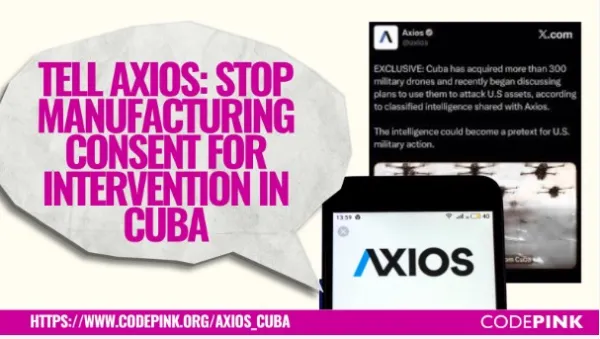
Tell Axios: Stop manufacturing consent for intervention in Cuba
The U.S. has no right to attack Cuba, threaten Cuba, starve Cuba, or decide Cuba’s future. The people of Cuba need fuel, medicine, food, and sovereignty. For more than 60 years, Washington has tried to force Cuba into submission through economic warfare, isolation, and regime-change operations. Media outlets should not help recycle the narratives used to justify escalation and intervention.
Cuba does not need another “new relationship” written in Washington. Cuba needs the U.S. to get out of its way.
To the editors of Axios,
We are deeply concerned by Axios’ recent reporting alleging that Cuba acquired hundreds of military drones for possible attacks on Guantánamo, U.S. vessels, and Key West.
At a moment when Cuba is enduring devastating blackouts, fuel shortages, food shortages, and severe economic hardship intensified by decades of U.S. sanctions, your reporting chose to center sensational and weakly sourced national security claims that rapidly spread panic across social media and political circles.
The Trump administration is simultaneously escalating pressure on Cuba through new sanctions, threats against countries and companies supplying fuel to the island, criminal charges against Cuban leaders, and increased military activity in the Caribbean under U.S. Southern Command.
In this context, media outlets have a responsibility to exercise extreme caution, skepticism, and historical awareness, especially when reporting anonymous intelligence claims that can contribute to fear campaigns and public support for escalation.
The United States has a long history of using exaggerated or manipulated threat narratives to justify interventionist policies in Latin America and around the world. Journalism should challenge those narratives, not help normalize them.
We urge Axios to provide greater scrutiny and context when reporting intelligence-based allegations about Cuba and to prioritize reporting on the humanitarian impact of U.S. sanctions on ordinary Cubans instead.
The Cuban people need food, medicine, fuel, electricity, and sovereignty, not another fear-driven narrative that pushes the region closer to war.