
Theocratic Fascism and the Emerging Political Order of the Middle East
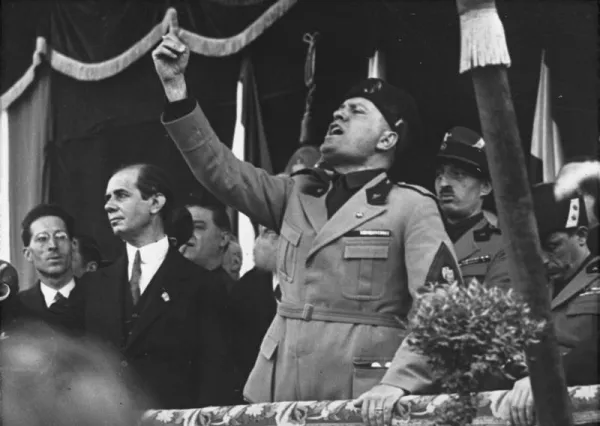
Bundesarchiv, Bild 102-09844 / CC-BY-SA 3.0, CC BY-SA 3.0 DE, via Wikimedia Commons

This essay examines whether political mechanisms historically associated with fascism are necessarily dependent upon secular nationalism, or whether analogous mechanisms can emerge within a religious revolutionary state. The Islamic Republic of Iran provides a particularly important case because its political order combines theocratic authority, revolutionary ideology, institutionalized coercion, restricted political competition, militarized power, and extensive regulation of society. The question is not whether Iran is simply another version of Mussolini's Italy or Hitler's Germany. The more consequential question is whether political structures and mechanisms historically associated with fascism can be reproduced under a radically different ideological foundation.
Criticism of the Islamic Republic's authoritarian political structure should not be interpreted as an endorsement of American hegemony or Israeli military policy. Conversely, opposition to American or Israeli power does not require political or moral justification of the Iranian state. These are analytically separate questions.
Iran's military resilience and the survival of the Islamic Republic following the recent United States–Israel war have strengthened the confidence of Iran's leadership in Tehran, which appears to regard the outcome as a strategic and political triumph. At the same time, the conflict exposed deepening distrust among Arab states toward the United States and raised questions about the durability of the long-standing U.S.–Israeli security order in the region. The Middle East may therefore be entering a significant geopolitical transition, marked not simply by shifting military alliances but by a broader redistribution of political and strategic influence. The recent NATO-style military pact involving Turkey, Saudi Arabia, and Pakistan further underscores this emerging realignment. Given the authoritarian political structures of these states and the distinct Islamic ideologies that shape their respective political orders, this alignment may represent something more profound than a conventional security partnership. It could signal the emergence of a new political and ideological configuration in the Middle East, with implications for American hegemonic influence, regional power, and the relationship between Islam, state authority, and political legitimacy.
Established following the 1979 Iranian Revolution, the Islamic Republic rejected both the monarchy of the Shah and the secular political models associated with the West. Its political legitimacy was instead constructed around Shia Islam, revolutionary ideology, and the doctrine of velayat-e faqih, or the guardianship of the Islamic jurist. Yet the Iranian state has also developed institutional and political characteristics commonly associated with authoritarian and, in certain respects, fascistic forms of government: concentrated political authority, ideological control, systematic repression of opposition, militarized coercion, restrictions on civil society, and the integration of political power with economic privilege.
This raises a central question: does the Islamic Republic reproduce structural characteristics associated with fascism while expressing them through a specifically Shia Islamist and theocratic ideology?
The question is complicated by the fact that classical European fascism was generally organized around secular nationalism, racial mythology, ethnic identity, militarism, and the glorification of the nation and state. The Islamic Republic does not derive its legitimacy primarily from a racial conception of the Iranian people. Instead, it derives legitimacy from Islam, revolutionary history, Shia political theology, resistance to foreign domination, Iranian nationalism, and the preservation of an Islamic political order. Nevertheless, the concept of "theocratic fascism" may provide a useful analytical framework if it is understood not as an assertion that Iran is historically identical to European fascist regimes, but as an attempt to identify comparable political mechanisms while recognizing fundamental differences in ideological content.
Fascism Beyond Its European Origins
Fascism is historically associated with movements such as Italian Fascism and German National Socialism, both of which emerged from particular European circumstances following the First World War. These movements combined authoritarian leadership, mass political mobilization, anti-liberalism, political violence, intense nationalism, suppression of opposition, militarism, and the construction of an idealized political community.
Race and nation occupied particularly important positions within European fascist ideology. Fascists frequently divided society between those considered authentic members of the national community and those portrayed as internal or external enemies. Political disagreement could therefore be transformed into a question of loyalty. The opponent was no longer simply someone with a competing political program but an enemy supposedly threatening the survival of the political community.
The Iranian case is structurally different. The Islamic Republic does not primarily organize political identity through race. Its central categories instead include Islam, Shia religious identity, revolutionary legitimacy, loyalty to the Islamic Republic, and Iranian national identity combined with its anti-imperialist foreign policy.
Religion in the Iranian system can perform some of the political functions that race, ethnicity, or secular nationalism performed within European fascist systems without being identical to them. Religion provides a comprehensive ideological framework through which political authority, morality, social behavior, and legitimate membership in the political community can be defined.
The analytical value of the term "theocratic fascism," therefore, depends upon separating ideological content from political structure. The ideology of the Iranian state is substantially different from European fascism. The comparison becomes meaningful only if it demonstrates that certain political mechanisms—not simply generic authoritarian characteristics—can operate in comparable ways under different ideological foundations.
This distinction is essential because authoritarianism and fascism are not interchangeable concepts. Concentrated political power, repression, militarization, and restrictions on political opposition can exist in authoritarian systems that are not fascist. The argument for theocratic fascism must therefore rest upon a broader combination of ideological mobilization, political exclusion, construction of internal enemies, subordination of individual autonomy to a transcendent collective order, and the institutionalization of coercive power.
Theocratic Authority and the Political Order
The constitutional structure of the Islamic Republic is particularly important to this argument. Iran possesses a president, parliament, elections, political factions and blocks, and other institutions that resemble those found in representative political systems. Yet these institutions operate within a broader structure of religious and constitutional authority. At the center of that structure stands the Supreme Leader. The doctrine of velayat-e faqih gives the Islamic jurist a privileged political role, placing ultimate ideological and constitutional authority above ordinary electoral competition.
This produces an important distinction: Iran possesses electoral institutions without being a liberal democracy. The existence of elections does not necessarily mean that political power is determined exclusively through unrestricted electoral competition. Political participation occurs within boundaries established by the constitutional and religious institutions of the Islamic Republic. The Guardian Council, for example, exercises significant influence over electoral eligibility and legislation, thereby limiting the range of political alternatives available to voters.
The following table identifies potential structural analogies between institutions and mechanisms associated with fascistic systems and their counterparts within the Islamic Republic.
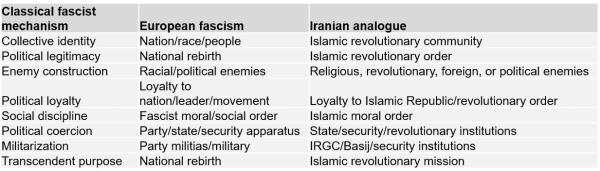
Table: Structural Analogies Between Fascistic Political Mechanisms and the Iranian Political System
The Iranian system should therefore not be understood simply as a conventional dictatorship in which elections have no political significance. Elections do matter. They can affect the balance between political factions, determine the composition of parliament, and produce changes in governmental policy. Yet electoral competition occurs within an ideological framework whose fundamental principles are not themselves subject to ordinary electoral revision. The result is a hybrid political structure: competitive institutions exist, but competition takes place within an ideologically bounded political order.
This distinction is important to the concept of theocratic fascism because authoritarian political systems do not necessarily eliminate institutions associated with democracy. They can instead transform those institutions so that political participation exists without granting citizens unrestricted authority to redefine the political system itself. The central issue, therefore, is not whether elections exist but where ultimate political sovereignty resides.
Political Opposition and the Construction of the Enemy
Another important point of comparison concerns the treatment of political opposition. Liberal democracy rests upon the principle that political disagreement is legitimate. Government opponents are presumed to remain members of the same political community even when they seek to replace those currently in power. Fascistic political systems tend to undermine this distinction by portraying political opposition as an existential threat. The Iranian revolutionary state has repeatedly used comparable categories of political exclusion under concepts such as moharebeh “enmity against God” and Mofsed-e-filarz “corruption on earth.” The political significance of this language is greater than its rhetorical content. It transforms the meaning of political disagreement. The distinction becomes: "You have a different political program" versus "You are an enemy of the state." Once an opponent is categorized as an enemy rather than a legitimate political competitor, extraordinary measures against that opponent can be represented as necessary acts of political self-defense. The political community is imagined as being under permanent threat, while coercion becomes justified as the means through which that community protects itself.
This logic has appeared repeatedly throughout the history of authoritarian movements. In fascist systems, the enemy is frequently portrayed as an existential threat to the nation. In the Iranian context, however, the concept of the enemy is mediated through religious and revolutionary ideology rather than primarily through racial nationalism. The resulting political logic may therefore resemble fascistic mechanisms without reproducing fascism's original ideological content.
Women, Morality, and the Ideological State
The Iranian system also illustrates the extent to which political authority can penetrate private and social life. The Islamic Republic has sought to regulate women's dress and behavior, sexuality, family relationships, religious observance, education, media, speech, and other dimensions of social life. These policies are not simply expressions of ordinary authoritarian state power. They derive legitimacy from an ideological claim that the state has a responsibility to maintain an Islamic social order. This produces an important characteristic of theocratic government: political conformity and moral conformity become interconnected.
The state does not merely claim the authority to determine who governs. It claims authority to define aspects of legitimate social behavior. In this respect, the Iranian system demonstrates how a comprehensive ideology can expand political authority beyond conventional government administration. The boundaries between politics, religion, morality, and social discipline become blurred. Fascist regimes historically attempted to create politically unified societies by subordinating individual interests to an allegedly higher collective purpose. The Islamic Republic similarly seeks to subordinate aspects of individual autonomy to a transcendent political and religious order.
The crucial difference is the nature of that transcendent order. Fascism generally elevated the nation, race, state, or historically defined people. The Islamic Republic elevates an Islamic revolutionary order grounded in Shia political theology. The structural comparison therefore cannot rest simply on the existence of social control. It rests on the question of whether a state claiming a transcendent ideological mission can use that mission to justify extensive political and social regulation in ways comparable to other ideological authoritarian systems.
The Revolutionary Guards and the Militarization of Political Power
The Islamic Revolutionary Guard Corps provides another important dimension of the comparison. The IRGC was created to protect the Islamic Revolution and has subsequently become an exceptionally influential institution within Iranian political, military, security, and economic life. Its significance therefore extends beyond conventional national defense. The existence of a powerful organization whose historical mission is explicitly tied to the preservation of the revolutionary political order demonstrates the importance of militarized political authority in Iran.
This also complicates the relationship between revolution and state power. Revolutionary movements frequently claim to overthrow established elites in the name of a new political community. Yet once revolutionary movements establish states, the institutions created to defend the revolution can themselves become permanent centers of power. The revolutionary organization consequently becomes part of the established order.
This creates a paradox at the heart of the Islamic Republic: A revolution can become an institution, and an institution created to defend a revolution can become an elite. The IRGC's political and economic influence is therefore important not only because of its military role but because it illustrates how revolutionary authority can become embedded in the distribution of political and economic power. The danger inherent in such institutionalization is that an organization originally justified as the guardian of a revolution can acquire interests in preserving the political order that the revolution created. Revolutionary legitimacy can thereby become a mechanism for defending institutional repressive privilege.
Revolution and Class Power
The Iranian Revolution also raises a broader question concerning class and elite formation. Revolutionary rhetoric often presents political transformation as a struggle against oppression and inequality. The Islamic Republic has repeatedly claimed to represent the mostazafin, or oppressed and disadvantaged, and has incorporated ideas of social justice into its revolutionary identity. Yet revolutionary political transformation does not necessarily abolish economic hierarchy. Iran developed networks connecting political authority, religious foundations, state institutions, Revolutionary Guard interests, merchants, businesses, and politically connected elites. Access to state resources, contracts, influence, and economic opportunities therefore became intertwined with political loyalty.
The important point is that revolutionary political transformation generated new forms of elite formation. This produces a persistent tension between revolutionary ideology and institutional reality. A state can continue to describe itself as revolutionary while simultaneously becoming conservative in its defense of established political institutions and privileged networks. There are historical parallels here with fascist movements, which often presented themselves as revolutionary forces capable of transcending existing political divisions while ultimately establishing highly hierarchical political orders.
The comparison, however, is distinctively different. The class politics of fascist Europe emerged from different historical circumstances and cannot simply be mapped onto Iran. The comparison is most useful at the level of political structure: revolutionary rhetoric can coexist with the preservation or creation of powerful hierarchies.
The more productive question is therefore not: "Is Iran exactly the same as fascist Europe?" It is not. The more productive question is: "Which political mechanisms associated with fascistic forms of authoritarianism is reproduced within a theocratic ideological system?" This formulation allows the comparison to remain historically serious rather than rhetorically convenient.
Toward a Theory of Theocratic Fascism
The concept of theocratic fascism therefore should be understood as a proposed analytical category rather than a claim that Iran represents a simple continuation of European fascism. In classical European fascism, political authority is represented approximately as: Nation → State → Leader. In the Iranian revolutionary model, the hierarchy is closer to: Islamic revolutionary order → Islamic state → Supreme Leader → political institutions and society. The ideological source of authority has changed. Race, nation, and secular mythology are not the primary foundations of political legitimacy. Instead, religious doctrine, revolutionary legitimacy, and the authority of Islamic jurisprudence provide the ideological foundation.
What remains potentially comparable is the claim that political authority possesses a higher moral purpose; that society must be organized around a unified ideological order; that opposition can be constructed as an existential threat; that coercive institutions protect the political community from internal and external enemies; and that individual political autonomy can be subordinated to a supposedly higher collective purpose.
The term "theocratic fascism" therefore describes a structural analogy rather than a historical identity. The distinction is essential. Without it, the concept becomes little more than political rhetoric. With it, however, the concept can become a framework for examining how political mechanisms historically associated with fascism might emerge under radically different ideological conditions.
The central theoretical challenge is to determine where the analogy ends. If every authoritarian state with an ideology, coercive institutions, political repression, and social control is classified as fascist, then fascism ceases to have analytical meaning. The concept is useful only if it identifies a distinctive combination of political characteristics that cannot be explained adequately by the broader category of authoritarianism alone. The Iranian case therefore presents a difficult but important theoretical problem: whether fascism should be understood primarily as a historically specific ideology rooted in European nationalism, or whether it can also be understood as a political form capable of adapting to different ideological and civilizational contexts.
The Future of Iran
The question of Iran's future cannot be separated from the tension between revolutionary legitimacy and institutional exhaustion. The Islamic Republic has survived for decades by combining ideological legitimacy, coercive power, institutional adaptation, factional competition, nationalism, anti-imperialist rhetoric and now war. Yet the same mechanisms that have allowed the system to survive can also generate contradictions.
A state that claims to represent popular sovereignty while restricting the boundaries of legitimate political competition faces a persistent legitimacy problem. A revolutionary state that becomes institutionalized must continually justify why the revolutionary order should continue to possess political authority generations after the original revolution. A government that claims to represent the oppressed while powerful political and economic networks accumulate privilege faces another contradiction.
These contradictions do not necessarily mean that the Islamic Republic is approaching imminent collapse. Authoritarian systems can survive significant levels of social dissatisfaction, economic hardship, political repression, and institutional contradiction. Indeed, the ability to adapt to crises may be one of the defining characteristics of durable authoritarian systems.
The question is therefore not simply whether the regime can survive. It is whether it can continue to reproduce its legitimacy under changing social conditions. Several trajectories remain possible. The system could preserve its existing theocratic structure while modifying aspects of governance. It could experience gradual institutional reform that expands political participation without completely abandoning the Islamic Republic. The prospects for such reform, however, would depend upon whether the institutions controlling political competition were themselves willing to accept meaningful changes to the boundaries of political participation. Alternatively, sustained mobilization by labor organizations, students, civil-society groups, and liberal or leftist movements could generate pressures for deeper political transformation. Moreover, the emerging order in the greater Middle East, may not be defined simply by the decline or persistence of American power. It may also be defined by the political systems that regional powers develop to justify authority, organize society, define enemies, and establish legitimacy.
Conclusion
The current Iranian political system demonstrates how authoritarianism, ideological political identity, militarized coercion, suppression of opposition, regulation of private behavior, and elite formation can develop within a religious revolutionary state that exhibits certain structural parallels with historical fascist regimes.
The concept of theocratic fascism is therefore most useful when treated cautiously: not as a declaration that Iran is simply fascist, but as a theoretical proposition about whether fascistic political mechanisms can exist independently of classical fascist ideology. The deepest question is consequently not whether Iran is identical to fascist Europe. It is whether fascistic political mechanisms can survive the transformation of their ideological foundations from secular nationalism to religious revolutionary theocracy.
If they can, the Iranian case suggests that fascism should be studied not merely as a historically bounded European ideology but also as a potential political form, one capable, at least in theory, of adapting itself to different civilizations, religions, and conceptions of collective identity. The future of Iran may ultimately turn on whether such a political form can continue to reproduce itself, or whether Iranian society will increasingly demand a political order in which religious authority, state power, and political legitimacy are no longer inseparable.
More broadly, the future political order of the Middle East may depend upon whether the region's emerging powers reproduce the existing model of authoritarian state-building in new forms or develop political arrangements capable of separating state legitimacy from ideological conformity. The decline of one hegemonic order does not necessarily produce a more liberal or democratic one. It may instead create space for new forms of political authority, new regional alignments, and new ideological configurations whose consequences remain uncertain.