
There will be true Columbus City Council districts, so what’s next?
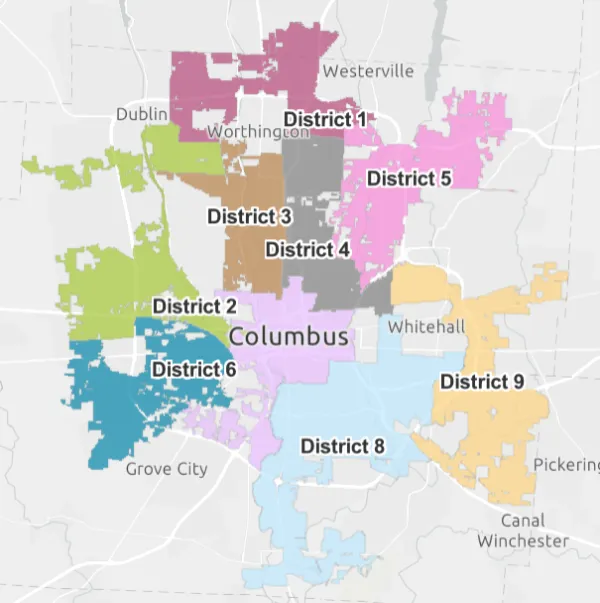
Issue 8 is the result of the Our City, Our Say grassroots citizen initiative proposing a total of nine Columbus City Council true ward-based seats. Each city district would have candidates running who live in the district, and only the people living in that district can vote for them. The ward-based voting is in contrast to the current Columbus system where you must live in the district to run to represent that district – but the voting is “at large” and the whole city votes for every seat.
Columbus City Council reacted to the Issue 8 initiative by concocting am alternate plan that creates 9 true-districts like Issue 8 but add 4 at-large seats for 13 total. It has momentum with staunch support from the Franklin County Democrats, local labor groups, the local NAACP and the endorsement of the Columbus Dispatch.
What if both Issues 8 and 9 pass? City Council has said if both Issue 8 and 9 receive more “yes” votes than “no” votes -- Issue 9 takes priority. This has caused quite a storm of confusion and the Free Press has repeatedly tried to get answers from City Council for a question no other local media is asking and should be asking:
Columbus City Council claims if Issue 9 passes it overrides Issue 8 because they are “complimentary.” Who made that decision and why?
This question came from our local news columnist Glen Tuomaala and to no one’s surprise City Council refused to answer. We then asked the Franklin County Board of Elections’ deputy director David Payne for an answer, who agreed it was a “good” question and would get back with a response.
“Issue 8 and Issue 9 both appear on the November 3, 2026 election ballot. The Franklin County Board of Elections will count the votes for each issue and ultimately certify the election results. I am told that Columbus City Council will determine what will happen if both Issue 8 and Issue 9 pass,” said Payne in an email.
Is there a chance that City Council will reverse itself and claim Issue 8 the victor? Not likely.
When City Council is asked legitimate questions they seem to never give Columbus residents a definitive answer let alone any answer. Probably why these establishment Dems have controlled Columbus for roughly a century.
Nevertheless, either way there will be true districts…
If either Issue 8 or 9 passes, each of the 9 city districts would have candidates running who live in the district and only the people living in that district can vote for them.
Issue 9 calls for districts to be redrawn before 2029 and creates a citizen-led redistricting committee to do so. The local NAACP and other Black activists such as Jonathan Beard say if Issue 8 prevails it will preserve the current majority-white Districts which were drawn by City Council in 2021.
“This is problematic under Section 2 of the Voting Rights Act of 1965, which generally requires that geographically concentrated minority groups have a right to elect candidates of their own choosing without having their votes diluted by the majority,” wrote Beard in a recent op-ed for the Free Press.
The debate leading up to the vote has for the most part been civil but at times contentious. We asked activists what they foresee and they agreed there will be smaller elections, more competitive primaries and more involved politicians. (Please add your own thoughts in our social media.)
“There’ll be hotly contested races in Northeast [Columbus], the Hilltop and Clintonville,” said David Harewood a Black activist who is a member of the Columbus Dispatch Editorial Board Advisory Committee. “This is one of the few times [Issue 9] that City Council made the right move.”
Rebecca Hunley, the current chair of the Franklinton Area Neighbors Civic Association agrees her District 7 which encompasses most of the central city will be very competitive in the next election.
“We had a grassroots candidate [Jesse Vogel] nearly accomplish what the Democrats are hoping to accomplish with the midterms. Allowing a district candidate to campaign, visit with residents, and focus on for that specific area will finally give us a voice,” she said. “This does not mean the exclusion of all other districts. We can still collaborate. Residents have good ideas. What we lack now is anyone listening or willing to move forward on basic safety issue lets along economic development that does not include corporate welfare.”
Former mayoral candidate Joe Motil also hopes for more contested district elections.
“But you never know. I would expect the Franklin County Democratic Party [FCDP] will run and endorse their handpicked rubber stamp candidates,” he said. “Regardless of whether or not the FCDP helps fund their candidate with a lot of money, district elections will be more competitive than corrupt and undemocratic at-large elections. I would also expect to see some co-opted or so-called ‘progressive candidates’ running either uncontested or with the party’s support.”
The debate has played out for weeks on Columbus Reddit and other social media:
“A ward [or district] system isn’t a panacea,” stated one post. “The Columbus Partnership can actually buy a ward seat for way less money than a city-wide seat. Thinking a ward makes Jesse Vogel automatically winning is stupid. Go look at the Council Leadership Fund in Cleveland. All the businesses buy ward seats in Cleveland.”
“Columbus is one large city. Issue 8 is trying to break us into wards, which have historically been bad in other large cities, because they encourage smaller scale corruption and discourage cooperation across neighborhoods,” added another post from Columbus Reddit.
Adrienne Hood was propelled into activism in 2016 after her son was shot and killed in Linden by the Columbus police “jump out boys.” She ran unsuccessfully in 2023 against City Councilmember Emmanuel Remy for District 4 which encompasses all of Linden and “a lot of people keep asking me this question [if she will run again].”
“To be honest, I don’t know. I do think there is a lot of work that needs to be done in the community as far as civic engagement and civic education is concerned before I would put my name back in the hat,” she said.
If district races do become more contested as many believe it should spark more civic engagement and more residents to vote.
“I feel like I need to do the work to galvanize and build the community that is actually going to go out and vote for me. Right now I just want people to be educated what this civic process is and the responsibilities that come with it,” said Hood.