
Trump and Netanyahu’s Hubris: From Miscalculation to Quagmire
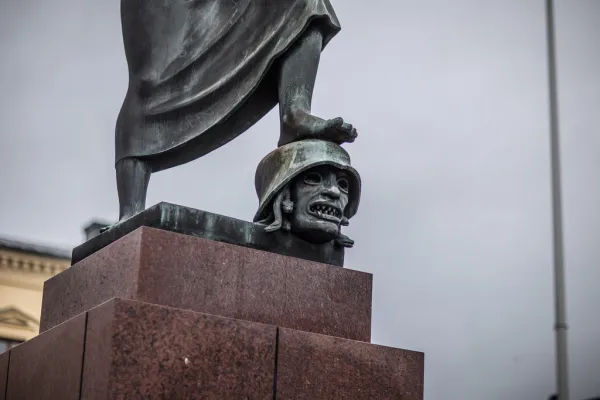
“Decapitation” Image credit Tom Woodward, via Flickr
The United States and Israel entered the war with Iran on a critical strategic assumption—one closely associated with the confrontational and leader-centric worldview of Donald Trump: that the regime was sufficiently fragile that removing its leadership would trigger its collapse. This logic—commonly known as “decapitation”—holds that eliminating top political and military figures will fracture authority, paralyze decision-making, and potentially ignite internal revolt. To its proponents, the logic is not without appeal: centralized systems can appear vulnerable to leadership shocks, particularly under external pressure. Yet the theory has an established track record—and it has repeatedly failed. Decapitation promises control; in practice, it often accelerates the very instability it seeks to prevent.
The precedent is clear. During the Iraq War, U.S. planners assumed that the removal of Saddam Hussein would produce rapid stabilization, if not democratization. Instead, the collapse of central authority—compounded by postwar policy failures—unleashed insurgency, fragmentation, and a protracted conflict that initial assumptions neither anticipated nor contained. More recently, a similar logic has shaped the approach of Benjamin Netanyahu in Gaza: the belief that leadership elimination, combined with overwhelming force, would extinguish resistance. Yet despite sustained assassinations and widespread destruction without decisive political outcome, armed resistance has remained durable—underscoring the limits of decapitation against movements rooted in deeper political and social conditions.
Weeks into the conflict with Iran, that same premise is proving detached from reality. Despite sustained bombardment and the systematic targeting of senior officials, the Iranian state has not unraveled. It has adapted. Command structures remain functional, authority has been reconstituted, and the regime continues to prosecute the war with coherence.
This resilience is not accidental. Iran has spent decades preparing for precisely this form of confrontation. Rather than attempting to match the United States and Israel in conventional military terms, it has invested in asymmetric capabilities designed for endurance under sustained attack. Dispersed command networks, hardened infrastructure, missile and drone arsenals, and a web of regional proxies all serve a single purpose: continuity under pressure. These military adaptations are reinforced by political structures designed to preserve regime continuity even under extreme stress. In this context, decapitation is not decisive—it is anticipated.
More significantly, Iran is not merely absorbing pressure; it is reshaping the cost structure of the war. By targeting critical energy infrastructure in Gulf states aligned with the United States and by threatening key maritime chokepoints such as the Strait of Hormuz, Tehran is widening the battlefield beyond its borders. The objective is not conventional victory, but cost imposition—raising the economic, political, and military price of continued conflict. In doing so, it introduces volatility into energy markets, strains regional alliances, and tests the willingness of external actors to absorb prolonged disruption.
The political consequences of this miscalculation are equally important. Rather than triggering internal fracture, external attack has, at least in the short term, reinforced nationalist sentiment and muted dissent. A regime once perceived as vulnerable is now operating under the unifying pressures of wartime survival—further reducing the likelihood that external force alone can produce internal collapse.
Meanwhile, the burden on the United States continues to escalate. Financial costs are mounting, regional instability is deepening, and the risk of broader escalation is growing. As the gap between initial expectations and unfolding reality widens, the strategic premise underpinning the intervention becomes increasingly difficult to sustain.
At its core, this conflict reflects a familiar failure: the overestimation of technological and military superiority combined with the underestimation of an adversary structured for resilience, adaptation, and asymmetric escalation. Iran is not attempting to outmatch its opponents on their terms; it is forcing them into a form of conflict where their advantages are blunted and their vulnerabilities exposed.
What was conceived as a rapid, decisive intervention is hardening into something far more intractable—a protracted and expanding confrontation in which the initial miscalculation is not simply persisting, but compounding. Like Iraq before it, the war risks becoming not a demonstration of strategic clarity, but a case study in how flawed assumptions, once embedded in strategy, become more dangerous precisely because they are not corrected.