
Trump & Co Sell Out Ukraine for Personal Gain
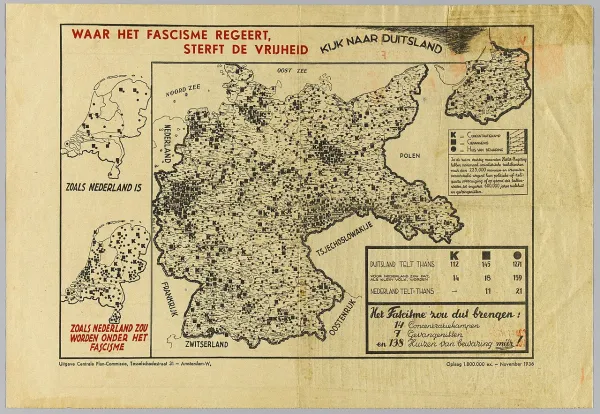
Unknown author, Centrale Plan-Commissie, Amsterdam (SDAP), Public domain, via Wikimedia Commons “Where fascism reigns, freedom dies. Look at Germany” published in November 1936 by the Centrale Plan-Commissie in Amsterdam

October saw the Trump administration provide many forms of economic and military aid to Russia’s war on Ukraine:
- A “diesel deal” to bail out the funding of Russia’s war machine.
- Lifting oil sanctions on Russia to help fund Russia’s war machine.
- Interrupting U.S. satellite intelligence warnings to Ukraine of incoming Russia missiles and drones.
- Disabling Elon Musk’s Starshield that Ukraine has used to track and defend against Russian drones and missiles and to guide its own drones against Russia’s invading forces.
- Refusing to release Patriot air defense missiles to Ukraine, which aids Russia’s terror bombing campaign on civilians far behind the frontlines.
- Trump repeatedly lying that Putin wants peace and Zelensky wants war.
- Trump and Musk echoing Putin’s demand that Zelensky be replaced.
What is motivating Trump’s support for Russia’s war against Ukraine?
Ukrainian president Volodomyr Zelensky, who has had many personal encounters with Trump, believes that it is simply Trump’s love of autocrats and the uber-rich as personified in Putin. “He speaks about it openly and loudly that he loves such people and he respects such people,” Zelensky said on October 15 when the full extent of the joint October war offensive against Ukraine by Trump and Putin had become apparent.
Zelensky seems right about Trump’s motivations as far as he goes. But it has also become especially apparent in October that Trump has baser mercenary motivations at play: profits for himself and his friends and family.
Trump seems to think that by helping Russia militarily to kill Ukrainians, Russia will return the favor with profitable business deals.
Russia Bails Out Trump
Russians around Vladimir Putin and his inner circle of oligarchs, spies, and mobsters have bailed out Donald Trump repeatedly, long before Trump’s current gestures to bail out Russia. Russian-linked real estate investments and loans have financed Donald Trump’s business and political ventures for five decades.
Trump’s first transactions with Russian links occurred in 1976 involving Soviet/Russian vendors in New York City for the redevelopment of the Commodore Hotel into the Grand Hyatt New York. One of those vendors would become part of Trump’s real estate network and sell mortgages to purchasers of condos in Trump Towers in the late 1990s and early 2000s. According to former KGB officials and intelligence historians, these 1970s transaction marked the beginning of Soviet/Russian intelligence agencies surveilling and cultivating Trump as a prominent American businessman with political ambitions whose vanity, narcissism, admiration for autocrats, sociopathy, amorality, and frequent financial binds made him a promising target for compromise and influence.
Trump’s direct relationship with top Russian government officials began in 1987 with a trip to Moscow at the invitation of the Soviet Ambassador to explore the possibility of a Trump hotel
Following multiple business bankruptcies in the 1990s (including the Trump Taj Mahal casino and the Plaza Hotel in New York City), traditional U.S. banks largely stopped lending to Trump because he had failed to make interest and principal payments on their loans. Trump was bailed out by Russian funding sources.
Russian buyers and investors have long been primary purchasers of luxury condominiums and properties in Trump-branded buildings. These transaction have amounted to a money laundering operation for Russian mobsters get their ill-gotten gains out of Russia. In one notable 2008 transaction, Trump sold a Palm Beach, Florida estate for $95 million to a Russian oligarch, which was $54 million higher than its purchase price four years earlier. Referring to wealthy Russian buyers purchasing individual luxury condominiums and high-end units in Trump properties, Donald Trump, Jr. would say that year, “We see a lot of money pouring in from Russia."
In the 2000s, the Bayrock Group – a real estate development firm with partners and backers tied to Russian organized crime bosses – operated out of Trump Tower in New York City and partnered with Trump on projects like Trump SoHo. Felix Sater, a Russian-born senior executive at Bayrock, carried business cards calling himself a “Senior Advisor to Donald Trump.” In 1998, Sater had pled guilty to a $40 million "pump-and-dump" stock fraud scheme connected to the Mafia and Russian mobsters.
In 2024 when Trump’s social media company, Trump Media & Technology Group (parent company of Truth Social), faced cash shortages and regulatory delays before going public, it received emergency loans from a Putin-connected Russian-American businessman already under scrutiny in a federal insider-trading and money-laundering investigation.
Minerals Deal
So it should not be surprising that Trump started his second term in office by extorting a so-called “minerals deal” from Ukraine as a precondition for U.S. support for Ukraine. The brutal ambush of Zelensky in the Oval Office on February 28, 2025 by Trump and JD Vance was not only the most flagrant example of imperialist bullying ever televised, it was a shakedown to extort Ukraine into signing an agreement to open up Ukraine to neocolonial plunder by Trump and his cronies. The deal requires that 50% percent of Ukraine’s future earnings from its natural resource wealth go into a fund under U.S. control.
Trump sold it as a “minerals deal,” highlighting unproven deposits of rare earth and other minerals that are so crucial for information technologies and solar power. But the deal was actually more about fossil fuels. It leaves the majority resources under Russian control in the occupied territories, including Ukraine’s vast offshore deepwater oil and gas in the Black Sea and onshore gas fracking fields, while giving U.S. oil and gas companies privileged access to joint venture participation. It was also about giving U.S. interests a stake in re-opening the expansive pipeline network across Ukraine to transport oil and gas from Russia to Europe.
The Alaska Summit Was All Business
When Trump had the red carpet rolled out for Putin at their summit in Anchorage, Alaska in August 2025, the administration had already given the green light when Trump took office in January 2025 to back-channel negotiations between ExxonMobil and Russia’s state-owned oil giant Rosneft to return the U.S.-based oil giant to the Russian market.
The summit that was advertised as being about ending the war. The proposals the U.S. was supposedly advocating were a ceasefire to set the conditions for fruitful peace negotiations, security guarantees for Ukraine against further Russian aggression, or else stronger oil sanctions on Russia. Putin rejected the ceasefire before a final settlement and Trump capitulated. The main focus was on U.S.-Russia business deals, particularly concerning oil and gas. On the same day he met with Trump, Putin issued a decree re-opening the Russian market to ExxonMobil.
Re-opening the Russia oil business to ExxonMobil and other foreign partners would generate billions for Russia’s war budget. Throughout 2025 before the Alaska Summit, U.S. and Russian negotiators had been discussing how to enable U.S. investors to participate in the re-opening of Ukraine’s oil and gas pipelines from Russia to Europe and the Nord Stream 2 pipeline for Russian gas to Europe.
A Den of Thieves
A lot more business was being discussed behind the scenes between the U.S. and Russia since Trump resumed the presidency in early 2025.
The principal Russian negotiator has been Kirill Dmitriev, the CEO of Russia’s sovereign wealth fund, who is Ukraine-born Russian citizen who raised by his Ukrainian scientist parents in Kyiv. He came to his position via a decade in the 1990s in the United States studying at Stanford and Harvard and working for McKinsey and Goldman Sachs.
Dmitriev then spent a decade in the Russian private equity business. Among his ventures was a massive fraud where he took investments from Ukrainians for a suburban gated community near Kyiv featuring nearly 300 luxury homes. Only a few were built without proper infrastructure to service them. Hundreds of families were ruined after pouring their life savings and loans into this scam. Contractors were not paid.
Ukrainians point to this swindle to warn the Americans not to trust Dmitriev. However, given the sketchy business practices of his American counterparts, Donald Trump, Steve Witkoff, and Jared Kushner may well admire Dmitriev as a fellow grifter.
On the American side, Steve Witkoff has been Trump’s envoy to Russia and the Middle East. Witkoff is a New York real estate billionaire who has been a business partner and golfing buddy to Trump for four decades. Witkoff and his son, Zach, co-founded the crypto venture World Liberty Financial along with Donald Trump and his sons, a business that has directly and significantly benefited from the actions, promotions, and regulatory rulings of the Trump administration to enrich its owners on the order of hundreds of millions of dollars.
Trump bypassed standard State Department structures to establish Witkoff as his primary backchannel communicator to Vladimir Putin. Because Witkoff has publicly displayed such gross ignorance about Ukraine, Putin convinced Trump to make Witkoff the principal U.S. negotiator. Witkoff has shown such obeisance to Putin that he recently told Putin to his face before the media cameras that he was a “humanitarian,” like his own president, Donald Trump.
Jared Kushner is also a billionaire in real estate and private equity. He joined Witkoff in Middle East negotiations beginning in April 2025 and in Russian negotiations in January 2026. He also played a major role in the first Trump administration engaged in personally profitable dollar diplomacy.
Since 2021, Kushner has been running a private equity firm called Affinity Partners with $6.2 billion in assets under management, almost all of which has come from the sovereign wealth funds of Saudi Arabia, Qatar, and the United Arab Emirates. Although he has long served as one Trump’s top foreign policy negotiators, he has never filed the ethics paperwork required for a high-level government official because Trump uses him as an informal emissary without a government job or salary.
Kushner claims he has never taken any diplomatic actions to benefit his firm, himself, or his investors. However, extensive reporting indicates Kushner has been engaged in diplomacy for profit. Yet extensive evidence indicates that at least $2 billion in off-the-books personal slush funds were provided to Kushner by Gulf States between 2017 and 2021 during Trump’s first term. These off-the-books personal accounts are separate from $6.2 billion investments that the Gulf kingdoms invested in Kushner’s private equity firm. Investigators suspect there is more to uncover concerning Kushner’s financial and diplomatic relationships with Israel, Saudi Arabia, Qatar, and the United Arab Emirates.
Kushner also seems to have used his position as foreign policy advisor in Trump’s first term for personal benefit by pressuing the Qatari investors to bail out his 666 Fifth Avenue property in Manhattan, for which he was struggling to service the debt on the $1.8 billion property purchased in 2007 on the eve of the financial crisis. After Qatari elites at first denied Kushner’s initial proposal that they invest $500 million in the property early in the first Trump administration, Kushner got the Trump administration to back a Saudi and Emirati economic blockade of Qatar that aimed to force a regime change. The Qataris soon turned around and financed a bail out of 666 Fifth Avenue and the blockade was called off.
Kushner’s Abraham Accords for the normalization of diplomatic and economic relations between Israel and Arab countries has also been personally profitable for him. His Affinity Partners is heavily invested in Israeli weapons manufacturers. Now he plans to profit through his central role in the so-called Board of Peace to build a “Gaza Riviera” featuring luxury beachfront properties and data centers without the involvement, or even by eliminating the presence, of Gaza’s Palestinians.
With this dubious record of diplomacy for profit in the Middle East, it is not hard to see why Putin and Dmitriev are trying to entice Kusher, Witkoff, and Trump to sell out Ukraine for personal gain.
$14 Trillion in Joint Business Projects
In February 2026, Dmitriev dangled $14 trillion in 10 proposed joint business projects before Trump & Co., which included:
- Rare-earth mining
- Nuclear-powered data centers
- Arctic oil and gas development
- Reopening the Nord Stream 2 gas pipeline under American ownership and control
- Resuming ExxonMobil’s oil and gas operations around Sakhalin Island and the Sea of Okhotsk off Russia’s far east coast
- Aerospace contracts
- A Bering Strait tunnel linking Alaska and Russia.
A Western intelligence report said Dmitriev’s proposals even named Trump associates who could benefit. In addition to Trump, Witkoff, and Kushner, it also named Richard Grenell, who has been a special envoy, intelligence director, and Kennedy Center director for Trump, and Gentry Beach, a friend of Donald Trump, Jr.’s. (Yes, Gentry Beach sounds like what Trump, Witkoff, and Kushner have planned for the Gaza beach front and the Albania island luxury resort. But that his really his name.)
Dmitriev’s $14 trillion in business proposals is quite ambitious coming from a country whose GDP is just $2.86 trillion in 2026, according to the International Monetary Fund.
Dmitriev had been discussing these proposals with Trump, Witkoff, and Kushner for months. The $14 trillion in joint projects was predicated on the U.S. forcing Ukraine to accept a peace settlement on Russia’s terms and ending Western sanctions on Russia, re-admitting Russia to the dollar-based financial settlement system, and returning the $280 to $330 billion of Russia’s frozen assets held by the West to the Russian central bank, Russian corporations, and Russian oligarchs.
Alaska North Slope Gas Deal
In the last month, details about two of the gas and oil deals have come out in which Trump & Co. are centrally involved. They concern Alaska North Slope gas drilling and the sale of Lukoil’s foreign assets.
The Russian company Novatek was exposed in late October for providing technology to and investing it the American company Polar LNG, which is developing a $9 billion project to extract fossil gas from Alaska’s North Slope. Novatek, one of Russia’s biggest energy companies, is under U.S. sanctions. The Russian investments were sent secretly via a shell company in the United Arab Emirates. The CEO of Polar LNG immediately resigned in September when he learned of the hidden Russian involvement in the project due to his moral qualms about supporting Russian aggression and worries for over legal liability for sanctions violations.
Trump’s special envoys Witkoff and Kushner discussed the Alaska North Slope gas project with Putin for three hours in Moscow on September 5. Trump waived oil and gas sanctions by executive order on October 16 in a legally dubious move. It seems to directly violate the Ending Importation of Russian Oil Act of April 2022. The executive order also violates the spirt of the Lindsey O. Graham Sanctioning Russia and Iran Act of 2026 that Trump signed in September, although that bill was toothless because it left the implentation of new sanctions to Trump’s discretion and the predictable outcome is now apparent.
Ukrainians are outraged at Trump’s energy deals with Putin. Svitlana Romanko is the executive director of Razom We Stand, a Ukrainian campaign for climate justice, stronger oil sanctions on Russia, and rebuilding Ukraine around renewable energy. “Every energy deal offered to Moscow during peace talks rewards the Kremlin for its war,” Romanko said. “Stopping these Russia-friendly policies will take political change in Washington. Lawmakers of both parties and the administration need to change course and put sanctions and Ukraine’s security ahead of deals with the Kremlin.”
Lukoil
Another energy deal that came to light in October concerns the sale of foreign assets of Lukoil, Russia’s second largest oil company, to the U.S. government and American investors. Trump, his three sons, Kushner and his wife and daughter of Trump, Ivanka Trump, and Witkoff and his son all have financial ties to partners in the deal, which requires sign offs from the Trump administration and the Kremlin.
The Trump, Witkoff, and Kushner families do not hold a direct financial stake in the specific corporate transactions under discussion. Instead, potential avenues for profit or financial benefit for them stem from indirect business relationships, shared investment partnerships, and political contributions from the dealmakers.
The consortium attempting to purchase Lukoil's global assets are in Kushner’s real estate network, including two Qatari billionaires (the Al-Khayyat brothers), who are also active co-investors in Kushner’s multi-million-dollar luxury real estate development project on an Albanian island, where there have been months of mass protests against the project that have sparked a general rebellion for more widespread reforms.
Trump and Witkoff's cryptocurrency business is also involved in the Lukoil deal. A senior member of the Abu Dhabi royal family is another major partner in the Lukoil bidding consortium. That Emirati investor is also a financial backer of World Liberty Financial, the cryptocurrency venture co-founded by Steve Witkoff in which the Witkoff, Trump, and their kids have made hundreds of millions from their investments while retail investors have lost their shirts.
Another American oligarch organizing the Lukoil acquisition consortium is American asset manager and investor Todd Boehly, best known as a co-owner of the Los Angeles Dodgers. Boehly has given $2 million to Trump’s political causes.
Because these Middle Eastern investment groups and American investors stand to profit massively if the Lukoil sale moves forward, the financial success of these partners directly enhances the capital available for their joint private ventures with Trump, Witkoff, and Kushner.
Putin is offering these $14 trillion in deals to entice Trump & Co. to support for Russia’s demands in a peace settlement. Trump, Witkoff, and Kushner are selling it to the public as incentives to get Putin to end the war. Their real objective is to force Ukraine to capitulate to Russia’s terms for a settlement that opens Ukraine up for neocolonial plunder by American and Russian business interests.
The Nuclear Connection
Trump & Co. have another criminal enterprise in mind with their Russian partners involving nuclear-powered data centers and Arctic oil and gas drilling. Investigative journalist Greg Palast has called the nuclear power industry a “crime wave parading as an industry.” Trump & Co. want a piece of that action, too.
Some of the projects Kirill Dmitriev has been discussing with Witkoff and Kushner would deploy small modular reactors (SMRs) to power hyper-scale data centers and Arctic Ocean offshore oil and gas drilling.
The SMRs require High-Assay Low-Enriched Uranium (HALEU). SMRs and HALEU are intrinsically linked technologically. That means U.S. SMRs, as well as SMRs in Russia, will depend on Russia, which is today the almost exclusive source of HALEU.
The U.S government is supporting HALEU production with subsidies and regulations under the nuclear provisions of the Biden administrations Inflation Reduction Act. But U.S. HALEU production is not expected to reach commercial scale until 2030.
The U.S. nuclear industry is pushing for relief from the 2024 law imposing sanctions on Russian imports of enriched uranium, both traditional low-enriched uranium (LEU) for conventional nuclear reactors and HALEU for the projected expansion of SMRs. Trump has already decided to not impose the new uranium sanctions in the Graham bill. He could well repeal all of the Uranium sanctions by citing national security reasons.
Russia has already deployed a Small Modular Reactor on a barge off the coast of Siberia in the Arctic Ocean. It plans 15 more floating nukes across Russia’s north Siberian shore in the Arctic Ocean. The floating nukes will power:
- offshore oil and gas drilling in the Arctic Ocean,
- gold and copper mining in Siberia,
- ports along the Northern Sea Route opening up due to global warming, and
- electricity and heat for the Siberian cities that host these projects.
Floating nuclear reactors on the Arctic Ocean powering offshore oil and gas drilling. What could go wrong? Critics call these floating Arctic nukes “Chernobyl on Ice” and “Floating Fukushimas.”
Russia has already left 10 nuclear reactors on the bottom of the Arctic Ocean due to sunken nuclear submarines, a sunken nuclear-powered surface ship, and other nuclear accidents from over 70 years of nuclear activity on Russia’s northern shore with the Arctic Ocean. Plans to raise the sunken reactors out of the water were discussed between Russia and foreign partners before the talks broke off in 2022 after Russia started its full-scale invasion of Ukraine.
Russia is aggressively marketing floating nukes to other countries including Brazil, China, Indonesia, and 11 African countries where it says “advanced talks” are proceeding with Egypt, Namibia, Tanzania, and Togo.
Russia is already the leading builder in the world of conventional nuclear power plants, with its state-owned Rosatom holding a 90% share of the market and nearly 40 nukes under construction across ten countries, including Hungary, Turkey, Kazakstan, Egypt, Iran, China, India, and Bangladesh.
By arranging business deals for data centers powered by SMRs in Russia, Kushner and Witkoff on behalf of Trump Inc. will have the insider knowledge and connections to secure their own lucrative cuts on these nuclear-powered data center projects, including the Small Modular Reactors proposed to power hyper-scale data centers and crypto mines in the United States.
Another aspect of this nuclear madness is the nuclear Russian Roulette that Russia has adopted in its strategy of targeting the high-voltage electrical substations that connect Ukraine’s nuclear power plants to the grid, threatening the stability of their cooling systems for reactors and spent fuel storage pools. In its quest to incapacitate all of Ukraine’s energy production and render Ukrainian cities uninhabitable in the coming winter due to a lack of electricity, heat, water, and sewage treatment, Russia is attempting force Ukraine’s power plants offline. Ukraine now gets 70% of its electric power from nuclear plants during peak hours.
Ukraine is building renewable solar, wind, and storage capacity on micro-grids as fast as it can in response. Renewable energy systems are more resilient against air strikes because they are decentralized and widely distributed, making them harder to incapacitate than large centralized power plants on a national grid. But that renewable capacity is not being built fast enough to replace by this winter all the damage to Ukraine’s coal and gas-fired thermal plants and its hydropower plants by Russian air strikes. The failure to cool nuclear reactors and spent fuel storage pools could lead to nuclear meltdown and the release of massive clouds of radioactive gas. This is a danger to Russia itself as well as Ukraine, Europe, and worldwide because the wind could blow that radioactivity back into Russia.
So all of this is corruption using state power for personal enrichment on a scale that we have never seen before except for Putin’s kleptocracy, which Trump & Co. seem to see as their role model.
Ukraine Resists the Trump-Putin Military and Business Alliance
Trump and his business-partner envoys Witkoff and Kushner are using U.S. state power to sell out Ukraine and bail out Russia for personal gain. They are trying to sell this Trump-Putin mobsters’ deal to the American pubic as a peace deal. The biggest problem for these gangsters is that the Ukrainians will not surrender to their imperial carve up of their country.
After the mid-term elections, Trump is now a weakened lame duck president. But that could mean he will have no incentives left to work with Congress or to please a public that supports Ukraine and loathes Putin by large majorities. Recent polling finds that 64% of Americans support military aid to Ukraine, while 85% have no confidence that Putin will do the right things in world affairs.
Trump may well resume the blocks on satellite warnings of incoming Russian air strikes and cripple the Starshield communications so vital for Ukraine’s defense. He may well blame Ukraine for extending the war because it failed to accept joint Putin-Trump demands for a so-called “peace deal” that amounts to Ukraine’s surrender. He may then go full throttle on the business deals with Russia, which have already been promoted as incentives for Russia to agree to a peace deal.
It is clear that Trump wants to join Putin in forcing Ukraine to surrender in a so-called “peace deal” that renders Ukraine so defenseless that the American and Russian imperialists can carve it up between them for plunder and profit. What Trump wants with Putin is like the deal that Hitler and Stalin made in August 1939 to carve up Poland between them in the secret protocol of the Molotov–Ribbentrop so-called non-aggression pact.
Russia is offering juicy business bait to hook Trump into fully supporting its war against Ukraine. I doubt that Putin really wants to share Ukraine with Trump. It would certainly be in character for Putin to stab Trump in the back in order to take all of Ukraine like Hitler did to Stalin when his Nazi army invaded the Soviet Union in June 1941. But whether or not my suspicions about Putin’s intentions are right, there is no doubt that Trump and Co. are drooling over the business deals that Russia is dangling before them.
The problem for both the Russian and American predators is that Ukraine shows no indication of surrendering to them. In the month after Trump publicly denigrated Zelensky in the Oval Office and then cut off intelligence sharing for a week in March 2025, Ukrainians were polled by the Kyiv International Institute of Sociology (KIIS) on the question of whether they would continue armed resistance against Russian aggression even if US support completely disappeared. 82% said they would continue to fight without U.S. support.
The monthly KIIS surveys on questions of war and peace in Ukraine show that strong majorities of Ukrainians support continuing to resist Russia’s aggression even though they have suffered another year and a half since the March 2025 poll of escalating Russian terror bombardment of civilians and infrastructure in cities far from the frontlines.
The KIIS surveys have shown that high majorities of Ukrainians on the order of 75% are willing to accept the difficult compromise Ukraine has offered of a peace settlement at the current frontline that accepts de facto (but not de jure) Russian occupation of a fifth of Ukraine as long as Ukraine gets international security guarantees against further Russian aggression.
However, the surveys also show overwhelming majorities of Ukrainians will fight the Russian invaders until there is a just settlement. The two latest KIIS war and peace surveys released in October show that by 84% to 12% Ukrainians believe “Russia wants to conquer Ukraine, therefore it is not ready for peace in which Ukraine will be a sovereign state with a strong army.” Asked if Russia’s bombardment of energy infrastructure cuts their access to electricity, heat, water, and sewage treatment would mean they would give in to Russian demands, or continue armed resistance, 76% said Ukraine should fight. Only 15% said Ukraine should comply with Russia’s demands.
Investigate Trump & Co.
Ukrainians will not accept unjust peace deal that the U.S. tries to force on them. Trump told Zelensky at the beginning of his second term that he had no cards to play. But Ukraine has played its cards well. It has been holding off Russian offensives on the frontlines and inflicting serious damage inside Russia to its military production and logistics and to the oil and gas industry that funds and fuels its military machine. Trump cut all U.S. economic and military aid to Ukraine 19 months ago. The only cards Trump has left to leverage Ukraine’s surrender is ending the warnings of incoming Russian air strikes, the use of Starshield, and the sanctions on Russia. Ukrainians already have made clear Trump cannot force them into accepting a partition of their country into Russian and American spheres of exploitation.
The incoming Democratic Congress does have cards to play. Congress can now stymie Trump & Co. from cutting a business deals Putin by undertaking corruption investigations by the Congressional committees they now chair. Trump, Witkoff, Kushner, and their friends and family have provided plenty of fodder for corruption investigations. They can also investigate the intelligence and Starshield disruptions.
More than investigations, the incoming Democrats have the opportunity to forge an alliance with pro-Ukrainian Republicans to create a two-thirds supermajority needed to pass major pro-Ukraine legislation and successfully override presidential vetoes. With that alliance, perhaps the first thing Congress should do is pass legislation to send the Patriot missiles to Ukraine that it urgently needs to intercept incoming Russian ballistic missiles. Congress should then move on to restoring economic and military aid to Ukraine and sanctions on Russia to the levels that Ukraine needs to win a peace settlement that safeguards its independence, security, and post-war reconstruction. If Congress does that, Trump & Co. will be out of business with Putin and Ukraine will be in position to secure a just peace.