
U.S.-Israel Military Merger Delayed: Here’s Why and How You Can Stop It
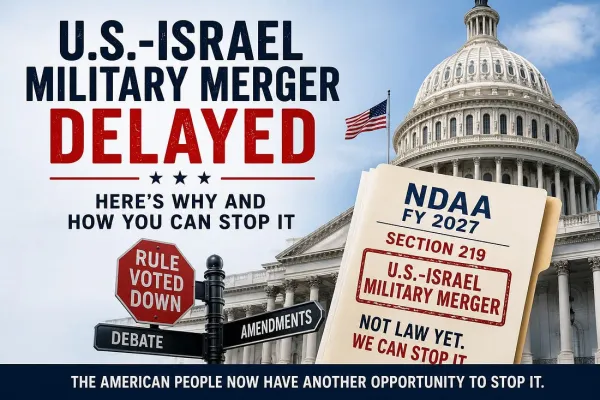
The U.S.-Israel military merger has not become law - yet.
Not because Congress rejected it, but because the House unexpectedly voted down the procedural rule governing debate on the National Defense Authorization Act (NDAA).
The Kucinich Report is a reader-supported publication. To receive new posts and support my work, consider becoming a free or paid subscriber.
That vote delayed consideration of the bill, but it did not remove the military merger from it. When the House returns, Congress will almost certainly have another opportunity to consider the legislation.
The American people now have another opportunity to stop it.
What Happened?
The Massie-Khanna Amendment, which would have removed the military merger from the bill, was not made in order by the House Rules Committee, which serves as the traffic cop on legislation, deciding which bills and which amendments move forward.
In this case, the Rules Committee played dirty cop and the fix was in to make sure the House would not be able to vote on the military merger because the amendment was simply not placed in the rule. In fact, the amendment was not taken up by the committee and did not even receive a vote.
It was ignored.
Welcome to civics class, Washington, D.C. style, on how a bill isn’t made.
How Congress Was Prevented from Voting
Every piece of legislation has its own specific rule, which determines, among other matters, how much time will be permitted for debate, what amendments are made in order, whether legislation can be further amended from the House floor, and whether a point of order can be raised to challenge the bill.
The Rules Committee makes up the rules for each bill as it goes along.
And it does.
Since Republicans control the House, they determine the committee’s membership. The Rules Committee consists of nine Republicans and four Democrats.
This particular rule governed consideration of the National Defense Authorization Act for Fiscal Year 2027, legislation that would increase annual Pentagon spending by an astonishing 67 percent to $1.5 trillion. The rule, approved by the committee on a partisan vote at the request of the President, also combined the NDAA with the so-called SAVE Act, restricting voter registration.
Before Members can vote on the underlying legislation, they must first vote separately on the rule. The rule establishes the terms of debate and determines which amendments may be considered.
If the rule goes down, the bill goes down with it.
Why Was the NDAA Vote Delayed?
Here is what happened.
Because of a dispute over the SAVE Act, the House voted down the rule. The NDAA never came before the House for debate or final passage. A disappointed Speaker adjourned the House until July 13.
As a consequence, the NDAA has not passed and the U.S.-Israel military merger it authorizes has not become law.
Yet.
The Fight Continues
When the House returns, the Rules Committee must meet again and draft a new rule. Based on what just happened in committee, there is every reason to believe the new rule will once again prevent any amendment from being offered to remove the military merger.
The Rules Committee should instead make in order the Massie-Khanna Amendment and other amendments that would remove the U.S.-Israel military merger and other deeply controversial provisions from the NDAA. Members of Congress should not be forced into an all-or-nothing vote on legislation of this magnitude without the opportunity to debate and vote on amendments on their merits.
Congress should not be asked to vote on final passage of the NDAA without first having the opportunity to consider amendments that remove the military merger and other controversial provisions.
If the Rules Committee refuses to allow those amendments, the merger provision will remain in the bill.
What we can do
Every Member of Congress should hear one simple message:
Urge House leadership and the Rules Committee to make in order the Massie-Khanna Amendment and other amendments that would remove the U.S.-Israel military merger and other objectionable provisions from the NDAA.
If the Rules Committee refuses, vote against the rule.
If the rule passes, vote against the NDAA until the military merger is removed from the bill.
This is the only way to stop this patently unconstitutional merger, which undermines American sovereignty and opens the door for Israel to drag the United States into more wars to advance its expansionist and murderous impulses.
This Fourth of July, celebrate Independence Day by defending the very principles upon which this nation was founded.
TAKE ACTION
The House is expected to take up the NDAA when it returns on July 13. The time to act is now, before a new rule is written and the bill returns to the House floor.
Let us truly celebrate our independence by staying independent. Please help spread the word by forwarding this article to your family, friends, and colleagues.
Find your Members of Congress:
House: https://www.house.gov/representatives/find-your-representative
Senate: https://www.senate.gov/senators/senators-contact.htm
Call the U.S. Capitol Switchboard at 202-224-3121 and ask to be connected to your Representative or Senators.
Ask them to:
- Support making in order the Massie-Khanna Amendment and other amendments to remove Section 219 from the NDAA.
- Vote against the rule if those amendments are blocked.
- If the rule passes, vote against the NDAA until Section 219 is removed.
Optional telephone script
My name is ______ and I am a constituent. I am calling to urge Representative ______ to insist that the House Rules Committee make in order the Massie-Khanna Amendment so the House can debate and vote on removing Section 219 from the NDAA.
If the Rules Committee refuses to allow that amendment, I urge the Representative to vote against the rule. If Section 219 remains in the bill, I urge the Representative to vote against final passage of the NDAA.
Congress should defend American sovereignty, uphold the Constitution, and reject any measure that integrates the executive and military functions of the United States with those of a foreign government.
Thank you.