
Wanderin Joe, where will you go? Beloved cat is Columbus’s newest NIMBY
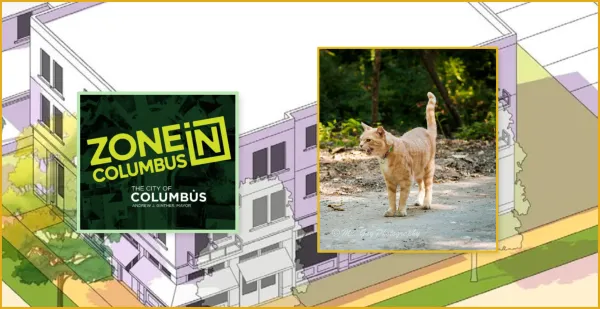
Phase One of “Zone In” threatens Columbus’s most popular corridors with density housing. Essentially, this means taller buildings crammed with overpriced tiny apartments, and with minimum to no parking spaces required.
Now comes the rollout of Zone In’s “Phase Two” and one of the area’s iconic green spaces, the picturesque Walhalla Ravine, could someday be targeted with the same brutalist-looking density.
Phase One only covered 5 percent of the city, while Phase Two covers 43 percent of the city’s parcels, affecting approximately 66,000 properties. The city for the next several weeks is seeking feedback for Phase 2 and City Council will then vote to approve soon after.
If anyone has something to say about the conservation of Walhalla Ravine – because City Hall scoffs at most humans who have concerns about Zone In – it should be the celebrity kitty that is “Wanderin Joe the Ravine Cat.”
As most everyone knows, especially in Clintonville, Wanderin Joe offers love to all creatures great and small as he travels the Walhalla Ravine. The loveable explorer’s popularity has resulted in his own Facebook page, and he’s often seen near the entrance of the ravine – where Walhalla Road connects to Indianola Avenue.
Seeing a future where the tree-filled slopes of the ravine are bulldozed away to build apartment buildings mere feet from Walhalla Road, some members of the Walhalla Ravine Association are taking creative measures to raise purrwareness, er, awareness. They’ve been asking neighbors and anyone who cares for the tabby’s well-being to send pictures of Joe to ZoningUpdate@Columbus.gov.
Currently, the entrance to Walhalla Ravine is zoned “RRR” or Restricted Rural Residential. Also referred to as “Triple R,” it mandates for larger lots and only one significant building per lot to preserve open space and rural character. Over 50 years ago, after a Walhalla Road resident split their property to build a second house, residents worked with City Hall to designate the entire ravine Triple R.
Zone In’s Phase Two, however, has plans for the entrance to Walhalla Ravine to be re-zoned “Emerging Mixed-Use.” Meaning a greedy apartment developer could convince the homeowners who live there to sell.
“It’s important to us those properties should be re-considered in Phase Two with all the other Triple R properties,” says Cindy Decker, a member of the Walhalla Ravine Association, as she and her husband are 26-year homeowners on Walhalla Road.
She adds that Zone In’s Phase 3 should also keep the entire ravine Triple R. Mindboggling is how City Council members told Decker and others the Triple R designation for the entire Walhalla Ravine will end with Phase 3, which will likely be implemented in 2027. And while city officials have said the ravine won’t completely be Emerging Mixed-Use, you never know what our (duplicitous) city officials will end up doing.
“Emerging Mixed-Use allows up to a three-story building with fewer setbacks on a sideroad. That would mean a 5-foot setback on Walhalla Road because that’s not the facing road [Indianola]. So, there could be a three-story building up to the road,” said Decker.
Several other properties on the ravine near the entrance were included in Phase Two to be re-zoned Emerging Mixed-Use, but after pressure from residents the city had them removed.
“The city has been responsive to a degree,” she said. “I am optimistic they will remove [the other properties].”
Nevertheless, Decker and others believe what Zone In wants now for the ravine isn’t “going to happen tomorrow. But could set the tone for the future.”
And it’s not just Wanderin Joe who loves the ravine, say others from the Walhalla Ravine Association. There’s a barred owl family, and bald eagles, herons and migratory birds regularly visit. The ravine is an urban oasis visited daily by humans as well and maintains its park-like setting thanks to the Triple R designation, they say.
Speaking of duplicity, Decker and many others are aware of the city’s goal to increase tree coverage 40 percent by 2050. She believes this rush to build density is eliminating trees, and density in Walhalla Ravine will take down some of the area’s tallest.
“They want to stop tree cover loss by 2030, which is less than four years from now, and they are not on the path to do it,” she said.
The Free Press is well aware of the vitriol spewed at us by “YIMBYs” (Yes In My Back Yard). Decker, by the way, said she is not against building density if it results in lowering housing costs. But the opposite has occurred, as housing affordability in Columbus has never been more challenging.
Worse is how the region, according to RentCafe, has become the “only Midwestern metro where Millennial renters are still the majority. Every other large Midwest city including Chicago, Detroit, Minneapolis, Indianapolis, Cincinnati and Milwaukee has already crossed over to a homeowner majority.”
The Free Press has asked this before and we will ask again: Why, for example, is City Council and Mayor Ginther not pushing for developers to build density – and make it owner-occupied density – at the Columbus Clippers derelict and long vacant stadium in Franklinton?