
Want to Live in a Safety Community? Build Trust, Not Surveillance Systems
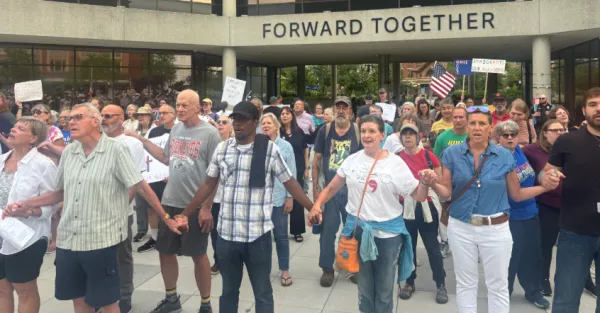
Viles Dorsainvil speaks at a rally in Springfield, Ohio on June 25, 2026. He came to the United States from Haiti in 2020 and is the executive director of the Haitian Support Center in Springfield. (Photo by Megan Henry, Ohio Capital Journal).
Testimony for Columbus City Council Public Safety & Criminal Justice Committee Hearing on Flock Cameras
Lynn Tramonte, Executive Director, Ohio Immigrant Alliance
August 10, 2026
If we want to achieve public safety for all, we need to first agree on what this means and what is missing. I’m going to speak bluntly, because we cannot misunderstand each other. The systems built by white and wealthy people when this nation was created — mainly by men — prioritize their safety while denying the humanity of indigenous people, Black people, poor people, immigrants, women, and children.
This isn’t ancient history. Today we have a nationwide crisis of public shootings and gender-based violence, and the people in charge have mostly ignored, denied, or deflected the issues, allowing them to metastasize. We’ve even built a whole genre of entertainment around gender-based violence, although for women, and gay and trans people, I think crime shows are about self-preservation.
The men who created today’s “public safety” structures apparently believed security could be achieved by criminalizing minor infractions, selectively; surveilling potential lawbreakers; and incarcerating people assumed to have broken the law. They did not worry about how their economic and social policies create what they call “crime.”
My testimony will talk about how Automated License Plate Reader technology is harmful, and how the money Columbus spends on a Flock contract would be better used to build systems that actually reduce harm to all people.
I am white, and grew up in an all white community. I know how leaders operating from a white-centered worldview see decisions like the one before Council today.
1. “It won’t affect me.”
2. “If you’re not doing something wrong, you have nothing to worry about.” 3. “Knowing what is going on in our communities is worth infringing on a few ‘civil liberties.’”
In my testimony, I tackle these three misconceptions, one by one, and outline an alternative way to view public safety that includes everyone.
It Does Affect You
Automated License Plate Reader (ALPR) technology affects everyone. We don’t know how many cameras are operating in Ohio, because Flock doesn’t provide that information. Ohioans are attempting to gather that data on their own. We deserve to know it. But a single law enforcement query of the Flock system can access data from more than 83,000 cameras that are active nationwide, including thousands in Ohio.
If you own a car that has been driven in the United States, your license plate has been read by a government surveillance camera controlled by a private corporation, probably many times. And with a 1-in-10 Flock error rate, your plate has probably been read incorrectly. Possibly many times.
Police stopped Brittney Gilliam and her family, including children, and held them at gunpoint after an ALPR incorrectly matched her Colorado SUV to a stolen motorcycle with Montana plates, and the police didn’t catch the error. Denise Green was also held at gunpoint after an ALPR misread a "3" as a "7" on her license plate and again, police didn’t notice the mistake. The same thing happened to Jason Burkleo, Jaclynn Gonzales and her 12-year-old sister, Brian Hofer and his brother, and Isoke Robinson. The number of people experiencing this terrifying situation is only going up as the number of Flock cameras expands around the country.
Police seem to treat the technology like it’s supposed to do the thinking for them, and they step in to make the arrest. Like everything with technology, we’re ceding our brain to the machine and that is a mistake.
Also, ALPR data about our movements can be used for reasons we don’t like, and we have no way to opt out of it. The Electronic Frontier Foundation found ALPR data was used by police in Texas to track a woman who had an abortion. Police then consulted prosecutors about filing charges against her. As a woman, I find this terrifying.
Hundreds of ALPR searches by police tracked No Kings and 50501 protests in 2025. The ACLU reported that the Drug Enforcement Administration and Bureau of Alcohol, Tobacco, and Firearms once planned to use ALPR technology to track attendees at gun shows. As a person who believes in free speech, I also find this terrifying.
We have all heard about the unauthorized uses, such as police officers stalking current or former partners. Intimate partner violence among police is a “nationwide scourge” according to Brian Stanley, an expert at the Boston University School of Public Health. “While the actual number of cases that happen every year is unknown, it’s likely in the tens of thousands,” he writes. “Police officers in almost every state have been charged with domestic violence since the start of 2025.”
Flock cameras give these stalkers a retroactive road map to their victims.
The Myth of Equal Enforcement
People who think surveillance breeds safety often say, “If you’re not doing something wrong, you have nothing to worry about.” We have all made mistakes, but we haven’t all been caught or punished equally. That doesn’t mean that surveillance, the rules, and consequences are fair.
What happens to me, a white woman and native English speaker, if a cop pulls me over while I’m driving and I don’t have my license? Am I taken to a police station? Do they call Immigration and Customs Enforcement (ICE) or the Border Patrol? Of course not.
What if I am a Latina woman who speaks English with an accent? Suddenly, that traffic stop looks very different, at least in most areas of Ohio. I am most likely whisked away and, unless I can immediately prove I am a citizen, I might not see my children again.
The recently released Flock audit found 15,577 possible immigration-related searches that pinged Columbus' Flock network in a national database since 2024, including 657 searches from the U.S. Border Patrol and Homeland Security Investigations.
Being an immigrant without legal status is not a crime. But many local police in Ohio think it is. They also think it’s something they can determine in a traffic stop, and that it’s fine for them to send this Latina woman to ICE. In fact, the police are the ones breaking the law in this scenario. What they are doing is racial profiling.
But in scenarios like these, police have the power and the privilege. The same is true with mass surveillance and that is why so many police agencies want to keep it. That doesn’t mean they need to have it.
U.S. immigration laws were not written to be coherent, logical, or fair. They are actually contradictory and difficult to follow, on purpose. Someone can be eligible for legal status and deportation at the same time. It’s up to the federal government to decide which avenue to pursue. The law also allows immigrants to be put in a criminal jail even though they aren’t being charged with a crime. They are going through a civil court process.
This is part of what I mean when I say we “criminalize minor infractions, selectively.” The other part is the way law enforcement behaves around Black people and in predominantly Black or mixed-race communities, versus predominantly white communities.
We see it in large and small ways.
Cleveland Police Officer Timothy Loehman shot and killed 12 year-old Tamir Rice less than two seconds after opening his car door when he arrived at Cudell Recreation Center. Akron Police Officer Ryan Westlake shot and wounded 15 year-old Tavion Koonce-Williams immediately after arriving on the scene. Both teens had toy guns. Neither officer attempted to verify whether the gun was real, or de-escalate the situation
like they are supposed to.1In contrast, Warren (MI) police officers calmly talked a white teen with a real gun down.
In an over-the-top show of force earlier this year, South Euclid sent police in múltiple patrol cars to a park where Black students were holding a prom send-off. Brandishing paintball guns, other weapons, and a K-9, they announced the park was closed and screamed at the teens to leave. Meanwhile, white kids continued to enter the park and play baseball. No one was breaking any law. The officers’ behavior was ugly and unnecessary, and reinforced a negative perception of the police among Black students and families.
We see this double standard in the disparities in arrests and sentencing for drug offenses, too. Do you think no one used or sold drugs, drove under the influence, or sexually or physically assaulted someone in the all-white community where I grew up? Of course they did. We just didn’t have a cop on every corner, or the behaviors didn’t get treated like crimes. Our teens got sent to treatment programs, not juvenile detention.
In a study published by the American Psychological Association, researcher John Wilson, PhD showed participants photos of Black and white men who were similar in size. “Participants judged the black men to be larger, stronger and more muscular than the white men, even though they were actually the same size,” he found. “Participants also believed that the black men were more capable of causing harm in a hypothetical altercation and, troublingly, that police would be more justified in using force to subdue them, even if the men were unarmed.”
The bias is not just with the police. It is with us. But police are part of society, and they carry guns.
More ALPR cameras are deployed in neighborhoods with higher percentages of Black residents, creating so-called “evidence” to reinforce a crime bias already manufactured by the systems that white men built.
And crime in white communities continues to go unreported, uninvestigated, unsolved. Cycles of abuse continue. We aren’t preventing crime, we are hiding it.
Surveillance Doesn’t Prevent Crime
To review, we’ve 1) established that surveillance harms everyone; and 2) unfairly impacts certain groups, such as immigrants and Black people. The final question is — is the “cost” worth the “benefit”? Is “knowing what is going on in our communities is worth infringing on a few ‘civil liberties,’ as people so flippantly say?
1 Westlake has since been fired for multiple incidents of excessive force. Both the cities of Akron and Cleveland had to pay settlements in lawsuits related to the teens’ deaths.
We’ve heard this a lot since September 11, 2001. This sentiment greased the passage of the PATRIOT Act, REAL ID Act, and — ironically — the creation of the Department of Homeland Security and ICE. How many civil liberties have we given up? Does anyone feel safer today?
Flock surveillance cameras do not prevent crime. That’s not even their purpose. ALPRs gather evidence to use after a crime happens. They don’t stop anyone from doing anything.
Are you truly willing to be pulled over by police and held at gunpoint, erroneously, because the license plate reader made a mistake? Are you OK with that happening to your child or grandchild?
Do you trust every police officer in every agency around the country? Because as of a while ago, hundreds of thousands of officers have been able to track your movements in your local community, and you didn’t even know.
The limits of Flock and ALPR camera usage have not yet been imagined or reached; they are as infinite as the human mind. And the company, Flock Safety, continues to obstruct any attempt at establishing guardrails, accountability, or transparency. They are even fighting to keep us from knowing how our own vehicles show up in their system, trying to get the HaveIBeenFlocked website banned from the Internet.
Flock is not an honest broker, and continuing to work with them is making a deal with the devil that has future consequences that no one fully understands. Amazon is no one’s model for corporate responsibility, and even they cut ties.
What Does Work to Fight Crime? Build Relationships, Invest in People and Communities
The police cannot make the public safe on their own. We need to stop pretending they can. It takes a whole-of-society approach and changes to social and economic policy. But the police should not endanger the public.
U.S. law enforcement takes a repression approach to crime and the people who commit it that actually creates more anger, pain, isolation, fear, and suffering, which create more crime. We pay for this with our tax dollars, and then act confused when “public safety” officers use tactics that endanger the public and our safety.
ALPRs are part of a failed containment strategy that was never designed to prevent hurt from happening. Incarceration is too. It’s an attempt to lock away the “problem,” for a time, without understanding and addressing what created the problem in the first place.
If you have ever spent a day in jail, or even walked into one, you know that it’s not designed for “rehabilitation” but “coercive control.” If you know anything about psychology, you understand that coercive control attacks a person’s sense of self and is diametrically
opposed to self-improvement. The fact that anyone ever emerges from jail or prison having “turned their life around” is truly a miracle.
Here is how we find out what is going on in our communities: we don’t “surveil them,” we know each other at a personal level. We help each other. We are trustworthy. Becoming trustworthy means we have to change some of the ways we do our work as institutions, and create and fund some new ones.
Consider who has been failed by the current system, or who the current system wasn’t designed to prioritize or protect. In all of these situations, people have to make calculations about what will make them safe, and calling the police is often not the safest choice. What if there was someone else to call?
Right now, victims of sexual assault cannot trust the police, prosecutors, or courts. The tools of the justice and domestic relations systems don’t work for them. They don’t make survivors feel safe, they don’t help them get safe, and they don’t work on changing behaviors of the people who hurt them so they can stay safe and the cycles stop. What if there were other systems and places to go for help that worked on the whole problem?
Black people cannot trust the police. When they call for help, they get treated like suspects. Immigrants cannot trust the police, even when they are the victims of crime or wage theft. It’s too likely they will be turned over to ICE or the Border Patrol. Even if they have documents, they might worry about exposing someone in their family or home.
Homeless people cannot trust the police. They know the police don’t see them as human or know how to help them. This is a society-wide problem, except we do know how to help them. House them. People with mental health problems cannot trust the police. Police are not mental health crisis experts. They don’t know how to help and will more likely harm them.
Public schools and houses of worship are left to be the only fairly universal safe spaces, and their reach is limited. Out of necessity, they have become health and mental wellness centers, food and clothing pantries, warming shelters. They provide extracurricular and athletic outlets, and also provide education or spiritual care — activities that are meant to be their core missions.
Yet in Ohio, we barely support public schools with our tax dollars and even then, we take significant funding from them to support private schools. Public school teachers and administrators work under tremendous pressure without the support they need and deserve.
Police cannot do everything. They cannot solve all of society’s problems and they, alone, cannot prevent crime. Investing in public transportation, education, housing, and health and mental wellness; raising the minimum wage; creating alternative response teams for
mental health, sexual assault, and other specialized needs, like we have for fighting fires; and building alternatives to incarceration are some solutions that require urgent investment.
Violence against women and children; suicide; and gun violence are all epidemics that cross race and income levels. They require honest diagnoses and approaches. No automated license plate reader system will fix them.
As I wrote in a column in The Land, “The truth is, this country is filled with hurt people who hurt other people. That’s not a city problem — it’s an us problem.” Let’s start fixing it.
Let’s put the money we save by cancelling Flock contracts to tackling these priorities.