
A War That Was Never Ours
Carlos Latuff, Copyrighted free use, via Wikimedia Commons
There is an old movie, based on a novel by Jimmy Breslin, about a crew of mobsters who thought they were powerful, feared, and in control—only to prove, again and again, that they were none of the above. Disorganized. Impulsive. Dangerously incompetent. Their violence didn’t project strength; it exposed weakness.
They called it The Gang That Couldn’t Shoot Straight.
What we have witnessed since February 28, with Donald Trump’s war on Iran, feels less like foreign policy and more like a live reenactment of that film—except this time, the consequences are global.
In Washington, wars often get names—clean, clinical. This one has taken on a different label: the “Epstein War.” Not because it explains anything—but because it reflects unease. The sense that motivations are layered, obscured, never fully confronted in public. Call it what you will. The label points to a deeper truth: This was never a straightforward American war.
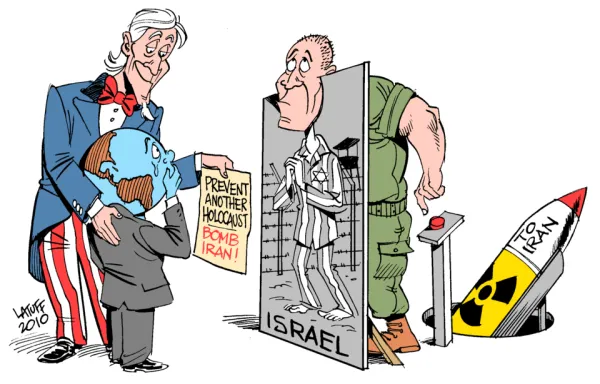
Let’s not dance around it. This war was waged on behalf of Israel.
From day one, the administration couldn’t get its story straight. Preemptive strike. Deterrence. Nuclear threat. Regime change. Securing shipping lanes. Eliminating proxies. Each week, a new objective. That’s not strategy. That’s improvisation.
And when the Secretary of State framed it in terms aligned with Israeli priorities, the mask slipped.
For over two decades, the United States has been pulled into wars in the region that serve interests not entirely its own. This one simply dropped the pretense faster.
Behind closed doors, the picture becomes clearer. Benjamin Netanyahu was not a bystander. He was actively making the case for escalation—forcefully, persistently.
Picture the situation room: urgency, pressure, red lines presented as inevitabilities. And then, the internal reaction. Not the public statements—the private ones. Senior U.S. principals reportedly described the push as stupid, farcical, detached from strategic reality. That contrast matters. Because when those responsible for safeguarding American interests recognize the absurdity of a course of action—and it proceeds anyway—the issue is no longer intelligence. It’s influence.
You cannot understand this war without addressing the role of the Israel lobby. John Mearsheimer and Stephen Walt have long argued that networks of lobbying organizations, donors, media platforms, and policy institutions shape U.S. Middle East policy. This is not conspiracy, It is structure.
Policies aligned with Israeli priorities face less resistance. Those that challenge them face immense pressure. In this case, that pressure appears to have crossed a line.
When intelligence is sidelined, when dissent is narrowed, when maximalist demands become policy, you are no longer witnessing alignment. You are witnessing distortion.
And when decisions of war and peace are shaped this way, the consequences are not theoretical. They are catastrophic.
We were told this would be easy. A walk in the park.
Two months later, Washington is reportedly leaning on Pakistan to broker a ceasefire with Iran—who was not eager to accept.
So which is it? Dominance—or desperation? Because you don’t ask for mediation when you’re winning.
The Strait of Hormuz—supposedly an objective—became a vulnerability. Markets reacted. Supply chains shook. The global economy felt it instantly.
And to add to the absurdity—and the gravity—of this war, one of its deadliest moments came not on a military installation, but in a classroom.
On February 28, the Shajareh Tayyebeh girls’ school in Minab was struck, killing roughly 165–170 students and staff, most of them young girls, with investigations finding a deliberate targeting by Israel.
A war sold as precise, controlled, and strategic. And yet, it produced one of the deadliest single attacks of the war against children in a school. At that point, the conversation is no longer about objectives. It is about consequences.
The defining mistake was the targeting of Iran’s Supreme Leader. This was not just a political miscalculation. It was a civilizational one.
The Supreme Leader is not a replaceable official. He is the center of gravity in a system built on Wilayat al-Faqih—religious authority fused with constitutional power.
Remove that figure, and you don’t fracture the system. You unify it.
Segments of Iranian society that were critical of the regime shifted overnight. External threat reordered priorities. Internal divisions closed ranks. And beneath that lies something deeper: historical memory.
For over a thousand years, Shia Muslims have carried the memory of Battle of Karbala—and, for many, a lingering sense of responsibility for not standing with Imam Hussein. That memory is not passive. It is lived, retold, and reactivated. So when an external force strikes what is seen as the heart of the system, that consciousness is activated. You didn’t weaken the system. You strengthened it.
Trump and his team expected protests, fractures, regime collapse. Instead, they got consolidation. That moment didn’t just escalate the war. It defined it.
Reality eventually surfaces from within. Joe Kent, a senior counterterrorism official, stepped away—and in doing so, sent a signal. His resignation clearly articulated a deeper problem: intelligence bent to fit conclusions, policy driven by narratives not grounded in institutional analysis. When someone at that level signals that the process itself has been compromised, you are no longer dealing with a flawed strategy. You are dealing with a broken system.
Then came the rhetoric. Threatening that an entire civilization could be wiped out is not deterrence. It is escalation at its most dangerous. Language like that strips away any moral posture. It confirms fears. It reframes the conflict as existential. remember Nazi Germany? Remember Adolf Hitler? And once said, it cannot be undone.
While all of this unfolds, Americans are dealing with something far more immediate. Grocery and gas prices at historic highs. Healthcare under strain. Debt spiraling.
People are not thinking about regional power balances. They are thinking about affordability, stability, and most importantly, survival. And yet, resources and attention are being poured into a war with no clear objective and no defined end. At some point, a country must look inward.
The goals were clear enough on paper: Destroy Iran’s nuclear capability, eliminate its missile program, dismantle its proxies, force regime change, and secure the Strait of Hormuz. None have been achieved. Mind you, the Straits were already open before the war and the US made the closure so easy for Iran to achieve, a goal they never dreamed of.
More importantly, none were realistically achievable in the way they were presented. Iran is not Iraq in 2003. This is a state with layered institutions, parallel systems, and the capacity for sustained, asymmetric retaliation. There is no clean military solution.
In Breslin’s story, the gang’s greatest threat wasn’t external. It was internal. Confusion, ego, and the inability to distinguish between performance and reality, all of that is what made them dangerous. Not their strength, but their belief in it.
Today, we are watching a similar dynamic unfold—on a global scale. There comes a moment when reality breaks through. When the narrative collapses. When even those inside the system recognize what is happening.
The question is not whether that moment will come. The question is how much damage will be done before it does.
And when it does, we would be wise to remember a simple truth: a nation’s strength begins at home. Our interests lie in focusing inward—on our people, our economy, our stability—not in being pulled by the nose by foreign interests, however aligned they may appear in the moment. And this is so important today as the US approaches the 250 year mark of her founding.
A republic that forgets how to prioritize its own citizens, and abandons the discipline of its founding principles, risks losing both its direction and its purpose.
Because this is not a movie, the consequences will not fade when the credits roll.