
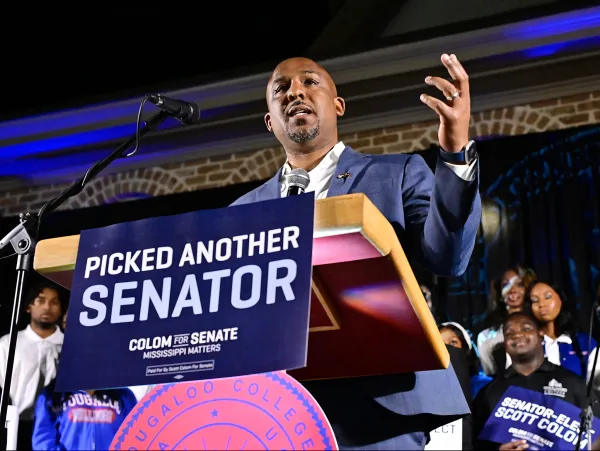
When Hell Froze Over: Mississippi sends Scott Colom to D.C.
“The future of the United States of America may well be determined here in Mississippi, for it is here that democracy faces its most serious challenge. Can we have government in Mississippi which represents all of the people? This is the question that must be answered in the affirmative if these United States are to continue to give moral leadership to the Free World,” so said Dr. Martin Luther King, Jr.
With the election of Scott Colom to the United States Senate this week, to what extent did the country inch ever so close to the challenge referenced by Dr. King? Is this the same Mississippi that Dr. King once described as a “state sweltering with the heat of injustice, sweltering with the heat of oppression?” Given what occurred this week some would say, no, this a changed Mississippi.
The less convinced might say the election of a Black man to the U.S. Senate should not blind us to the ignominious history that has so characterized race relations between Blacks and whites for which Mississippi has always been well known. Always been well known! Case, in point: according to data compiled by the NAACP and that which can be found in Ida B. Wells Barnet’s indispensable Red Record from 1882 to1968, the state of Mississippi ranked first in the country in lynchings.
Dr. King had hoped that before his death Mississippi “would one day “be transformed into an oasis of freedom and justice.” Is the election of Colom a sign of things to come? Has Mississippi turned the corner? These are questions for which there are no substantive answers at present. Still, the idea that Mississippi would usher into the United States Senate a Black man was about as unthinkable as the United States electing a Black man as president in 2008, maybe even more so. Despite Mississippi having the largest percentage of African Americans of any state, it has never elected an African American to a statewide office of any kind which makes Colom’s election to the U.S. Senate even more incredible.
Several African Americans have made runs at the offices of governor and the U.S. Senate in Mississippi only to fall short. A few of the notables include Congressman Mike Espy who ran for the United States Senate in 2020 and lost to Cindy Hyde-Smith, the same woman that Colom bested. That was his second defeat in as many attempts. He lost in 2018 in a special election, also to Hyde-Smith despite the controversy that swirled around her for saying she would be “on the front row” if a supporter invited her to “a public hanging.” The Jackson Free Press, predecessor to the Mississippi Free Press, reported the story. In 2011, Hattiesburg Mayor Johnny DuPree lost a bid for the governor’s office. Several decades earlier, in 1971, Charles Evers, brother of Medgar Evers, ran as an independent candidate for the U.S. Senate, garnering a surprising 23 percent of the vote.
If nothing else, Colom offers hope that if it can happen in the Magnolia State it can happen anywhere. Colom’s victory as well as the victories of the other African Americans who now hold seats in the U.S. Senate and governors’ mansions will inspire other African Americans to run for high-profile statewide offices (meaning governor and U.S. Senate) in their respective states.
For years, the thinking was that white voters would not elect a Black to the office of senator or governor no matter how qualified or how much their policy positions were in synch with white voters. Some Blacks understood this, thus avoided running for said positions. What we have witnessed over the last week or so may indeed have changed all that. If it can happen in Mississippi, perhaps it can happen anywhere.
Judson L. Jeffries, PhD, MPH, is Professor of African American and African Studies at The Ohio State University.