
When a Muslim Is the Victim, Where Is the Outcry?
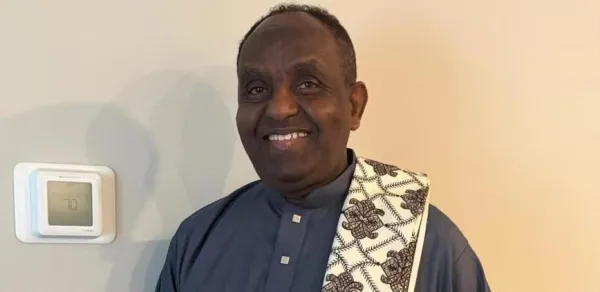
Mohamed Yusuf, a Somali American Uber driver, remains in critical condition following a weekend attack near Minneapolis. Family Handout
A Somali American Uber driver, Mohamed Yusuf, is fighting for his life in a Minnesota hospital after a passenger attacked him in the early hours of November 14. The 51-year-old father of five remains in a coma with life-threatening injuries.
What happened to Mohamed Yusuf?
According to reporting by Somali Brief and Minnesota Public Radio, Yusuf was driving a passenger in Hopkins, a suburb southwest of Minneapolis. His brother, who was also working as an Uber driver, was on the phone with him during the ride.
The passenger asked Yusuf his name. When Yusuf answered, Mohamed, the passenger reportedly responded, "I don't like that name."
According to the criminal complaint, the passenger, identified as 25-year-old Samit Apurva Patel, subsequently strangled Yusuf with his seat belt, took control of the vehicle, and ran him over, leaving him in a ditch.
Yusuf's brother heard the struggle over the phone and heard his brother screaming that he was being choked and run over.
Police found Yusuf in a ditch, approximately 15 feet from the road, using information from his smartwatch and a police drone.
His injuries include broken ribs, a broken leg, spinal injuries, collapsed lungs, and extensive internal bleeding. He has undergone multiple surgeries, including the removal of several organs. His family says he remains in a coma.
The legal question: Was this a hate-motivated attack?
Patel has been charged with second-degree attempted murder and first-degree carjacking.
Hennepin County Attorney Mary Moriarty said prosecutors reviewed the evidence but could not establish beyond a reasonable doubt that bias motivated the attack. Minnesota uses a sentencing enhancement for crimes motivated by bias rather than a separate hate-crime statute.
I understand that prosecutors must meet the legal standard of proof. However, the passenger's reported objection to Yusuf's name raises a legitimate question that deserves a thorough investigation.
Human rights lawyer Qasim Rashid, Esq., addressed the legal aspects of the case in a November 17 post on X. His analysis is worth considering:
https://x.com/QasimRashid/status/2122824160007143569
I also find it disturbing that public discussions of terrorism and hate crimes involving Muslims often carry assumptions that would be challenged if the circumstances involved another community. Why should the same standards of scrutiny, fairness, and accountability not apply to everyone?
Political rhetoric has consequences
One of Yusuf's family members told Somali Brief at the hospital, "This is pure hate crime!" The family member added, "Our politicians created this hostile environment."
The family's concerns cannot be dismissed. President Donald Trump has repeatedly used derogatory language about Somali immigrants. In December 2025, he called them "garbage," said he did not want them in the United States, and urged them to return to their country.
More recently, Trump has repeatedly targeted Michigan's Sen.-elect Abdul El-Sayed, mocking his name and calling him a jihadist. At one rally, he defended his use of the name Mohamed by saying, "I'm the president. I can call him whatever the hell I want."
Such statements deserve scrutiny, particularly when directed at Muslim Americans and entire immigrant communities.
A community organization in Columbus, Ohio, has also spoken out. Engr. Mohamed, posting on the Facebook page of Somali Response from Columbus, wrote:
"The Somali American community is paying the price for the Somali hate sponsored and legitimized by the political rhetoric of the Trump administration."
Read the original Facebook post:
https://www.facebook.com/share/v/1DMrLzz7oT/
The Somali Brief news network also interviewed Yusuf's family at the hospital, where he remains in a coma. Readers can hear directly from his relatives here:
https://x.com/Muslim/status/2122057549063037312
The Guardian reported that a GoFundMe campaign established on behalf of Yusuf and his family had raised more than $425,000. His family described the consequences of the assault as devastating and appealed for financial support.
Uber issued a statement expressing shock and horror over the attack and said it stood ready to assist law enforcement with its investigation.
America deserves better
I addressed Trump's reckless public remarks and frequent insults against Muslims in an article published last month by the Columbus Free Press, titled "A President's Words Can Set a Nation on Fire."
Read it here:
https://freepress.org/article/president-s-words-can-set-nation-fire
A president's words carry enormous responsibility. They can help bring people together, or deepen divisions and encourage hostility.
I am not suggesting that political rhetoric alone establishes the motive behind this particular assault. That determination belongs to investigators and, ultimately, the courts. But the concerns raised by Yusuf's family and the Somali American community deserve to be heard and taken seriously.
Mohamed Yusuf deserves justice. His family deserves answers. And every American, regardless of religion, ethnicity, or the origin of their name, deserves to live and work without fear of being targeted.
America deserves leadership that unites rather than divides.
Mahmoud El-Yousseph
Palestinian freelance writer and retired U.S. Air Force veteran. He writes about U.S. foreign policy, Middle Eastern affairs, and justice.