
Who Owns Iran's Future? War, Regime Change, and the Politics of “Iranian Zionism”
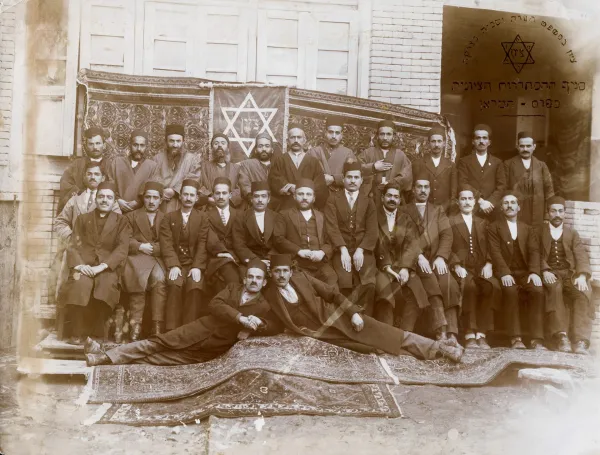
Iranian Zionism: Persian Jewish Oral History, Public domain, via Wikimedia Commons
Although the United States-Israeli military campaign against Iran may appear to have entered a period of reduced intensity, there is no peace on the horizon. Instead, the warfare has moved into another arena. What began with an extraordinary campaign of airstrikes and the targeted killing of senior Iranian political and military leaders—a strategy of regime decapitation—has increasingly evolved into a broader and more comprehensive campaign of economic warfare: sanctions and financial restrictions targeting virtually every major sector of the Iranian economy, including banking, automobile manufacturing, and aviation; a naval blockade; and efforts to choke the Iranian economy and sever its remaining connections to international trade.
The financial cost of the conflict to the United States alone illustrates the scale of the problem. By September, estimates put the cost of U.S. military operations at approximately $43.6 billion, while the Congressional Budget Office had estimated roughly $38 billion through August 1. These figures, however, do not capture the full economic consequences of the conflict, including disruptions to energy markets, depletion of U.S. military stockpiles, damage to regional infrastructure, and the broader economic effects of prolonged instability.
The first phase of the war was unmistakably military. On February 28, 2026, the United States and Israel launched a major campaign against Iran. Among its most consequential actions was the killing of Supreme Leader Ayatollah Ali Khamenei, alongside senior Iranian military and security officials. The operation was therefore not simply an attempt to destroy Iran's military infrastructure; it also directly targeted the leadership structure of the Islamic Republic.
The strategic logic behind these attacks extended beyond the destruction of weapons systems. U.S. officials described objectives that included eliminating Iran's nuclear and ballistic-missile capabilities, destroying elements of its military infrastructure, and weakening the regime itself. However, as reported by the Congressional Research Service, the broader objective of the military campaign extended to the possibility of toppling the Iranian regime. According to the CRS account, this strategy included efforts to organize supporters of the Pahlavi monarchy inside Iran and encourage attacks against government and military institutions, as well as efforts to support, arm, and train Kurdish forces based in Iraq with the objective of enabling them to enter Iran.
This marked a significant expansion of the war's objectives. The campaign was no longer confined to degrading Iran's military capabilities or preventing the development of nuclear and ballistic-missile programs. It increasingly encompassed an effort to undermine the political structure of the Islamic Republic itself.
Despite all of these efforts, the Iranian regime survived and demonstrated a significant degree of resilience. The campaign failed to produce the immediate political collapse that its strategy of regime decapitation appeared to anticipate. Instead, Iran's political and security institutions remained intact, while the country's military forces continued to operate and respond to the attacks. Iran also inflicted significant damage on U.S. military infrastructure and naval assets in and around the Persian Gulf, demonstrating that the destruction of senior leadership and critical military facilities had not eliminated its capacity to retaliate. The survival of the regime, combined with its ability to sustain military operations and impose costs on U.S. forces, fundamentally altered the trajectory of the conflict. Rather than ending the confrontation, the initial military campaign appears to have opened the way for a prolonged struggle in which military force has increasingly been supplemented by economic pressure, blockade, and attempts to isolate Iran from the international system.
It is in this context that the activities of Iranian opposition groups outside the country take on particular significance. A recent gathering of Iranian opposition figures from the United States and Europe in Israel points to another development in efforts by Isreal to reshape Iran's political future. During an event in Tel Aviv, participants discussed what organizers described as “Iranian Zionism”—an idea that Iranian opposition movements could draw lessons from the political movement that contributed to the establishment of the modern State of Israel. The gathering was organized in cooperation with the Abrahamic Movement, the Jerusalem Interfaith Center, the Cyrus Fund, and Project Aftab.
The emergence of the term “Iranian Zionism” is particularly significant in the context of the growing efforts by Pahlavi supporters to promote their political vision for post-Islamic Republic Iran. In this context, the concept can be viewed as an attempt to reframe the Pahlavi movement's slogan, “We will take back Iran,” within a broader ideological narrative of national restoration and political transformation. Rather than presenting the movement simply as a campaign to restore the Pahlavi monarchy, the language of “Iranian Zionism” places it within a historical framework modeled on Zionism—the movement that sought to establish a Jewish national homeland and ultimately contributed to the creation of the State of Israel.
This framing, however, carries a deeper political implication. The very idea of “Iranian Zionism” risks suggesting that the Islamic Republic represents something fundamentally separate from Iran itself—that the existing Iranian state is somehow alien to the nation and that an alternative political movement, particularly one associated with the Pahlavi dynasty, represents the authentic Iran. That is a consequential claim. Iran's political history, national identity, and sovereignty cannot easily be reduced to the history of a single dynasty, just as the Iranian nation cannot be equated with any one government or political faction.
The irony is therefore difficult to overlook: in seeking to redefine Iran through the language of “Iranian Zionism,” the movement risks reproducing precisely the kind of historical and political binary it claims to oppose—one in which Iran is divided between those who are portrayed as the country's rightful representatives and those who are portrayed as outsiders to the nation. The question then becomes whether this emerging political language is genuinely intended to build a broader Iranian national movement or instead seeks to establish a government subservient to Israel and United States and claim ownership over Iran’s political identity and future.