Anti-War

There’s nothing new about this, which is why I know it’s there before having seen the new budget proposal. The United States funds most of the world’s most oppressive militaries, sells them weapons, and trains them. It has done so for many years. But if you’re going to propose an enourmous budget that relies on deficit spending, and you’re going to claim that a gargantuan military budget (bigger than the Vietnam War budget that derailed LBJ’s domestic priorities) is somehow justified, then I think you ought to have to stand and justify every bit of it, including the 40% or so of U.S. foreign “aid” that’s actually money for weapons and militaries — first and foremost for Israel.
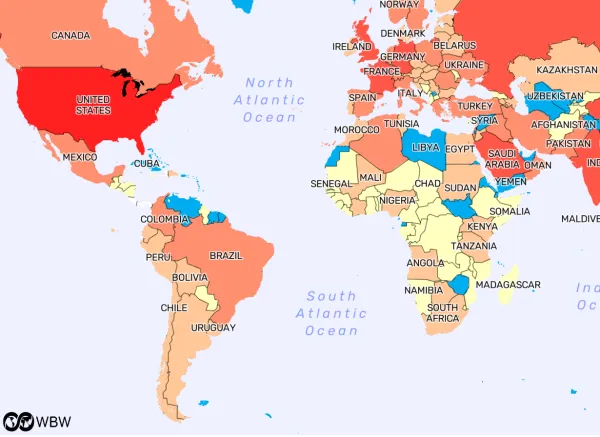
A U.S.-government-funded source for a list of the oppressive governments of the world is Freedom House, which ranks nations as “free,” “partly free,” and “not free.” These rankings are supposedly based on civil liberties and political rights within a country, with apparently no consideration of a country’s impact on the rest of the world.

Here’s a video from one of the facilitators lined up for World BEYOND War’s online course on War and the Environment which begins on June 7th, 2021:
This course could not be more important. A culture of extraction and destruction is closely tied to a culture of war. Questioning that ethos of destruction and consumption is challenging, but it has belatedly begun. Challenging a culture of militarism is even harder.

Suddenly a shard of history comes flying at me from the ebbing days of World War II, hitting me in the heart. You mean world leaders (not to mention all the rest of us) were serious about transcending — for good — the hell the world had just been through and . . . ending war?
In February 1945, President Franklin Roosevelt, on his return from the Yalta Conference with Great Britain and the Soviet Union, and two months before he died, gave an address to Congress, as quoted recently by Medea Benjamin and Nicolas J.S. Davies:

Human Rights Watch recently labeled Israel an “apartheid regime,” their recent bombing campaign on Palestine sparking protests across the world – including one this coming Friday in Goodale Park at 6:30 pm. Yet Ohio taxpayers are funding Israel’s military occupation of Palestine through both federal and state taxes. While the US federal government pays almost $4 billion a year for Israel’s military, Ohio’s Treasury also invests hundreds of millions in Israel, holding a total of $220 million in Israel Bonds – the highest amount for any state in the US.

Of course there are 60,000 Pentagon super (duper!) spies prancing around the globe with tracking devices in their shoes, goofy wigs on their heads, collections of comical sunglasses, and — for the employee of the month! — silicon handsleeves and silicon faces to fool the airport cops, or maybe it’s the Vaccine Nazis, or perhaps it’s the Marxist conspiracy and election stealers denounced by the head of the Space Command who was fired last week for straying from his designated delusions.
After all, this is the military that produced 120 retired generals openly proud of their batshit balminess. When you dump $900 million dollars unbeknownst to anybody into 130 private companies listed absolutely nowhere to get 60,000 undercover clowns employed at household-name corporations that even the author of the article linked above doesn’t name a single one of, who is to say what will happen?
I am.
Horrible things will happen.

An interesting recent article by international lawyer John Whitbeck suggests that the billions of dollars that the United States gives to Israel annually is not technically “foreign aid” as the Jewish state is as measured by per capita GDP the 19th wealthiest in the world, ahead of countries like Germany. It is, instead “tribute,” which is defined as the “payment made periodically by one state or ruler to another, especially as a sign of dependence.”

While the proposal for a global ceasefire during a disease pandemic has done the opposite of catching on, there are a few small signs of sanity and even of successful activism. While most big military spenders (including the super-mega-biggest one) have increased or kept their spending steady, the SIPRI numbers show a serious reduction from 2019 to 2020 in military spending by Brazil, and reductions as well by China, Russia, Saudi Arabia, South Korea, Turkey (the only NATO member stepping out of line on this), Singapore, Pakistan, Algeria, Indonesia, Colombia, Kuwait, and Chile.
Chile is reducing its military spending by 4.9% in order to better address the health crisis. I did say “small,” but small percentages tend to be significant amounts of money when you’re talking about military spending.