
Editorial

The final year for using medical marijuana illegally on 420 could be 2016 as two groups are seeking to put a medical marijuana amendment on this November’s ballot. Parallel to these 420 activists are Ohio lawmakers who introduced a medical marijuana bill a week before April 20th.
State lawmakers plan on fast-tracking the bill (House Bill 523) to Gov. John Kasich before any November ballot, and they said if it passes this summer, Ohioans could be using medical marijuana by 2018.
The two groups seeking a citizen vote on medical marijuana – Ohioans for Medical Marijuana and Grassroots Ohio – will most likely stay the course, as they have said they don’t have confidence in the Republican-dominated Ohio Legislature passing an effective law. Thus Ohio could have competing medical marijuana measures on this fall’s ballot.
Two weeks before the Ohio primary, OSU head football coach Urban Meyer was having none of that endorsement stuff. He said he was not going to run that play.
Coach Meyer had been burned in 2013 when he apparently was pressured by Columbus' big money dilberts to endorse the Columbus school levy. The tax measure went down in the flames.
Bad play. Don't run it again, coach.
Meyer may have stuck to that playbook until Donald Trump said at a rally in early March that Meyer had “said good things about him (Trump).” Trump did not claim an endorsement but the implication that Ohio's most popular public figure was in Trump's corner was inescapable.
That was back when the pride of central Ohio's big money dilberts, Gov. John Kasich, was scrambling to keep what was left of his loss-ridden presidential campaign alive by winning Ohio. But Kasich was trailing Trump in public opinion polls in advance of the state's March 15 GOP primary.
Kasich promised to drop out if he did not win Ohio's primary so the pressure was great on Ohio's absentee governor to win his home state.
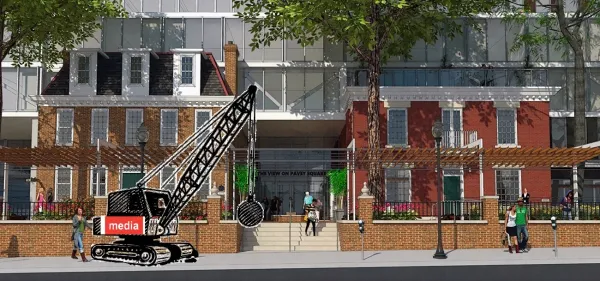
After increasing pressure from North Campus residents, the high-end apartment developer behind The View on Pavey Square has drawn up another redesign. The developers said while previous designs were a mismatch, this new design complements Pavey Square, which is arguably one of the city’s most historically organic and visually distinct areas. Some of the North Campus activists, or the group Protect Old North, say this is another victory considering the developer, JSDI Celmark, has come back with several redesigns in response to their push back.
Some with Protect Old North have told The Columbus Free Press their position has always been that all development plans follow the University Area Plan, which calls for a maximum height of 45-feet for this area of High Street.
But does their position truly protect North Campus?
And so it begins. A 10-year pollworker named Diane contacted the Free Press. She had just gone through three hours of training and gave the Free Press her manuals. She said she had been ordered to re-take the training because she had asked too many questions about counting paper ballots during training.
“They came in with a stack of 800 ballots from the last election that had never been counted. One they weren’t going to count because the city and zip code had been left off even though there was an address on it,” she explained. “I asked them why if the voter has already shown ID with his address on it and you’ve given him a ballot based on the candidates running in that precinct where he lives, why would you not count his vote when you have his name, street address, and date of birth?”
Diane noted that she was told not to tell voters to fill in the required information before they left. “Why do you have to sit there and watch them walk out and know their vote won’t be counted when you could tell them to fill it all in?”
How do we make sense of the current battles within the Democratic Party? Hillary vs. Bernie – and grassroots progressives vs. Boss Bill Anthony, Franklin County Democratic Party Chair, and the corrupt one-party machine in Columbus?
In the case of Sanders, we’re witnessing a critical juncture in U.S. history. Sanders and his followers are single-handedly destroying “American Exceptionalism” – the fact that there is no mass socialist/labor movement defending the rights of working people. The U.S. is now ruled by a corporate capitalist kleptocracy (rule by thieves). Sanders and his activist cohorts are out to stop the looting. Hillary is running as the “realist” candidate who will negotiate with her corporate donors to steal less.
Columbus mirrors the battleover corruption in the national Democratic Party. As Jon Beard, currently running for the Franklin County Democratic Central Committee, puts it: “This Columbus area corruption is like an onion: keep peeling the layers back and it gets more and more stinky. This is what happens when a small group of people sees political power as “theirs” for the exploiting, and not the people’s for serving.”
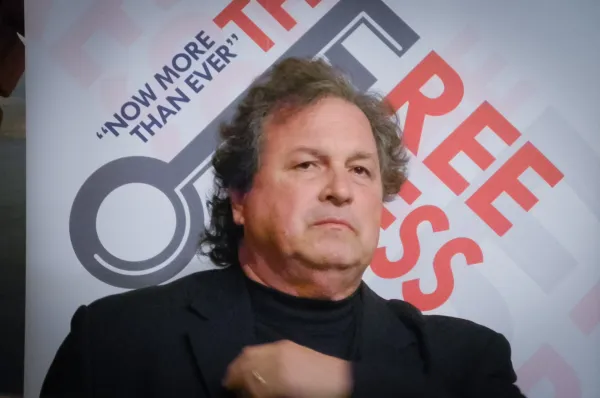
How do we make sense of the current battles within the Democratic Party? Hillary vs. Bernie – and grassroots progressives vs. Boss Bill Anthony, Franklin County Democratic Party Chair, and the corrupt one-party machine in Columbus?
In the case of Sanders, we’re witnessing a critical juncture in U.S. history. Sanders and his followers are single-handedly destroying “American Exceptionalism” – the fact that there is no mass socialist/labor movement defending the rights of working people. The U.S. is now ruled by a corporate capitalist kleptocracy (rule by thieves). Sanders and his activist cohorts are out to stop the looting. Hillary is running as the “realist” candidate who will negotiate with her corporate donors to steal less.
Columbus mirrors the battleover corruption in the national Democratic Party. As Jon Beard, currently running for the Franklin County Democratic Central Committee, puts it: “This Columbus area corruption is like an onion: keep peeling the layers back and it gets more and more stinky. This is what happens when a small group of people sees political power as “theirs” for the exploiting, and not the people’s for serving.”
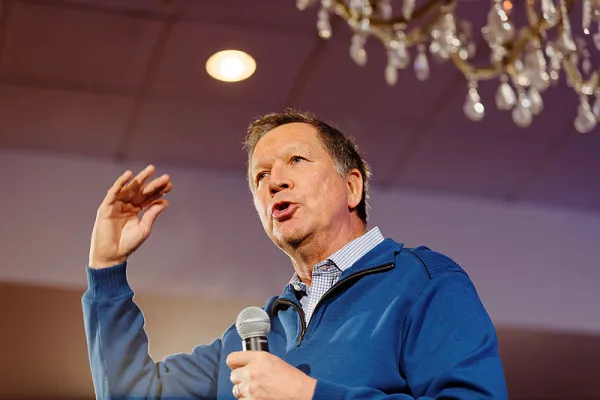
Gov. John Kasich's bid for the Republican presidential nomination already appears to have cost Ohio taxpayers $1 million.
The governor has refused to release the cost of security and transportation, among other items, citing exemptions to Ohio public records laws. Hence, taxpayers cannot learn the expenses incurred by the Ohio Department of Public Safety in protecting and providing transportation for Kasich and his family while Ohio's first family campaigns out of state.
The following is a breakdown of the $1 million that the Kasich campaign apparently has cost Ohioans so far:
First, there is the cost of Kasich's salary and benefits while he is campaigning out of state and not doing the state's business he was elected twice to do.
In round numbers, his annual salary is $150,000 with another $50,000 in fringe benefits and retirement contributions. That's $200,000. Kasich was campaigning for president out of state about half the time during 2015.
Mark the cost to Ohio taxpayers as $100,000.
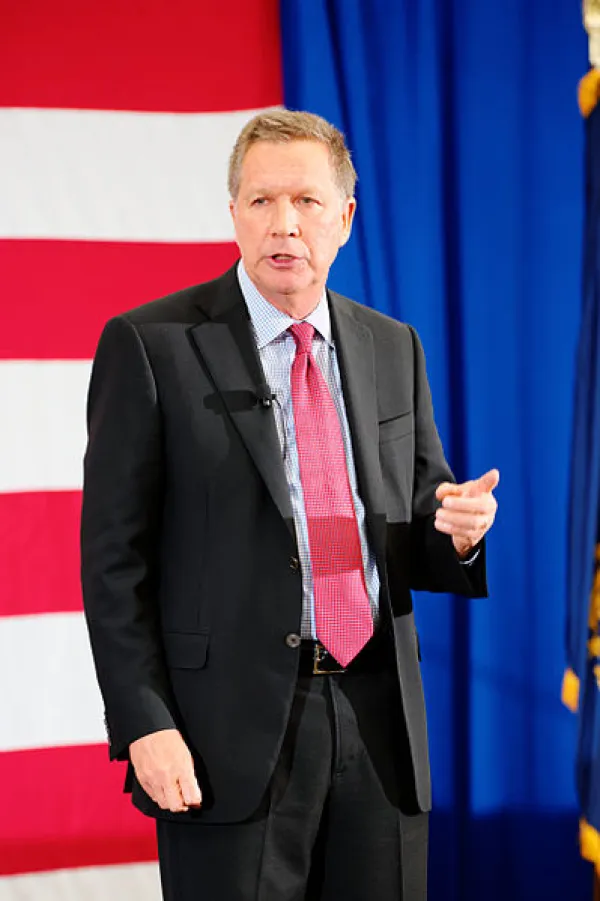
The New York Times is no match for Gov. John Kasich's slick manipulation.
We already know that The Columbus Dispatch is an easy mark for the governor turned presidential candidate.
In a NYT Sunday Magazine article Jan. 3, reporter Robert Draper lets Kasich have his way, failing to immediately counter misstatements.
Some for-instances:
Kasich quote: "I don't spend any time thinking about him" (rival and front-runner Donald Trump).
Truth not reported: Kasich interrupted and harshly criticized Trump a few debates ago and Trump slapped him down like a bug.
Kasich quote: "I don't like divisiveness. I don't like negativity."
Truth not reported: See above attack on Trump and recent brickbats Kasich hurled at rivals Chris Christie and Marco Rubio.
Kasich quote: "I don't care what the polls say."
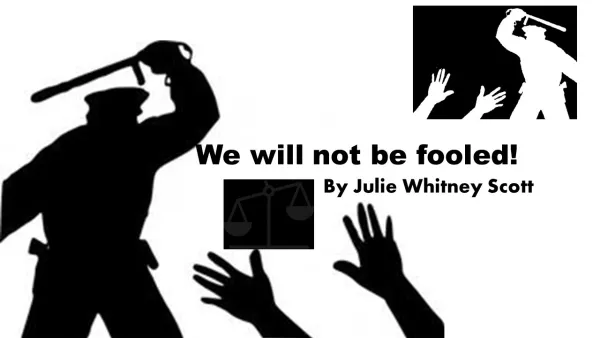
Last December 2015 while some waited for the holidays to bring them “good cheer” and were consumed with the media hype in regards to Trump, or just waited for the year to end, many African Americans and Civil Rights Activists were more concerned with the outcomes of grand jury indictment decisions and jury trials held in December concerning African Americans who lost their lives in 2014 and 2015 at the “alleged” hands of police officers.
Twenty-Five year old Freddie C. Gray Jr., was arrested on April 12, 2015 in Baltimore and while being transported by a police van to jail fell into a coma and died April 19, 2015 from “injuries to his spinal cord.” On December 21, 2015 a hung jury left the Gray family as well as Officer William Porter and the other five officers awaiting trial, in limbo until a retrial this June 2016.
A good newspaper understands the political sensitivities of the community it serves and reflects that understanding in the newspaper's coverage and opinion-making.
A newspaper that fails to understand and reflect the nature of its community is bound to lose readers.
Such is the plight of the Columbus Dispatch that was purchased by GateHouse Media in June.
The political disconnect between the Dispatch's news and opinion policies and its core readers is likely a key factor in a one-year drop in circulation of nearly 9 percent. The annual report published in the Dispatch in October stated that the average number of copies sold on the day nearest to the filing date was 127,477, down sharply from 139,696 the average number of copies sold during the previous 12 months.
A copy of a print newspaper is read by an average of two people, so the Dispatch is reaching about 255,000 people per day.