Human Rights

March 6th, Sandy Hook Promise applauded the introduction of the Safety and Violence Education for Students (SAVE Students) Act in the Ohio State House. This new legislation in Ohio is aimed at combating the crisis of violence, bullying, and suicide that is devastating our nation’s schools. If passed, this bill would set a new national standard for statewide school safety programming.
In response to the introduction of this legislation, Sandy Hook Promise released the following statement: “We know school violence is preventable when we teach youth and adults to ‘know the signs’ of violence and suicide and get help to stop a tragedy before it can happen,” said Mark Barden, co-founder and managing director of Sandy Hook Promise, and father of Daniel who was killed in the Sandy Hook Elementary tragedy. “This legislation would protect Ohio’s students across the state and create a national model for prevention that empowers our youth to help save lives.”
Strange dramas are unfolding these days in the Ohio Statehouse and City Hall in Columbus. While concerned Ohioans rally around citizen initiatives to ensure our rights, legislators are reeling out laws to limit those rights. Lawmakers opposing affordable healthcare, safe water, and other popular measures cite divisions among their constituents. Common sense and lopsided funding against citizen proposals reveal that objections pivot less on differences between Ohioans than on the demands of powerful corporate interests. In broader terms, Ohio is engaged in an epic battle between human rights and corporate rights that is determining the future of the state.
The Medicare for All Act of 2019, is scheduled to be introduced into the Congressional House by Congresswoman Pramila Jayapal of Washington State this coming Wednesday, February 27th. She hoped to have more than 100 cosponsors at the time the bill is introduced.

Naked Imperialism
Barely one in five Venezuelans knows who Juan Guaidó is. His newly minted international supporters have trouble pronouncing his name. Yet that is the man whom the Donald Trump administration wants to make President of Venezuela – by any means necessary. White House national security adviser John Bolton has already floated a trial balloon of “5,000 troops to Colombia.”
Kaleidoscope Youth Center (KYC) is excited to announce that we are now directly serving and supporting homeless and housing insecure LGBTQIA+ youth and young adults with the introduction of three new housing programs! Since 1994, KYC has worked in partnership with young people in Central Ohio to provide safe and affirming spaces for LGBTQIA+ young people in our drop-in center, in the schools, and in the community. Over the last year, KYC, in partnership with other local organizations, has worked to prevent and end youth homelessness through coordinated community planning.

Longtime Columbus residents understand some of the inherent causes that lead to homelessness in our community. Tax abatements for high-end real estate developments and a slowed job growth rate in 2018 mean that many middle class individuals can’t afford to live here. For those earning minimum wage or the unemployed, the threat of homelessness is very real.
In fact, families and children are among the highest at-risk populations for homelessness. According to the Ohio Housing Finance Agency (OHFA), about 30 percent of the homeless serviced by various state agencies in 2017 were minors. In addition, the overall rate of homelessness increased across the state in 2018. Homelessness isn’t under control in Ohio by any means.
As the new year begins and the old year ends, we begin another transition in our lives. We make our individual resolutions, our resolutions as couples and as a family. Some of us no longer make resolutions because we have failed to keep, meet or come close to achieving our goals.
To make a resolution is to make a firm decision to do or not to do something. When we make resolutions, we take an action, or at least we say we are going to take an action, to solve a problem, a dispute, or contentious matter. We hope to have “peaceful” resolutions with others so that we can come to a satisfactory agreement, one that will benefit both parties involved, and if necessary, to the benefit of others that we advocate for or who will also benefit from the resolution of the problem.
As I write this article, our government is trying to resolve the issue of building “a wall” that the President of the USA wants to build at the price of five million dollars. Americans are looking at a government shutdown for their new year in 2019. Both the House and the Senate put the battle to rest on December 27 until New Year’s Eve.
The “Offense Book of Books” kicks off their publication during three events in January.
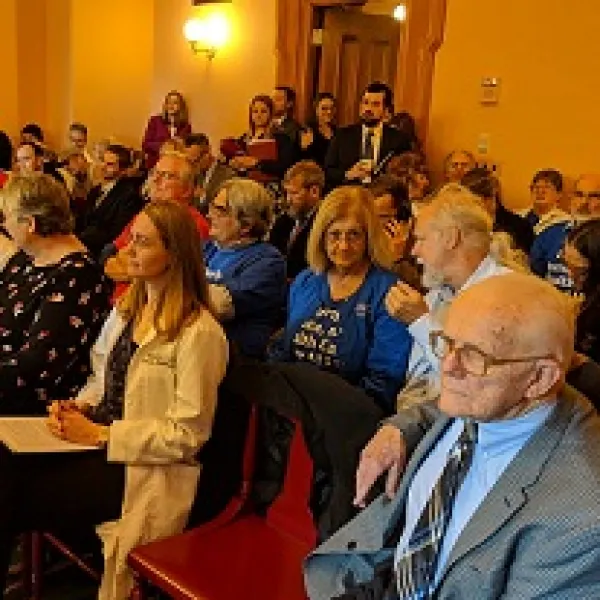
Every once in a while something good seemingly falls into your lap. The proponent hearing on HB 440, the Ohio Health Security Act (OHSA) in the House Insurance Committee on December 5 and 12 was pure serendipity.
The OHSA would provide payment for all necessary health care for all Ohio residents for life. It includes inpatient and outpatient hospital care, preventive care, mental health, vision, hearing, prescription drugs, dental, medications and medical devices, emergency services-including transportation, rehabilitation, hospice care, home care and other necessary medical services as determined by any state licensed health care practitioner. It is “Medicare for All for Ohioans.”
Co-sponsors of HB 440 are Ohio House Representatives Teresa Fedor and Bernadine Kennedy Kent.