
News
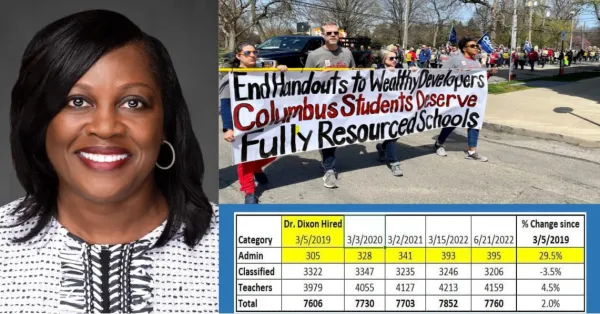
More educators, reducing class sizes, and air conditioning are on the bargaining table between Columbus City School teachers and the Columbus Board of Education (the Board). But teachers are telling the Free Press that Superintendent Dr. Talisa Dixon, the Board itself, and the way the district has been run since Dixon took over are also under scrutiny and one reason why they may strike.
Dr. Dixon was hired by the Board early in 2019 and she led the district with its 50,000 students through the pandemic. She also lost her father at the beginning of the lockdown.
Her first three years were eventful to say the least. But during this time the district’s 4,100 teachers noticed more administrators were being hired. A lot more, actually.
Indeed, nearly 100 administrators, who are not members of the teachers’ union, were hired (see above chart provided by Columbus City School teachers). Many of these of positions pay over $100,000, and many are “central office” admins, meaning they do not work in the schools.

The criminal trials against three Columbus police officers for their actions during the 2020 summer protests has, some activists believe, turned farcical and (once again) shows how the Division and its union act in an autonomous and defiant way.
Last week lead special prosecutor Kathleen Garber resigned out of frustration – and probably out of fear from the fallout of trying to prosecute Columbus police officers in a criminal trial.
Garber confirmed to the Free Press she fainted in the courtroom during a recent trial day, and afterwards, the FOP Capital City Lodge #9 sent her flowers.
Whether it was out of spite to mock her or the flowers were heartfelt is a good question. But one the local FOP probably won’t answer, or if they did, an answer not to be trusted.
“That is accurate,” confirmed Garber to the Free Press is an email. “They sent flowers addressed to me at the office of Public Safety, even though I was not employed there or have an office there.”
Be careful what you wish for, as the City and Neighbors 4 More Neighbors push for more urban density

In what arguably is the Midwest’s largest boomtown, City of Columbus leadership and the grassroots effort “Neighbors 4 More Neighbors” have been seeking greater housing density for Columbus’s downtown and nearby neighborhoods, such as the Short North.
Just this week City Council unanimously passed a zoning change which could lead to 800 more apartments inside the popular Scioto Audubon Metro Park.
Those pushing greater density – such as Neighbors 4 More Neighbors or “N4MN” – are adamant this is the path Columbus needs to take. You can put the downtowns of Cincinnati and Cleveland in Columbus’s downtown in square miles, they say.
What’s more, says N4MN, Columbus and Central Ohio has sprawled so far, so fast, its straining resources and government services, to maintain roads, add water lines and provide public transit, etc.
Greater density has also become policy, as Mayor Ginther and City Council in June announced the Columbus Housing Strategy with a core effort “to build more housing at all price points region-wide.” Part of this plan includes a $200 million affordable housing bond on November’s ballot.

“Those who fail to learn from history are condemned to repeat it.” – Winston Churchill, 1948
Americans recently spent the July 4th holiday celebrating their freedoms and inalienable rights of life, liberty and the pursuit of happiness per the Declaration of Independence signed on that date in 1776. However, a recent Gallup poll found that at only 38 percent of respondents say they are "extremely proud" to be an American, down from the 55%. What happened?
For one, just five individuals two weeks earlier rescinded a Constitutional right that had been affirmed by a similar body 50 years earlier. With little forewarning other than subterfuge, this move that affected 64 million Americans landed like a gut punch.

Ohio has been going gun crazy for years and it’s only going to get Wild West worse.
As of this month the state is now not only a “stand your ground” state, but also permitless carry, meaning state-mandated training or a background check to legally carry guns is optional, and gun nuts also have the option to openly carry because God says it’s okay.
The above picture was taken at a local grocery store. True, grocery stores are targets for active shooters, but must we all be openly carrying so to put an end to active shooters?
When it comes to America’s gun fetish there’s too much blame to go around, but arguably the biggest gun-pusher trap house in Ohio is the Ohio Statehouse, as its dominating GOP leadership apparently wants an AR-15 slung over everyone’s shoulder.

After a two-year virtual-only hiatus, ComFest is in many ways rising from the pandemic’s ashes and returning to its full glory at Goodale Park.
What should never be undervalued is the energy and creative power of the volunteers who have run ComFest, which many know is coolest party in town, if not the only party in town that truly matters, for the previous half century.
But what also shouldn’t be forgotten is how they kept ComFest going in the face of a pandemic. There were two virtual ComFests, and they required a great deal of technical expertise and logistical planning that was entirely new to the volunteers, says ComFest volunteer Marty Stutz.
“Really, it was a lot of the same folks who put together the regular ComFest, and they just decided, ‘Hey, this is really important, and what can possible be done to keep ComFest going even though there’s not going to be a live festival in the park?’,” said Stutz. “There was a whole lot of people who came together with not a lot of time to put the virtual together.”

For decades environmentalists have warned that climate disasters are looming, but they are already here. Storms exacerbated by climate change knocked out electricity to a large portion of Central Ohio this week. Then came a brutal heat wave, which followed the normal pattern of climatic calamity. What we're seeing in Ohio is out of the ordinary, but it's quickly becoming the norm. We are all paying the price because our state and, for a long time, the Federal government have refused to recognize climate change as a health danger.

Hundreds of Columbus residents who have been living in tents and other makeshift shelters – community members who cannot afford traditional housing – have been evicted by the City of Columbus. More evictions of tent camps utilizing bulldozers are in the works, including the encampment at Heer Park scheduled for this Tuesday morning where anywhere from 60 to 100 community members reside.
A City eviction notice ducted-taped near the park states “you will be arrested if you are still there on June 14th” when City workers “come in for remediation,” which means all items will be removed and likely with the apparent efficiency a bulldozer provides. This type of so-called bulldozer “remediation” occurred near Green Lawn Cemetery roughly two weeks ago.
Heer Park, which is adjacent to the Great Southern shopping center, was closed by the City during the winter of 2021, but then become a temporary or state-of-flux community for those who, as some describe it, are “camping out.” But the reality is, pitching a tent and sleeping outside is the end-of-the-line when someone is facing the multiple stages of houselessness.
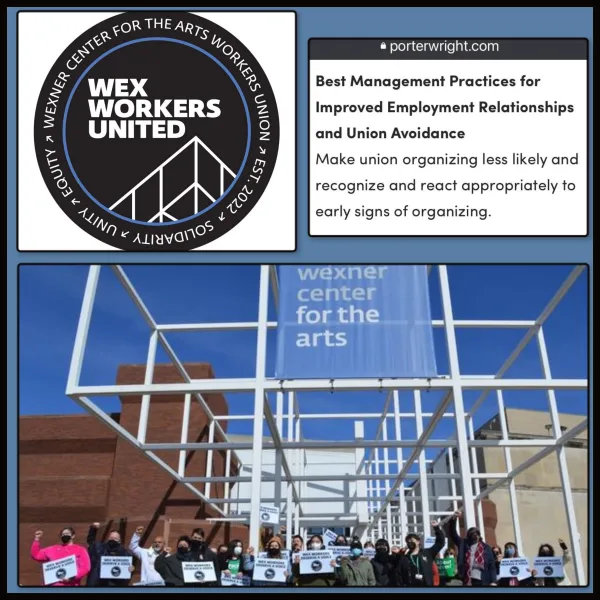
Columbus is witnessing two labor movements, and while Starbucks United has had success, the other more local of the two, Wex Workers United, says it is in a standoff with its boss, the Ohio State University.
Wex Workers United or “WWU” and its affiliate union, AFSCME Ohio Council 8, first asked OSU for voluntary recognition three months ago because an “overwhelming number” of Wexner Center for the Arts employees support unionization, but there’s been no answer from the university.
If OSU refuses to allow the union, Wexner Center workers would take a vote. But OSU, WWU, and the State Employment Relations Board or SERB, must first come to an agreement that a vote should be made, and the university hasn’t consented to this either.
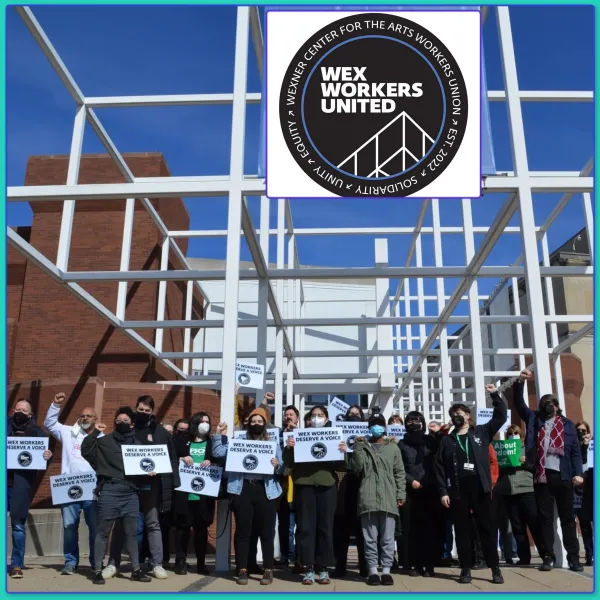
Ohio State is “stalling” on giving their workers consent to vote or voluntarily allowing them to form a union, AFSCME Ohio Council 8, the local union helping Wex Workers United or “WWU” to organize, told the Free Press. OSU has also hired lawyers to push back against WWU, said AFSCME.
University leadership received WWU’s petition to vote back in March, a petition facilitated and endorsed by the State Employment Relations Board, which represents state employees. AFSCME Ohio Council 8 says three months is far beyond any reasonable time for a response from OSU. AFSCME is part of the AFL-CIO.
A petition is now circulating “telling OSU President, OSU Board Members, Wexner Center Director…to STOP Delaying and Set a Union Election Date.”