
News

Toledo, OH: At a meeting held on Monday, December 10, to certify the Lake Erie Bill of Rights (LEBOR) to the special election ballot in February, the Lucas County Board of Elections instead received a written protest which will be the subject of a contested hearing on December 20. A Columbus law firm filed the challenge on behalf of Josh Abernathy of 247 Plymouth Street, Toledo, to keep the LEBOR off the ballot. The Columbus firm, McTigue and Colombo LLC has represented corporate, labor and governmental clients in other cities, including Columbus and Bowling Green, in attempts to keep citizen initiatives off ballots.
The basis for the protest is that the Board of Elections and Ohio Supreme Court already decided this matter and the BOE cannot vote on it a second time. However both the BOE and the Ohio Supreme Court decided that another Toledo citizen initiative, “Keep the Jail Downtown”, could not go on the ballot, but Toledo City Council ordered that measure to be placed on the ballot for the February special election, and faced no ballot protest.

What did you miss this year that was really important? We depend on Project Censored to fill us in. The Free Press would like to cover everything – but just can’t do it in our monthly paper or even on our two websites: columbusfreepress.com and freepress.org. However, Project Censored did honor Free Press Publisher/Editor Bob Fitrakis and Senior Editor/Columnist Harvey Wasserman for the 3rd most censored story in 2005 on the theft of the 2004 election and also for “Search Engine Algorithms and Electronic Voting Machines Could Swing 2016 Election as the 4th "Most Censored Story of 2016."
Project Censored reviewed over 300 Validated Independent News stories (VINs) representing the collective efforts of 351 college students and 15 professors from 13 college and university campuses that participated in the Project’s Campus Affiliates Program during the past year. Some topics are positive, some are understandably negative, and a few are substantially horrifying. The top ten are:
#1 Global Decline in Rule of Law as Basic Human Rights Diminish

An alarming number of atrocious right wing reactionary bills are being introduced during this year’s lame duck period – after election day and before the new state legislators take office. Here’s a roundup of what our state legislators have done, are planning to do and how people are fighting them, all conveniently categorized for you as Good, Bad, and Horrendous.
GOOD

On Thursday, November 15, extremist anti-abortion legislators in the Ohio House passed the six-week abortion ban, furthering their goal to outlaw abortion in the State of Ohio.
The Ohio General Assembly passed the six-week ban once before, and Governor-Elect Mike DeWine has promised to sign the bill if it passes the legislature. Despite Kasich’s veto last year, state politicians continue to push this unconstitutional ban, which could mean abortion access in Ohio will become inaccessible for the majority of women.
Statement from Iris E. Harvey, President and CEO, Planned Parenthood Advocates of Ohio:
“The Ohio Legislature is continuing their ideological crusade to ban abortion in Ohio – starting with the unconstitutional six-week abortion ban. Many women do not even know they are pregnant before six weeks.
“This bill takes away a woman’s ability to make a decision before she knows she has a decision to make. This legislation criminalizes physicians from providing critical care to tens of thousands of patients who need it. Women should be trusted and respected to make their own health care decisions, period.

After toughing it out like a little meatball surrounded by ravenous wolves, one of High Street’s remaining old-school campus cool establishments is closing its doors at the end of this month after 40-plus years of history.
Mama’s Pasta and Brew owner Terry Fahy says the “handwriting was on the wall” as sterile corporate campus gorges on the properties surrounding their Pearl Alley location near 15th and High.
Fahy’s sentiment is like a skipping record, something we’ve heard over and over from old-school campus that’s felt the pressure to abandon High Street. By the way, there are no independent music stores directly across from campus anymore.
The city is widening Pearl Alley and needed four feet of their building to do so, says Fahy. Having the deed to the property and realizing how much work a rebuild would have meant, Fahy sold the building to Campus Partners, the Ohio State off-campus development arm working in tandem with private developers for two decades now to transform High Street.

They’re at it again, which is probably a good thing. The FDA is again seeking comments concerning cannabis like it did last May. This time, it’s looking at five categories (abuse potential, actual abuse, medical usefulness, trafficking, and impact of scheduling changes on availability for medical use) regarding 16 substances, including cannabis. Addressing only herbal cannabis and its extracts, the Ohio Rights Group responded with quotes from scientific studies. What follows is a summary:
Abuse potential:
Cannabis has a lower risk of dependence. “… the experience of dependence on marijuana tends to be less severe than that observed with cocaine, opiates, and alcohol … the severity of the associated consequences is not as extreme.” Addiction & Clinical Practice, 2007.
Cannabis is non-toxic and does not cause fatal overdose. “… cannabinoids have minimal toxicity and present no risk of lethal overdose.” Clinical Journal of Pain, 2012.

Simply Living, The Columbus Community Bill of Rights, and the Columbus Free Press are co-sponsoring a screening of We The People 2.0 Tuesday, October 30, 7 PM at the Drexel Theatre, 2254 E Main St in Bexley 43209.
The film offers a framework to understand why a successful ballot initiative to let voters decide whether to ban oil and gas operations in Columbus was approved by the Columbus City Council, but later rejected and removed from the November 6 election by the Franklin County Board of Elections.

GW Pharmaceuticals: Savior of mankind or bane of human existence?
Once upon a time, there was a guy who knew a lot about marijuana. He attended cannabis conferences and participated in presentations. He hobnobbed with a wealthy well-known insurance magnate. Eccentric described him, but he also had a wonky, biochemical side intent on legitimizing marijuana as medicine. He claimed he had “no beef with people who grow, smoke, or provide their own cannabis.” He decried the drug war’s toll on U.S. marijuana policy.
But there was another side. He’s been portrayed as the master mind behind an unfair marijuana monopoly that patents plants, extraction techniques, medicines and extract inhalers – and then sues violators. A Monsanto that resorts to heavy-handed police state scare tactics. A purveyor of prohibition that prevents people from managing personal healthcare or growing personal medicine.
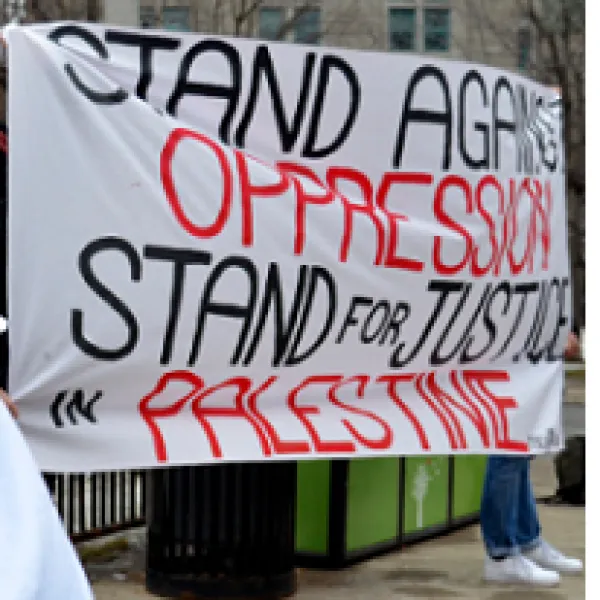
I’m a member of the Central Ohio chapter of Jewish Voice for Peace. JVP was founded in 1996 to further the cause of peace in the middle-east. I’ve been asked to write about the ongoing Boycott-Divest-and-Sanction, or more simply, BDS movement, that has been in the news for quite a while, and how it affects your 1st Amendment rights.
So, I’d like to ask: Were aware of BDS before today?
BDS didn't really appear on most folk's radar until about 2 years ago, however, it's origins are found in the controversial behavior of the State of Israel regarding the Palestinian people that live under Israeli control. BDS is the peaceful response of the Palestinian population of Israel/Palestine to the abuse they have suffered, and continue to suffer, at the hands of the Israeli government. BDS is non-violence and free speech in a single package that is designed to regain basic human rights, legal standing, freedom, and respect, for the Palestinian people living in Israel/Palestine.

The infamous Trumputin consigliere Paul Manafort worked with the GOP operatives who stole Ohio’s 2004 presidential election at the same time they teamed up to install the Kremlin’s chosen mafia don in Ukraine.
Manafort is Donald Trump’s former campaign manager. He’s been convicted of a wide range of high-profile crimes by a jury evaluating charges brought by Special Prosecutor Robert Mueller.
Manafort also worked in Ukraine following the 2004 popular Orange Revolution with Ohio-based IT specialist Michael Connell and Tennessean Jeff Averbeck to install the Putin-backed Viktor Yanukovych as president of Ukraine. Connell and Averbeck have been deeply implicated as being among the chief architects of the stolen Ohio 2004 vote flip that gave George W. Bush a second term in the White House.
Craig Unger, in his essential book House of Trump, House of Putin, places Manafort in Ukraine in “late 2004.” Manafort worked out of a small six-to-eight-person office at 4 Sofievskaya Street in Kiev. Over the next decade, Manafort made 138 trips to Ukraine, according to Unger.