
News
Image
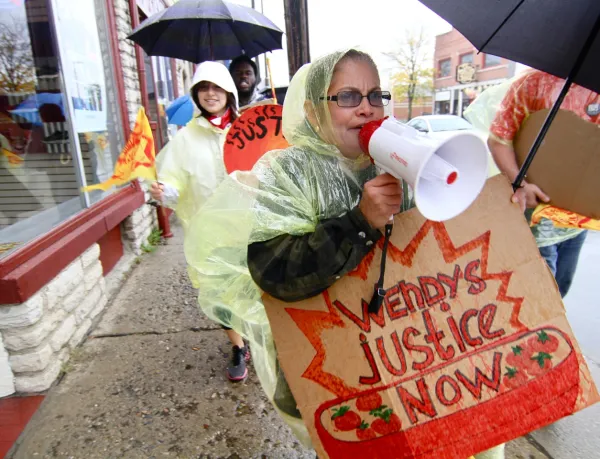
This past Saturday, over 50 Ohioans braved the cold and rain on game day to rally outside the Wendy’s just south of the Ohio State campus. Ohio Fair Food, a group consisting of students, farmworkers, people of faith and organized labor, showed up demanding one thing: that Ohio-based Wendy’s join the Fair Food Program, a program which ensures a humane work environment and increased pay for Florida tomato pickers.
Of the five largest fast food corporations in the country — McDonald’s, Subway, Burger King, Taco Bell and Wendy’s — Wendy’s is the only one not participating in the Fair Food Program. The reasons for Wendy’s to sign on are clear; the program provides a modest increase of 1 penny more per pound of tomatoes picked, a code of conduct which ensures basic rights such as water and shade for farmworkers, and gives farmworkers a voice on the job, including the right to file grievances without fear of retaliation.
Wendy’s CEO Emil Brolick was the President of Taco Bell in 2005 when the chain became the first corporation to join the Fair Food Program. At the time Brolick stated, “We are willing to play a leadership role within our industry to be part of the solution.
Last week the Free Press suggested that our city should not be named after a genocidal conquistador. So far we have three nominations to re-name Columbus. Keep your suggestions coming to: bob@columbusfreepress.com.
Nominations:
Home of the Whopper
Arawak City: Native people Columbus encountered in 1492 when he landed, lost, in the Americas.
"Perunaville" or "Perunatown": Dr. Hartman's Peruna, the turn of the century elixir that was vastly popular (and was 27% alcohol, which no doubt accounts for the popularity) was largely responsible for creating Columbus as an urban center for more than state government. See more at:
http://614columbus.com/article/columbus-200-white-lightning-in-a-bottle…
Image

Over the millennia, the often deified and sometimes demonized Cannabis
plant has taken a circuitous route from friend to foe and back.
Scholars differ on when mankind first discovered the medicinal mysteries
contained within Cannabis. Some trace usage back to 4000 BC in Central
Asia. Charred seeds found in an ancient Romanian burial site suggest
inhalation of the herb's potent and pungent smoke in third millennia BC.
In 1500 BC, it was mentioned the Altharva Veda, one of four ancient holy
books. A basket of seeds and leaf fragments dating back 2,800 years was
discovered in China where Cannabis graced the pharmacopeia of emperor
Chen-Nong.
On October 15 in partnership with USA Today The Ohio State University (OSU) sponsored the third in a series of panels by the Bipartisan Policy Center's Commission on Political Reform. The Center intends to hold a series of town hall style meetings to build the appearance of national consensus around policy recommendations they intend to offer Congress and the President in 2014. The event took place on the same day that the Center and USA Today released a joint poll claiming that most Americans support the Center's conclusions.
The event featured two panels, each with a moderator who asked questions, and took written and vetted questions from the audience and the internet. Questioners were required to list their affiliation along with their name on the tiny question sheets. Unscripted questions from the press and audience were not permitted during the panels. Broadcast teams from C-SPAN and a Los Angles based media outlet that declined to identify itself covered the event. The Lantern, the OSU student paper with advertising and business departments operated by USA TODAY, also ran a story on the event.
Image

While Mayor Coleman pushes his $1 million advertising blitz in support of his proposed 24 percent tax increase for Columbus City Schools, pesky facts keep getting in the way of all the glossy mailers, radio spots and 30-second television ads. And those facts keep suggesting that more money will not solve the problems of Columbus City Schools.
Whether you agree or disagree that the Mayor and other community leaders should be out championing for a permanent $77 million a year tax increase for a school system that is under some serious scrutiny, you have to admire the slick mailers. They manage to promote lofty goals on behalf of the Board of Education without ever mentioning the school board – which is the entity that will be receiving the money. That is how discredited this school board is – the campaign hides it behind children and celebrities and hopes you forget it is there.
Of course the million dollar levy campaign doesn’t mention the high cost of the levy. Nor does it mention Columbus City Schools and the Board of Education – an entity under tremendous focused investigation by the Auditor of State, Ohio Department of Education and U.S.
Image

How does one end up living in an “Earth Ship?” Well, if you are Jay and Annie Warmke, it starts with the impending birth of your grandchild. In 1993, the Warmkes purchased 38 acres in Muskingum County, in the foothills of the central Appalachian mountains to develop a retreat for their extended family.
After the land purchase, Annie was listening to a radio show and heard the words of architect Michael Reynolds outlining the Earth Ship house concept. Their Earth Ship is a house built of waste products such as old tires and bottles, as well as what nature provides with straw, clay and mud. Annie became a contractor and project manager for what is now their home and a tourist attraction, called Blue Rock Station which hosts 20,000 visitors a year.
Annie likes to tell tour visitors how she arranged for the Ohio Environmental Protection Agency to haul in 1200 tires from an illegal dump to create the foundation and walls of their family abode and other buildings on their property. The outer wall of the Earth Ship is buried, well, under the earth, and the walls are made of tires and bottles covered with mud.
Image

So what is a school system to do when faced with evidence that it has impermissibly and unlawfully altered data to make its performance seem good, when it was in fact bad? If it is Columbus City Schools, lawyer up, clam up, obfuscate and deny.
Audits and Investigations Uncover Fraud and Data Manipulation
After a year of damning report after damning report, CCS has yet to admit any serious problems. Board member Ramona Reyes says, “we need to act on facts and evidence. We need not rush to judgment with suspicions, but take firm action when violations are proven.“ The Board apparently never found any violations with former Superintendent Gene Harris, who retired at her leisure this past summer. The first damning report came from Auditor of the State of Ohio David Yost, and found that each of the ten middle schools tested improperly coded students as having withdrawn or transferred, which removed those records from the school and district report cards.Image
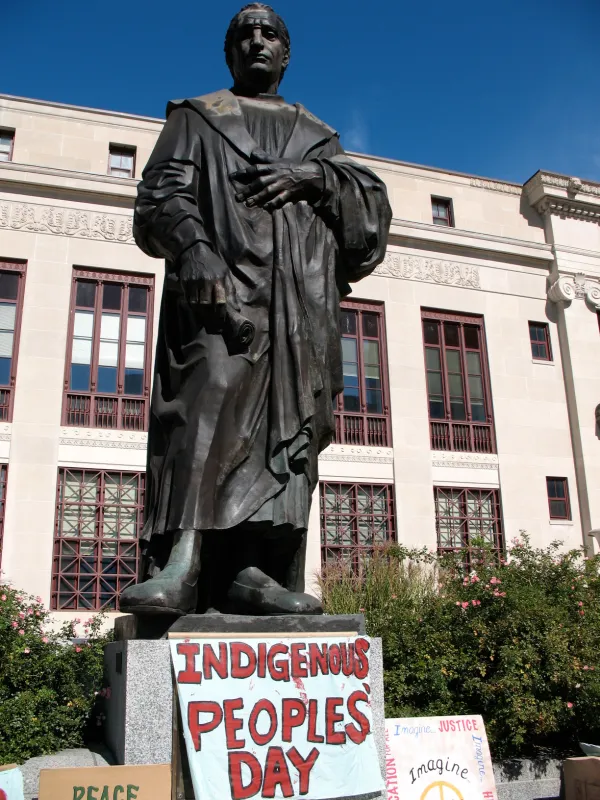
Monday was Columbus Day all across the nation. Perhaps this is a good time to reflect on the real legacy of that conquistador. As James Baldwin once put it, “What passes for identity in America is a series of myths about one’s heroic ancestors.”
One of the best ways to reconsider Columbus is to read the diaries of Columbus and Bartoleme de Las Casas. Las Casas’ extensive writings, including his most famous – “A Short Account of the Destruction of the Indies” – gives us insight into the namesake of our city.
Here’s the good Friar Las Casas' summary of Christopher Columbus’ activities in America: “What we committed in the Indies stands out among the most unpardonable offenses ever committed against God and mankind and this trade [in Indian slaves] as one of the most unjust, evil, and cruel among them.”
I know what you’re thinking. Just because Columbus was the creator of the slave trade in America, doesn’t mean he wasn’t a pretty good darn navigator.
Image

We are bringing you the top ten censored stories in this week’s Free Press, listed democratically in order of importance, according to the Project’s judges. These stories announced on October 1st are from the 2012-2013 news cycle. The Censored 2014 edition is co-edited by Mickey Huff and Andy Lee Roth and the project is based at Sonoma State University. This year’s volume of censored stories is entitled “Fearless Speech in Fateful Times.” The Free Press agrees.
Image
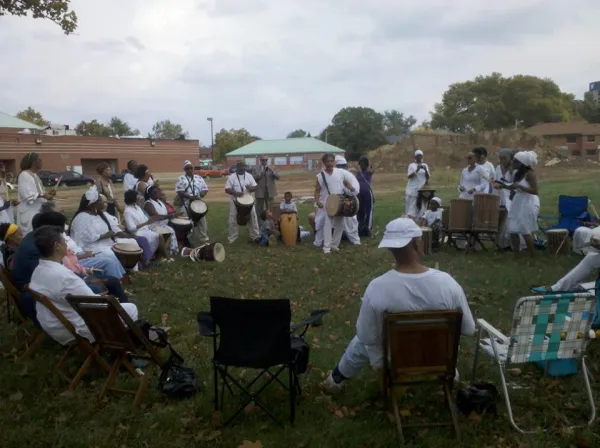
Despite the recommendation of an Expert Group to save 10 buildings of historic Poindexter Village, Columbus Metropolitan Housing Authority (CMHA) has been determined to leave no physical evidence of the housing authority that nurtured so many great African-American contributors to the development of Columbus. Voting unilaterally to tear down all 35 buildings, CMHA has reneged on what community activists believe was a promise to save at least a small portion of buildings that preservationists say are eligible for a place in the National Register of Historic Places.
“We see this as a lack of integrity and lack of good faith in CHMA’s own process. It disrespects the former residents, historic preservationists and the black community as a whole,” noted Reita Smith. Smith is a member of the Poindexter Village History Advisory Group (PVHAG) and the Coalition for the Responsible and Sustainable Development on the Near East Side. She is also a member of Ohio’s First Families having documented her family history back to the 1700’s.