
Local
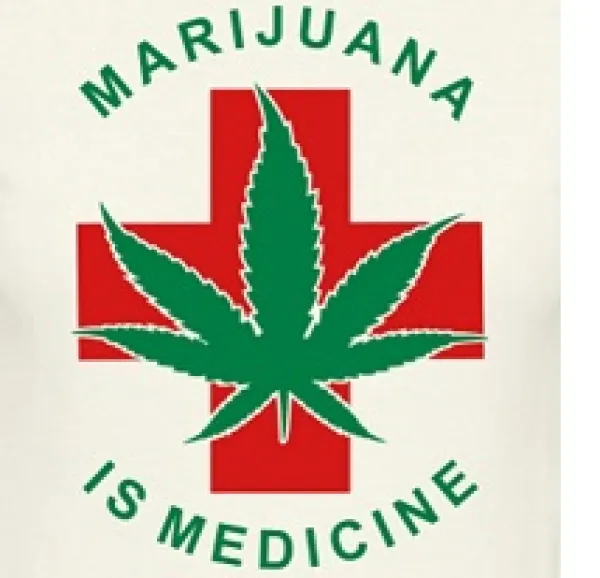
Even though The Ohio State University has researched cannabis to discover new therapeutic benefits, the university is refusing to test cannabis for The Ohio Medical Marijuana Control Program.
State law says medical marijuana, like other agricultural products, has to be tested for quality and levels of pesticide, for example, before being sold to the public. And when Ohio legalized medical marijuana in 2016, state lawmakers mandated they would only allow public universities during the program’s first year to test the medicine.
OSU is not alone when it comes to researching cannabis but at the same time refusing to set up a testing lab. The University of Cincinnati and Ohio University are researching cannabis for medicinal uses, to help epileptic children, for example, but have also turned a cold shoulder to the state program.
What’s more, could this double standard by state universities delay the program?
Bob Bridges, the patient advocate on the state’s medical marijuana advisory board, recently told the Columbus Dispatch he doesn’t have confidence the program will be up-and-running for its designated “fully functional” date of September 8th.
Sun, June 5, 12pm
61 Jefferson Ave.
This is our June Crafternoon event!
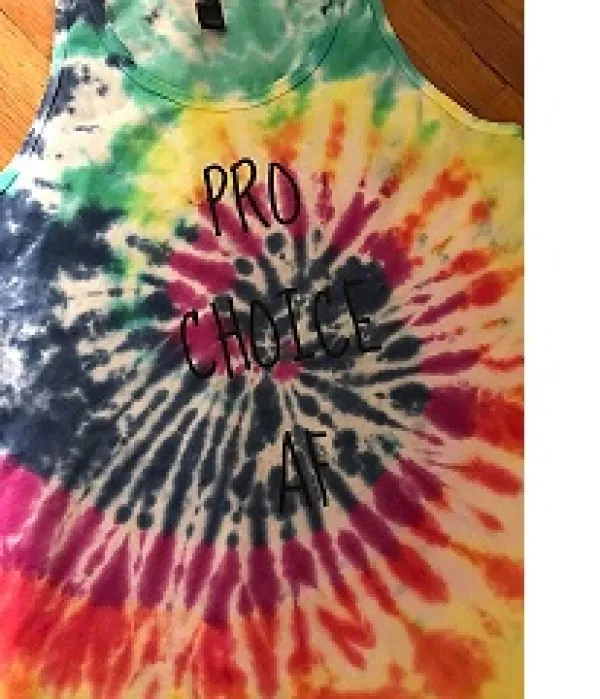
Help us get ready for PRIDE season!! We've got white tank tops AND t-shirts that say PRO CHOICE AF for you to tie-dye! The cost is $15 and it includes either a t-shirt or a tank top and whatever colors (and materials) your heart desires for your tie-dye!
It'll also be a potluck! Bring something summery and we'll try to cook out!
Make sure to wear clothes you're okay with getting dye on - accidents happen after all. :)
We *should* have enough dye for some individual projects if you want to bring your own stuff, but we hope you like us enough to wear a NARAL Pro-Choice Ohio shirt that you've dyed yourself!
These will also double as our summer tabling shirt, so we hope you love us enough to volunteer with us this summer, too!!
Saturday, June 2, 10pm-2am, The Summit, 2210 Summit St.
It’s summertime, we chillin’ in the sun (finally), and Community Pride is about to JUMP OFF with four QTIPOC DJs from Columbus and Cleveland: Adab, Fana, A.S.L. Princess, and Noided.
Bring your best LOOKS and get it JUMPIN’ to club, techno, disco beats, and more. Instead of buying into sponsored parties or crowded, expensive bars, let’s start Pride right: alongside our own community!
Unfortunately, you must be 18 or older to attend this event. Check our calendar at the end of the description for all-ages events!
Visual ASL Interpreters will be provided for all Community Pride events. Please contact the interpreter coordinators at cbuscommunityprideinterpreters@gmail.com to request close vision or tactile interpreters for all Community Pride events.
Near the end of his life, Dr. Martin Luther King came to some radical conclusions about the fundamental root of oppression. “Why are there forty million poor people in America?” he said in 1967. “When you begin to ask that question, you are raising questions about the economic system, about a broader distribution of wealth. When you ask that question, you begin to question the capitalistic economy.
“We have moved from the era of civil rights to the era of human rights, an era where we are called upon to raise certain basic questions about the whole society,” he said in a report to the Southern Christian Leadership Conference. “We have been in a reform movement…. But after Selma and the voting rights bill, we moved into a new era, which must be the era of revolution. We must recognize that we can’t solve our problem now until there is a radical redistribution of economic and political power.”
US Attorney’s Office
303 Marconi Blvd
Columbus, OH 43215
In response to the growing number of children and youth separated from their immigrant families at the border or their homes, and the thousands of children who have been harmed or abused by Trump's immigration agencies, we are holding a non-violent National Day of Action for Children on Friday, June 1st. More info at familiesbelongtogether.org
I sat down last week ready to say how the week before had bruised my ego. Some (very, very few) progressives won Democratic primaries and the Korean negotiations collapsed overnight. I hadn’t expected any progressives to even come close to victory and I thought any dysfunction surrounding the then-upcoming Korea summit would be minor and only occur in dribs and drabs. Then more children were murdered as they studied peacefully in their school. I was disgusted at the lack of response from all politicians and found myself unable to write about another mass shooting and how gun violence is easily unavoidable so soon. So I decided to give myself another week to start to get over my horror and see if anything would be done to stop innocent people being gunned down on a daily basis.
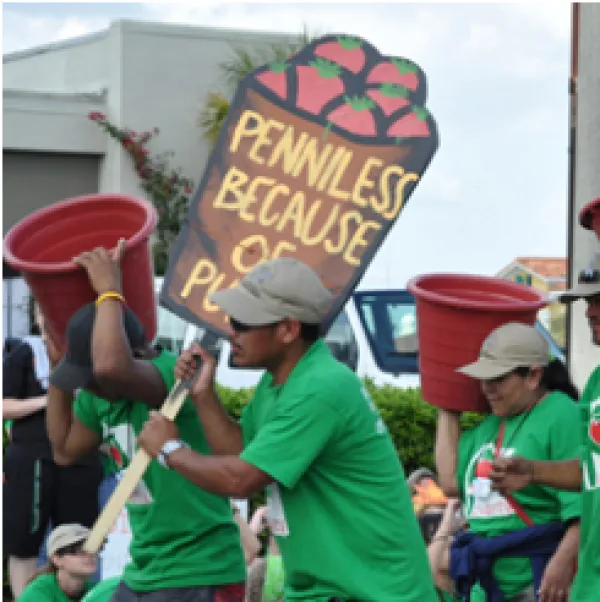
Five years ago, five activists and I set up a protest action at the Wendy’s restaurant located on South High Street in Columbus, Ohio. We lined up on the sidewalk in front of the restaurant with a 30-foot-long banner that stated, “Wendy’s Stop the Exploitation, Join the Fair Food Program.”
Customers did not turn away or stop driving into the parking lot, but when they sat at the outdoor dining area, they would shout out, “What’s wrong with Wendy’s?”
That’s the problem: not many people know what’s wrong with Wendy’s. It is necessary to reiterate the reason that larger and larger groups of farm workers and consumers demand that Wendy’s join the Fair Food Program.
Collaborating as the Coalition of Immokalee Workers (CIW) the farm workers’ demands are simple: to be compensated just one penny more per pound for tomatoes picked, and for the companies to purchase from participating farms that adhere to the Fair Food Standards (FFS).
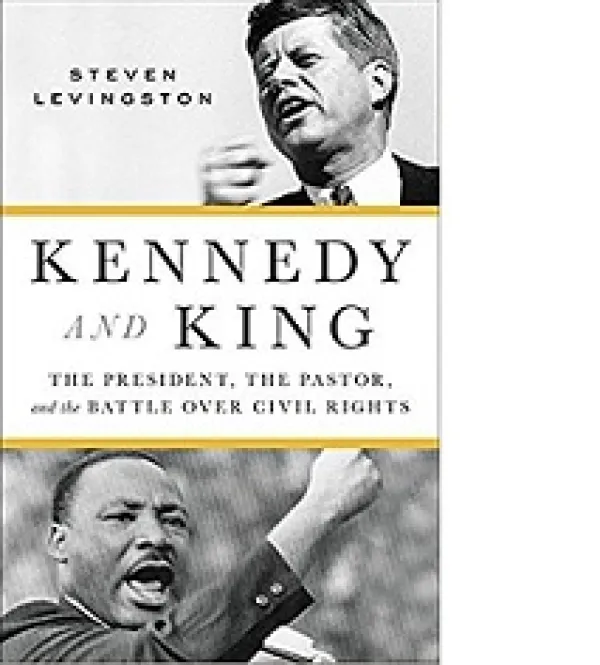
This year marks the fiftieth anniversary of the assassinations of the Rev. Dr. Martin Luther, King, Jr. and Senator Robert F. Kennedy. Already a surfeit of books about the two men are in the stores. Indeed, books about the sixties in general and 1968 in particular are now in high demand.
Kennedy and King looks at the herculean battle over civil rights through two of its larger-than-life protagonists: President John F. Kennedy, and the Rev. Dr. Martin Luther King, Jr. The junior senator from Massachusetts was working double time to be chosen as the Democratic nominee in the 1960 presidential election. Wealthy, handsome and charismatic, Kennedy was only one of many Democrats interested in running that year. His record in Congress was thin, and he was seen as a dilettante and playboy. Liberals such as former first lady Eleanor Roosevelt found him wanting; his pragmatism generally won out over idealism. And while not a dyed-in-the-wool racist, Kennedy was like millions of northern, urban whites who seemed to be uninterested in and untouched by northern de facto racism.
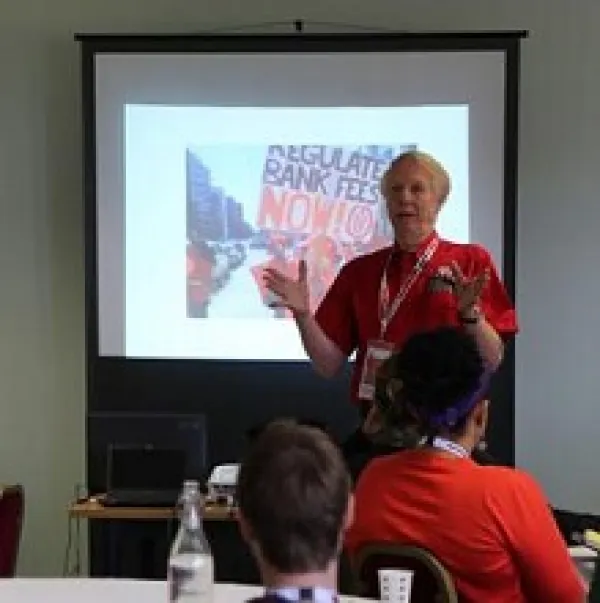
In building an organization for social change it is clear to everyone that the group should be nonprofit, but what does that really mean? Talking to other people there seems to be an automatic assumption that nonprofit means the same as tax exempt. Asking for advice from colleagues and lawyers, there is often a kneejerk presumption that if the organization is going to be nonprofit then by definition it should become a tax exempt under the rules of the Internal Revenue Service.
What is the real deal? Is this an automatic and default option or is this something that an emerging group of leaders and organizers really needs to spend time thinking about when they begin building this new organization?
Structure matters! Every minute spent on the front end of these decisions may determine the long-term future of the organization, so the time to debate these questions and make the hard decisions is at the very beginning before it prejudices the ends.
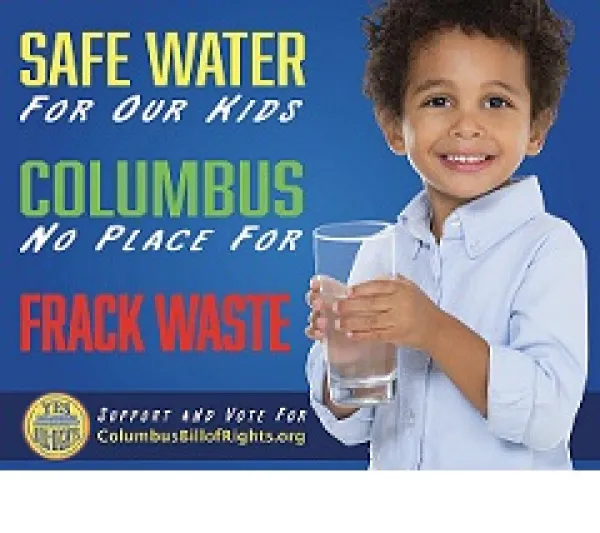
There’s something Nasty in the Columbus Watershed. In the Upper Scioto Watershed, farm crops are growing, cattle and sheep are grazing and in the middle of 13 of these farm fields, one can see an old oil well from days gone by - rickety, rusted, out of commission relics - one might think.
But these abandoned vertical oil wells have become something of a hot destination for the Fracking Industry. When a well is fractured to release natural gas, millions of gallons of fresh water is mixed with toxic chemicals, and through the fracture process radioactive elements combine with the toxic water that flows back up. This Frack water waste is so deadly that the industry is desperate to find ways to dispose of it.