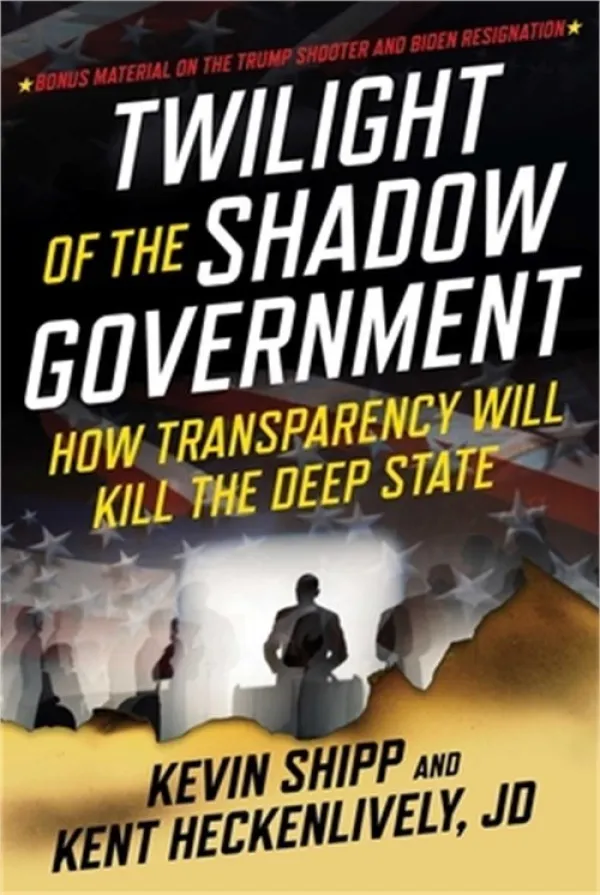
Twilight of the Shadow Government, by Kevin Shipp and Kent Heckenlively, is a notable and provocative contribution to the limited body of literature critical of the Central Intelligence Agency. Its significance rests largely on Shipp’s background: he is a former CIA officer who served for approximately seventeen years in senior roles, making him a rare example of a high-level insider willing to publicly criticize the agency.
Shipp’s career reportedly ended after he attempted to alert superiors to a vulnerability that he believed endangered CIA assets. According to his account, his concerns were unwelcome, and the agency retaliated in ways that placed both him and his family at risk, ultimately resulting in his forced departure from the CIA. While readers must evaluate such claims carefully, his narrative is detailed and internally consistent, lending it a degree of credibility.
Historically, few books have openly criticized the CIA from an insider perspective. Notable predecessors include The CIA and the Cult of Intelligence by Victor Marchetti and John D. Marks, The Search for the “Manchurian Candidate” by John Marks, and Legacy of Ashes by Tim Weiner, which Shipp explicitly cites. More recently, John Kiriakou’s The Reluctant Spy offered a firsthand account of CIA practices, written after Kiriakou served prison time for exposing the agency’s use of torture. Shipp’s work situates itself within this small but consequential tradition.
As with all former intelligence officers, Shipp was required to submit his manuscript for CIA prepublication review. This process resulted in extensive delays and redactions. The impact is evident throughout the book: Shipp frequently resorts to implication rather than explicit description, carefully phrasing suspicions and avoiding details he is legally prohibited from disclosing.
A recurring theme in the book is Shipp’s religious conviction, which he presents as a source of moral guidance and hope in his effort to expose what he terms the “shadow government.” On this point, I respectfully disagree. I also diverge sharply from his apparent political sympathies, including his support for Donald Trump and his criticisms of diversity, equity, and inclusion initiatives. These views are not peripheral; they are woven directly into the narrative.
The introduction, titled “The Empire of Lies,” is particularly challenging for readers who do not share Shipp’s conservative worldview. His political orientation is unmistakable. In this chapter, he asserts that the media deliberately downplayed U.S. involvement with gain-of-function research at the Wuhan Institute of Virology and dismisses claims that Syrian President Bashar al-Assad used chemical weapons against his own population. These assertions, presented as self-evident truths, are likely to alienate some readers and detract from the broader institutional critique.
The book proceeds to examine Project Mockingbird, the CIA’s Cold War–era program to influence domestic and international media. Shipp argues that media manipulation did not end with the program’s formal exposure but continues in more sophisticated forms today. He controversially implicates journalist Bob Woodward as a willing participant in shaping public perception during and after Watergate. Media control and narrative management remain central themes throughout the book.
Shipp traces what he views as the CIA’s pattern of illegal and unethical conduct back to the agency’s earliest years, invoking President Eisenhower’s warning about the military-industrial complex. He devotes considerable attention to former CIA Director Allen Dulles, drawing on David Talbot’s The Devil’s Chessboard and L. Fletcher Prouty’s The Secret Team. The CIA’s MKUltra mind-control program and its alleged history of financing covert operations through narcotics trafficking are also discussed.
A particularly significant moment in the book is Shipp’s reference to President Harry Truman’s December 1963 op-ed—published one month after President Kennedy’s assassination—in which Truman warned that the CIA had strayed far beyond the limited intelligence-gathering role he originally envisioned when he signed the agency into existence.
Shipp goes further than most former intelligence officials by openly suggesting CIA involvement not only in the assassination of President John F. Kennedy but also in the events of September 11, 2001. He outlines what he considers circumstantial and institutional evidence for agency complicity, arguing that Kennedy’s pursuit of détente and peace posed a threat to entrenched power structures.
Chapter Five focuses on Ted Shackley, a long-serving CIA officer whom Shipp holds personally responsible for actions taken against him and his family. Shackley’s career is presented as emblematic of the agency’s methods. Shipp highlights Shackley’s own writings, in which he describes techniques for manipulating public opinion and controlling elected officials, stating bluntly that when persuasion and coercion fail, physical violence—including assassination—becomes the final option.
While Shipp suggests Shackley may have played a role in the Kennedy assassination, his involvement—if any—would more plausibly lie in the subsequent cover-up rather than the operation itself. Researchers of the assassination more commonly focus on figures such as Allen Dulles, William Harvey, David Atlee Phillips, and James Angleton. Nonetheless, Shackley’s description of institutional methods is relevant to understanding how such events might be obscured rather than exposed.
It is noteworthy that Shipp feels able to make such claims publicly. As recently as five years ago, such statements from a former CIA officer would have been virtually unthinkable.
Regarding September 11, Shipp concentrates on three issues. First, he highlights suspicious airline stock “put options” placed shortly before the attacks, naming former CIA Executive Director A. B. “Buzzy” Krongard. Second, he points to the collapse of World Trade Center Building 7, which fell later that afternoon despite not being struck by an aircraft, exhibiting characteristics consistent with controlled demolition. Third, he underscores Saudi Arabia’s role, noting that the official report’s chapter addressing Saudi involvement remains heavily redacted.
These issues represent only a fraction of the unresolved questions surrounding 9/11, and while Shipp briefly references others, the focus remains narrow.
The book also addresses CIA involvement in Iran-Contra, Watergate, the COVID-19 pandemic, and the false intelligence claims regarding weapons of mass destruction that justified the Iraq War. Inevitably, many documented and alleged abuses are omitted, given the scope of the work.
In his concluding chapter, Shipp acknowledges that the CIA is only one of seventeen U.S. intelligence agencies, but emphasizes its outsized budget and influence relative to the others. He ends on an optimistic note, suggesting that increasing public scrutiny will force the agency out of the shadows and restore democratic accountability.
I find this conclusion deeply unconvincing. Shipp largely ignores the expanding technological and corporate infrastructure of surveillance and control, including data-mining firms such as Palantir, widespread facial recognition, media consolidation, and the growing coordination between intelligence agencies, corporations, and political elites. When these realities are considered, the trajectory appears far more troubling than Shipp admits.
Reading between the lines of this otherwise informative book, my own conclusion is stark: the forces described here suggest not a system on the verge of reform, but one that has become increasingly entrenched, opaque, and resistant to meaningful democratic control.