
Amulets Infused With Spirits & Zombies
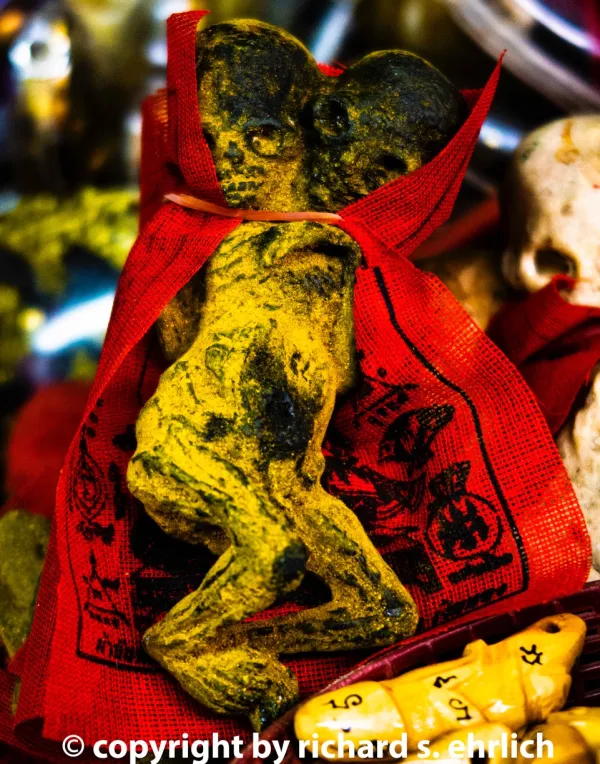
A two-headed baby "zombie" is the most terrifying amulet you can buy but if you feed it every day, the undead spirit could protect you against misfortune. Photo copyright by Richard S. Ehrlich
BANGKOK, Thailand -- When you come to Bangkok, a visit to the capital's sprawling, inexpensive, amulet market will take you on a trip into another dimension.
Here in the market's crowded riverside amulet market, a two-headed baby "zombie" is the most terrifying thing you can buy, but if you promise to feed it every day, the undead spirit could become your loyal slave and protect you against misfortune.
"In Thailand, the lowest level of believers buy these zombies and other amulets like this," said a saffron-robed Buddhist monk, warily examining the grotesque doll-like totem.
"The next highest level of believers buy amulets which have the faces of Buddhist monks.
"The highest level of believers are people like me, who believe only in Buddha," the monk said.
Most Thais are Buddhists, but they also mix a bewildering slew of other beliefs -- including Hindu, animist, and superstitious -- into their spiritual outlook.
Buddha was not into amulets, and advised followers to ignore such illusions.
But modern-day Thais surround themselves with as much protection as possible by wearing, carrying, or keeping at home one or more small amulets.
According to believers, amulets can bring good luck, true love, wild sex, cold cash, or exquisite relief from obscure personal problems.
The pieces come in all styles and shapes, made of metal, wood, bone, or plaster, and can include sacred ash from incense, colored dust from a temple's bricks, human hair, or other material.
Some portray Buddha, or other notables including famous senior monks and kings, in bas-relief.
Amulets can also depict a mythical creature or cryptic script, often in Khmer language or indecipherable.
Tube-shaped "takud" amulets look like innocuous cylinders of metal or wood, but may contain secret ingredients or have been "blessed" in an intense ritual.
Most amulets claim to incorporate some aspects of Buddhism, though bizarre images and tales abound.
Thailand is one of the world's biggest producers, sellers, and exporters of amulets, which are available in public markets in virtually every Thai city.
Some men, including tough guys in danger of being killed, wear a necklace of several big, heavy amulets in a pretentious form of Buddhist bling.
Antique or rare amulets can fetch more than $100,000.
Most Thais, however, usually get their amulets at a Buddhist temple after making a small donation, or by rummaging among humble stalls where prices begin at less than $1.
A two-headed baby zombie sells for about $10 in Bangkok's main amulet market next to Phra Chan Road and Thammasat University, along the Chao Phraya River.
It is made of "pressed powder," hardened to form the shape of Thailand's legendary Khu Mon Tong zombie.
A more common one-headed Khu Mon Tong is also on sale.
Crouched in almost a fetal position, the baby zombies come wrapped in a red cotton "incantation cloth" which is adorned with auspicious, wood-block printed designs.
Different versions of Khu Mon Tong include tiny-sized zombie amulets which can be worn as a pendant on a necklace.
For example, a tiny inexpensive Khu Mon Tong zombie is available in the form of a symbolic, unadorned splinter of wood, inside a tiny vial filled with a clear nourishing oil made from flowers.
Stories explaining most amulets are often half-remembered, and can change depending upon who is describing the charm and its powers.
According to some legends, Khu Mon Tong is a baby who died, perhaps still-born.
His loving father fed Khu Mon Tong's corpse, and successfully reanimated its spirit, which gratefully protected the parent.
If you buy a Khu Mon Tong zombie, you must diligently feed it a morsel of food every day, offer it toys, and call it "my son" -- in exchange for its purported ability to protect you against your enemies.
Some amulets can be sinister things.
Fanatics, seething with revelations and greed, created gruesome Khu Mon Tong zomie amulets by using the crushed skull of a baby, or with the dripping oil from a roasted infant.
A much more popular and peaceful amulet shows a faceless Buddha sitting cross-legged, atop a layered plinth.
The rectangular amulet, often called a "Phra Somdet," is easy to produce from a plaster-like substance, and is frequently given to devotees for free at Buddhist temples.
On the reverse side, it may include the name of the temple, or the monk who manufactured it, or other information.
One version has a small fish bone embedded in the back, which some people believe bestows special power.
Another amulet is illustrated with a large ship, and is sometimes called a "Krom Ma Luang Chumporn."
It is said to protect people during ocean voyages.
Another amulet portrays a chubby, cross-legged, devout monk covering his face with both hands, supposedly to hide either his handsome face from groupies in the street or a perceived and distracting resemblance to Lord Buddha.
Legends say people mistakenly worshipped him, thinking he was actually Buddha, until he hid his face so no one could see him.
The amulet is called "Phra Phid Ta," which translates as "Monk With Closed Eyes."
Possess this amulet, and you will remain virtually invisible to your opponents, according to believers.
Thailand's amulet bazaars include shops selling plastic and glass containers of all sizes -- each with a metal, silver, or gold frame -- to enshrine an amulet small enough to be worn on a necklace, or reverently placed on a shelf in homes, shops, offices, schools, government buildings and elsewhere.
Professional collectors will whip out a tiny magnifying glass and scrutinize an amulet's details to determine if it is genuine, or one of the many forgeries offered to unsuspecting buyers.
Several magazines, published in Thailand, are devoted solely to amulets, with full-page photographs of the best ones, accompanied by hard-sell advertisements.
Websites also tout amulets, alongside supposedly signed guarantees describing where, when, why, how, and by whom the talisman was manufactured.
To create a best-seller, monks may gather at a Thai temple along with caldrons, fire, ladles and other equipment, and pour molten brass, silver, or gold into a preformed cast, which cools to become an amulet.
Monks pray intensely over each fresh batch, and perform other acts to "infuse" the amulets with spiritual functions.
Huge fortunes are made from selling amulets, prompting allegations of corrupt monks and temples raking in massive profits, which are publicly unaccounted and tax-free.
Worries are also frequently voiced about blatant commercialization of Thai-style Buddhism tarnishing Buddha's 2,500-year-old lofty ideals.
Others express regret and despair over Buddhists who have degenerated into believing mindless superstitions.
Believers meanwhile will often swear how their favorite amulet saved their life during a car crash or violent attack.
To boost morale, Thailand's military hands out amulets to its Buddhist soldiers -- including Buddhist troops fighting in the south against Muslim separatists.
Rules to obey while wearing an amulet include removing it during sexual intercourse, keeping it away from people's feet, and off the floor.
High prices for rare and antique amulets have resulted in thieves targeting temples, shops, and homes to steal expensive amulets, creating a irony in which "protective amulets" need protection.
People who complain that their amulet failed to function are usually told that it works only if the person who possesses it is a pious Buddhist, creating a marvelous loophole to avoid refunds.
In 2007, many Thai Buddhists became obsessed with a large, medallion-sized amulet, despite warnings from monks and the media that the popular circular icon was nothing more than a delusionary cosmic crutch, corrupting Buddhism and Thai society.
The frenzy for the Jatukam Ramathep amulets just got worse.
When a fresh batch of Jatukam Ramathep amulets first went on sale in April 2007, buyers stampeded, trampling a woman to death.
Robberies increased with thefts of the lucrative charm from shops, homes, and temples.
Jatukam amulet sales reached up to $500 million during a two-year-long heyday, economists said, though estimates varied because many transactions were in cash, without receipts.
"Jatukam is the most popular deity in Thailand today," The Nation newspaper reported in 2007, but experts disagreed over who the amulet represented.
Some experts insist Jatukam Ramathep are the names of two princely brothers who lived in this region hundreds of years ago.
Others believe Jatukam Ramathep is one person, perhaps King Chandrabhanu, who ruled much of Southeast Asia during the ancient Srivijaya kingdom.
Others said the person on the amulet is a potential Buddha, or perhaps a Hindu deity.
In the center of the cookie-sized amulet, a man in traditional regalia sits in a meditative pose, left hand on his knee, and right hand held shoulder-high, palm outward.
Variations can include one or two dragons behind him, or a multi-headed serpent, or a surrounding ring of Hindu deities.
Jatukam Ramathep medallions come in red, white, black, silver or gold.
The amulet's reverse side may show a man standing, or instead display a sun or moon emitting rays, or 12 cosmological signs.
Excitement over the amulets coincided with a public debate about how Buddhists should behave, and how much financial and political power the elderly, conservative, male, saffron-robed clergy should wield.
"Many high-ranking [Buddhist] monks in Bangkok are astrologers, masters of the occult arts, or entrepreneurs in the amulet industry, making Thailand one of the world's largest amulet producers," wrote Mettanando Bhikku, a Thai Buddhist monk who often criticized contradictions within the religion.
The officially sanctioned amulet market is controlled by the Buddhists' Ecclesiastical Council in Thailand which allows temples to gain millions of dollars, tax-free, from amulet sales, Mettanando said.
"Essentially, this is a worship of spirits," lamented The Bangkok Post's assistant editor Sanitsuda Ekachai.
"The Jatukam Ramathep phenomenon does not only reflect public insecurity from political uncertainties and terrorism threats, it also shows that we are basically animists.
"If we really need a national religion, animism should be the one. At least it can help us stop fooling ourselves that we are still Buddhists, and see who we really are," she wrote.
Thailand's Supreme Patriarch, who heads this country's Buddhist clergy, announced in 2007 he will stop providing materials from his temple to make Jatukam amulets, but declined to specify why.
His temple earlier provided sacred ash from burnt incense, colored powder from bricks used in temple construction, and other Buddhist-related material to make thousands of Jatukam amulets.
The Supreme Patriarch's announcement came after thieves reportedly broke into a nearby Buddhist temple and stole 30 Jatukam amulets, valued at about $430.
Earlier, robbers in Thailand's south slithered through an amulet stall's ceiling and snatched Jatukam amulets totalling $5,700 before escaping.
Most Jatukam amulets were made with the blessing of Wat Phra Mahathat Woramahawiharn, the Supreme Patriarch's temple in southern Thailand's Nakhon Si Thammarat city.
When the amulets' price soared, dealers throughout Thailand rushed to set up stalls next to the temple, hoping to get the newest versions.
Crowds crushed a woman to death, and injured about 100 others, in April 2007 when thousands of people ran toward a school in Nakhon Si Thammarat to buy the amulets.
One month earlier in the same town, an amulet-collecting woman used her husband's 9-mm pistol to kill a man who was allegedly breaking into her home along with three other criminals to steal her amulets.
They fled into the night.
A few days earlier, another amulet collector shot dead a suspected thief in the same southern town, police said.
More than 90 percent of this nation's 65 million population believe in Buddhism, a religion which emphasizes freedom from superstition, gods, and other illusions.
Many Thai Buddhists, however, collect and wear various amulets which also depict famous monks, kings and other people, living or dead.
The first Jatukam amulet was reportedly made in Nakhon Si Thammarat in 1987, to raise funds for the city's shrine.
Originally selling for about one or two dollars, those early medallions soared to list for $2,000 to $28,000.
More than 100 versions of the Jatukam amulet eventually appeared in shops throughout Thailand, and competition among sellers was fierce.
Some versions included tempting names, such as the expensive "Arch-Millionaire" and "Money Pouring In" series.
*****
Richard S. Ehrlich is a Bangkok-based American foreign correspondent reporting news from Asia since 1978, and winner of Columbia University's Foreign Correspondents' Award. Excerpts from his two nonfiction books, "Rituals. Killers. Wars. & Sex. -- Tibet, India, Nepal, Laos, Vietnam, Afghanistan, Sri Lanka & New York" and Ehrlich's newest, "Mindfucking DeepSeek: Pushing China's AI to the Extreme" are available at
https://asia-correspondent.tumblr.com