
Commemorating the 60th anniversary of the Black Panther Party for Self-Defense
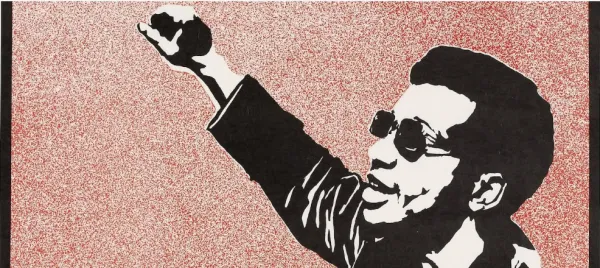
Fred Hampton, leder af Black Panther Party i Chicago. Under portrættet står teksten 'I am a Revolutionary'. Af Ukendt/The New York Historical. CC BY NC ND 4.0
Exactly sixty years ago, 24-year-old Huey P. Newton and 29-year-old Bobby Seale, two college students, formed the Black Panther Party for Self-Defense in Oakland, California in response to citizens’ complaints of mistreatment by the police. The police department had a history of cracking heads for sport and harassing people for no legitimate reason. Not surprisingly, Black and brown people were disproportionately targeted for this special kind of treatment.
Determined to alter the way police interacted with the city’s residents, the Panthers began patrolling the police. Armed with rifles and other artillery, cameras, tape recorders, a copy of the U.S. constitution as well as the California state constitution, and walkie talkies the Panthers cruised the streets, sometimes four in a vehicle, with the express purpose of:
a) safeguarding motorists and pedestrians against the violent whims of the city’s police
b) ensuring that police officers complied with the law resulting from the landmark June1966 Supreme Court decision in Miranda v. Arizona and
c) showing residents that the police were not omnipotent; that the people had the power to hold the police accountable.
Although much of what the Black Panther Party is known for revolves around the police patrols, shootouts with law enforcement, the incarceration of Huey P. Newton for three years and the murder of Defense Captain Mark Clark of Peoria and Fred Hampton Sr. deputy chairman of the Illinois State Chapter of the Black Panther Party, what gets lost in the telling of the Party’s story is its commitment to meeting the daily needs of those whose quality of life left much to be desired.
The Party was most effective when its leadership decided to institute an array of Community Survival Programs. While the Panthers’ free breakfast program was its most well-known initiative other programs include free health clinics, free shoes and clothing giveaways, political education classes for the community, free grocery giveaways, door-to-door sickle cell anemia and tuberculosis testing, liberation schools for kids during the summer months as well as programs that assisted the community’s elderly residents in various ways. An example of the latter is S.A.F.E. which stands for Seniors Against a Fearful Environment. Panthers would escort the elderly to supermarkets, drug stores, banks, and anywhere else they needed to go and make sure they were not the victims of muggings or other acts of violence.
Contrary to popular belief, it was not the Panthers’ arsenal that concerned local law enforcement and J. Edgar Hoover’s Federal Bureau of Investigation but the increasing numbers of supporters the Black Panther Party was attracting not only among Blacks but whites and other people of color as well as the gay and lesbian community. The Panthers made it their business to form coalitions, both within and outside the United States. Its members were well-traveled with the intention of fomenting a revolution that would not be confined to the United States but worldwide.
For example, on November 18, 1969, Fred Hampton traveled to Canada, Saskatchewan and Alberta, to be exact, not just to deliver a lecture to students and others at the University of Saskatchewan’s Regina campus but to drum up support for the revolution. A revolution is what the Panthers sought, meaning a total overhaul of America’s capitalistic system that they believed formed the basis of racial and class oppression.
For those who believed that the Panthers were guilty of treason and sedition or in violation of the Smith Act were not familiar with Thomas Jefferson’s writings. The founding father maintained that when the government begins to act in a way that is antithetical to the peoples’ interests the people have a right to overthrow it and begin anew. The Panthers took Jefferson’s words literally.
The Panthers demonstrated a level of commitment to protecting and enhancing peoples’ lives that few have matched. I can think of no period in my lifetime that warrants a comparable commitment than now. That raises the question: what important lessons have we gleaned from the Black Panther Party in the 60 years since its founding that will bring us closer to freedom, justice and equality?
Judson L. Jeffries PhD, MPH, is Professor of African American and African Studies at The Ohio State University.