
Double Executions for Bangkok's Chinese Bombers
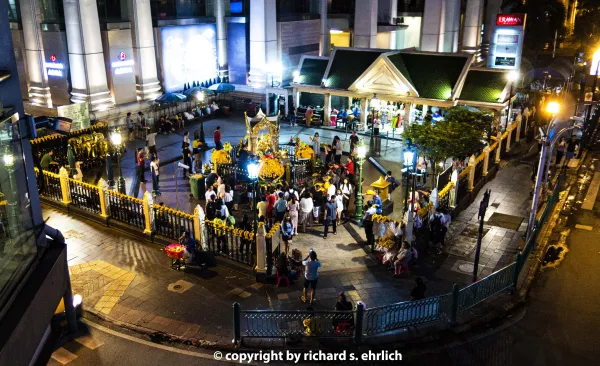
The elegant, glistening Erawan shrine, is dedicated to a gilded four-faced statue of the Hindu god Brahma. Photo © copyright by Richard S. Ehrlich
BANGKOK, Thailand -- After an 11-year delay, a Bangkok court sentenced two Muslim ethnic Uyghur Chinese men to death for bombing a Hindu shrine in the heart of the capital, killing 20 people and spotlighting Thailand's complex links to China's treatment of its Uyghur minority.
The Bangkok South Criminal Court on June 11 sentenced Yusufu Mieraili and Bilal Mohammed to be executed for bombing the crowded, outdoor, streetcorner Erawan Shrine popular with Thailand's Buddhist majority and international visitors.
The court "imposed the harshest penalty available under the law, the death sentence," said one of court's four judges on June 11, announcing the verdict.
The conviction included murder and illegal possession of explosives.
Their lawyer said both men would appeal and cited allegedly harsh "treatment of the defendants during the proceedings."
China welcomed executing the two men.
"The perpetrators were utterly devoid of humanity and absolutely heinous," China's Foreign Ministry Spokesman Lin Jian told a news conference in Beijing on on June 11.
"China supports Thailand in conducting the trials in accordance with the law and bringing the culprits to justice," Mr. Lin said according to the ministry's transcript.
The two bearded men languished in prison for 11 years because Thai officials said it was difficult to find translators and for other bureaucratic reasons.
Murky circumstances surrounding the explosion prompted allegations that the bombers were protesting Bangkok's crackdown on human smuggling routes which had enabled Uyghurs to escape China, cross Thailand, and find sanctuary in Malaysia, Turkey, and other Muslim-majority countries.
The case also sparked international complaints about a lack of human rights for Uyghurs in western China's Xinjiang province.
On August 17, 2015, Thai security officials had the grizzly task of collecting victims' remains scattered across the Erawan Shrine's busy intersection.
The blast site was ringed by five-star hotels and huge shopping malls, and crowded with tourists and evening rush-hour commuters.
The explosion set off billowing flames when nearby motorcycles and taxis ignited underneath the intersection's passenger-packed Skytrain monorail.
The Ratchaprasong intersection is sometimes described as Bangkok's smaller equivalent to New York's Times Square.
"The perpetrators are cruel and heartless because they intended to take lives," then-National Police Chief Somyot Poompanmoung announced shortly after the powerful pipe bomb exploded.
"Everyone knows that at 7 p.m. at the shrine there are a lot of people gathered around there -- both Thais and foreign tourists -- and if they plant a bomb there they know, or can assume, they will cause casualties.
"The blast radius of the bomb is about 100 meters (about 325 feet). The bomb experts say that the bomb weighed about three kilograms (about six pounds)," Mr. Somyot said.
No one claimed responsibility for the attack.
It was bloodiest bombing in Bangkok since U.S. and British aerial attacks in World War II after Thailand declared war on both countries at the start of a 1942-1945 military alliance with Japan.
The elegant, glistening Erawan shrine, dedicated to a gilded four-faced statue of the Hindu god Brahma, was damaged by the explosive device.
Casualties included worshippers and tourists who had squeezed into the shrine's outdoor courtyard to pray or watch ornately costumed Thai women perform graceful traditional dances in exchange for payment.
The Ratchaprasong intersection and surrounding area is one of the most heavily monitored urban crossroads in Thailand, with dozens of CCTV cameras mounted at scores of locations, installed after a bloody insurrection in 2010 in that zone.
Hunting for clues, Thailand's U.S.-trained military, police, and intelligence officials sifted through video of pedestrians and vehicles passing through the area from multiple feeds viewed on screens in a police bunker hidden in a nearby swanky hotel.
Those screens included CCTV cameras deep inside surrounding shopping malls, hotels, offices, residential buildings and elevators, allowing police to follow people walking in and out of nearby buildings.
Shortly after the bombing, police issued an identikit portrait of their main suspect, created from CCTV images.
It portrayed a young man, "a foreigner," before and after the explosion, wearing a yellow T-shirt and later identified as Mr. Mohammed.
Mr. Mohammed, using a forged Turkish passport naming himself as Adem Karadag, allegedly appeared on CCTV depositing a backpack at the Erawan Shrine, walking away minutes before the explosion, and disappearing as a passenger on a motorcycle taxi.
Meanwhile, police said Mr. Mieraili was arrested several days after the blast, trying to cross Thailand's border into Cambodia while carrying his legitimate Chinese passport.
Mr. Mieraili gave the bomb-laden backpack to the man in a yellow T-shirt on the day of the attack, the court said.
Mr. Mieraili, born in China, had been living in Turkey for the past decade, police said.
Mr. Mieraili was convicted of assembling the bomb after components were discovered inside a Bangkok safe house where Mr. Mohammed was arrested several days after the blast.
During the past few decades, hundreds of Uyghurs illegally escaped Xinjiang mostly by sneaking across the China's mountainous southeast border into Vietnam before traveling through next-door Laos and Cambodia into Buddhist-majority Thailand.
Many entered Thailand on real or fake passports, sometimes allegedly bribing Thai border officials.
Before the bombing, Uyghurs were illegally sheltered in Bangkok's Muslim neighborhoods and transported south, either to promised jobs in Muslim-majority Malaysia or to apply for refugee status and flights to Muslim-majority Turkey.
That cross-Thailand route, and its profits for human traffickers, disappeared when about 350 Uyghurs were caught in southern Thailand near the Malaysian border in 2014.
The U.S., European Union, United Nations, Turkey, and human rights groups pleaded with Bangkok to give those countries and organizations authorization to decide their fate amid allegations the Uyghurs would be unjustly imprisoned, tortured, and possibly executed if deported to China.
Squeezed on all sides, Bangkok allowed 180 of them, mostly women and children, to fly to Istanbul but forcibly deported 109 Uyghur men and women to Beijing in July 2015.
Beijing-controlled China Central Television showed Chinese security forces encasing the 109 Uyghurs' heads in black hoods during their flight from Bangkok and frog-marching them, handcuffed, onto the tarmac in China to detention.
China charged more than a dozen of them with "terrorist activities" but did not publicly provide evidence.
One month later, the bombing occurred "because Thai authorities destroyed the illegal businesses of a transnational human trafficking network. They were obstructed, so they were angry," Thailand's then-Police Chief Somyot Pumpanmuang told reporters.
"The other issue was the Thai authorities' decision to send 109 Uighurs back to China," Mr. Somyot said in September 2015.
"If we don't do this, what else are we going to do?" Thailand's coup-installed then-Prime Minister Gen. Prayuth Chan-ocha said to reporters in July 2015 after an international outcry against his decision.
"Do you want to feed them until they breed litters of offspring?"
More recently, Bangkok deported 40 Uyghurs in 2025 to Beijing.
Most Uyghurs live in Xinjiang province alongside China's bleak Taklamakan Desert where Marco Polo wandered in the 13th century when "Silk Road" caravan routes connected China and Europe.
During the 1930s, Beijing and London feared Moscow wanted to seize Xinjiang, which Russia's political supporters were infiltrating.
Since then, Beijing moved millions of atheist ethnic Han Chinese into Xinjiang to form a majority and exploit its lucrative minerals, petroleum, and other resources.
Opposed to China's 2017 anti-Islamist regulations -- forbidding "long beards" on men and veils on women -- some Uyghurs escaped to Turkey or other Muslim countries.
Others left China simply to find work because Xinjiang's job market prefers Han Chinese.
International concern over China's Uyghurs include allegations that some joined Islamist guerrillas in the Middle East for training, hoping to return to Xinjiang to create a pan-Central Asian nation to be called Turkistan, uniting Xinjiang with Turkey.
***
Richard S. Ehrlich is a Bangkok-based American foreign correspondent reporting from Asia since 1978, and winner of Columbia University's Foreign Correspondents' Award. Excerpts from his two new nonfiction books, "Rituals. Killers. Wars. & Sex. -- Tibet, India, Nepal, Laos, Vietnam, Afghanistan, Sri Lanka & New York" and "Apocalyptic Tribes, Smugglers & Freaks" are available at
https://asia-correspondent.tumblr.com