
Eco-Sumud
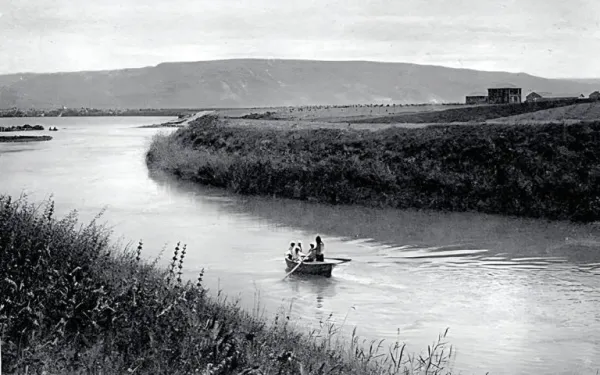
The Jordan River before it was reduced to a small stream. (In 1957, it used to carry 1,350 million cubic meters per year, now it flows at only 20 mcm/year.)
Every country on earth was subject to colonization and/or had a history of colonizing other countries. Post-colonial studies are replete with examples of the kinds of struggles native people engage in. Here, I want to bring in an issue less discussed in this massive literature, one that challenges colonization via activities that sustain humans and nature or what we can dub “eco-sumud” (ecological steadfastness).
Palestine is in the western part of the Fertile Crescent, where humans first developed agriculture and which, therefore, is the cradle not only of the three monotheistic religions but also of human civilization. The Natufian Agricultural Era (15,000 to 11,500 BP) is named after Wadi Natuf (now in the West Bank); and our ancestors, the Canaanites, were the descendants of the Natufians.1 During these early centuries, relatively few conflicts took place here, whereas over the past thousand years, one could point to the arrivals of the Crusaders and of the Zionists as historical events that resulted in mass killings and the displacement of the local people. Now in the twenty-first century, the situation of Palestine remains one of the few dis-stabilized anti-colonial struggles in the world. Incidentally, anti-colonial struggles are stabilized (though never completely “resolved”) by one of three possible scenarios: First, the Algerian model (two million Algerians killed before the colonizers left); second, the model exemplified by Australia and the United States (the genocide of the natives); and third, the model seen in the rest of the world, which shows the coexistence of descendants of colonizers and colonized in one country. Because the latter option is the most common, we should ask why this is. Can we look at it in terms of local resilience?
Palestinians cannot and will not give up their country for an Israeli racist apartheid state. This fact has become more visible to the rest of the world since October 7, 2023. Without justice to the Palestinian people, there will not be peace here – or indeed in Western Asia and North Africa (the Arab and Islamic world) or, by extension, the rest of the world. This is because Palestine was and is a critical area for the three monotheistic religions and arouses the passion of millions of justice-seeking people around the world. Currently 8.5 million (more than half of a total of 15 million) Palestinians are refugees or displaced people, denied their right to return to their homes and lands, a right enshrined in the Universal Declaration of Human Rights and the International Covenant on Civil and Political Rights. Zionism, since its inception, has been intent on transforming the multiethnic, multicultural, and multireligious country of Palestine into the “Jewish State of Israel.”
It is important to note that all Zionist actions in Palestine that impact the Indigenous people and local nature are contrary to international law and countless signed conventions. These include, among others: the United Nations Charter, the Universal Declaration of Human Rights, the Fourth Geneva Convention, and the conventions related to the environment (such as the Convention on Biological Diversity).
Before the Zionist project, in the late nineteenth century, Palestine had some 1,300 villages and towns, each with a small and manageable population. The total population then was 850,000 with various religious persuasions (3 percent Jewish, 13 percent Christian, 80 percent Muslim, 4 percent other faiths).2 It was only in 1948–1950, when Israel was founded by military rule, that a large wave of ethnic cleansing happened, and Zionists took control of much of the land of the local Palestinians. Nearly 500 villages and towns were destroyed and their lands were recultivated, mostly with European pine trees, which damaged the local environment.
 Yasser Hamoudeh’s children water their mini-garden outside their tent in Gaza (growing beans, onions, and fennel).
The system of occupation and colonization creates significant issues for the local people and the local environment. We could write volumes on the impact of colonization on the environment (eco-colonization) but let us just list a few examples: the draining of the Hula wetlands in northern Israel (a key biodiversity area, especially for migratory birds); Israel’s diversion of the headwaters of the Jordan Valley that has significantly impacted the valley system and resulted in the drying of the Dead Sea; the planned Red Sea–Dead Sea canal, a joint project between Israel, Jordan, and the Palestinian Authority; Israel’s practice of putting some of the worst polluting industries in Palestinian areas; the settlements and the walls, built with little environmental impact assessment, that scar the biblical and natural landscape; these Israeli colonies were built on stolen Palestinian lands and concentrated on the high grounds (hills and mountains), causing a runoff of wastewater, pollution from industrial colonists in declared “industrial zones,” and soil erosion on the surrounding hills, which directly impacts Palestinian communities located in the lower areas adjacent to these colonies. Moreover, settlers regularly and increasingly attack and destroy Palestinian property, which includes but is not limited to the burning of trees and the direct dumping of sewage on farmland; there is uneven distribution of water between the natives and the Israeli colonizers. The devastation of Palestinian-owned landscape through conflict is most visible in the recent war on Gaza, where Israel has destroyed most of the tree cover, most greenhouses, and most habitats of rare and endangered species.3 It could take decades to restore some of the habitats, including soils, water, and eco-landscapes.
 A revived farm in Gaza (with solar panels salvaged from rubble, and greenhouses reconstituted).
There are many other issues where the occupation can affect sustainable development and protection of the environment because it is profitable to the occupiers. Alon Tal, founder of the Israel Union for Environmental Defense, acknowledged, “It’s a Zionist paradox. We came here to redeem a land and we end up contaminating it.”4
Besides colonization, other issues affect environmental conservation in Palestine. Rapid natural and unnatural (via migration) growth of population places pressure on our limited space and overtaxed water resources. The industrial consumerist agriculture imported from the West exacerbates these developments (the use of pesticides, monoculture, etc.). Law enforcement related to nature conservation remains marginal, and Palestinian society remains largely disconnected from nature, focusing on mere survival. Finally, we can state that research and development efforts have been very meagre because of the complicated stressful political situation and social conditions in Palestine.
I have written a book titled Popular Resistance in Palestine: A History of Hope and Empowerment, in which I cite hundreds of examples of amazing positive action that counters the destructive forces of wars and repression in Palestine which negatively affect also the environment. Yet, since the publication of that book (2012), we have in many places done amazing work to counteract environmental destruction. A number of reports on the state of the environment have been issued in the past ten years, with coverage including the damage in the Gaza Strip. These include reports from the Land Research Center, UN Environment Programme, Forensic Architecture, the Environment Quality Authority, the Conflict and Environment Observatory, the Legal Center for Arab Minority Rights in Israel–Adalah, Applied Research Center–Jerusalem ARIJ, and many others. Papers have been published on research that used remote sensing (because physical access was not possible) and other tools to assess environmental and agricultural damage caused by the ecocidal and genocidal war over the past three years.
Such studies set the stage for efforts in restoration, mitigation, and adaptation. For example, the Arab Group for the Protection of Nature has a program to revive Gaza’s farmlands,5 while the Rebuilding Alliance hopes to recycle rubble to new housing in Gaza.6 The Palestine Institute for Biodiversity and Sustainability will build a parallel institution in Gaza that focuses on sustainable human and natural communities. The Al-Qarara Baladi Seed Bank in Khan Younis, damaged during the war, was rebuilt by local families that are determined to preserve indigenous Palestinian crop varieties. Thamra still focuses on food sovereignty in Gaza.7 The Gaza Urban and Peri-Urban Agriculture Platform (GUPAP) was established years before the current devastation but is becoming more important during the current crisis. GUPAP connects farmers, women’s cooperatives, universities, NGOs, and community groups that are focused on urban agriculture, agroecology, and local food systems. It helped support rooftop farming, household food production, women-led agribusinesses, and local seed exchange systems. Another initiative is a seven-week course titled “Bioremediation of War Contamination: Community Strategies for Healing Lands and Transforming the Toxic Legacies of Occupation and War” that earlier this year was attended by Palestinians from all walks of life. A report from FAO highlights many other initiatives.8 On the individual level, we know of many individuals in our country, including in Gaza, who are planting, rehabilitating landscape, and strengthening human and nature’s resilience. Individual initiatives, such as the one initiated by Yasser Hamoudeh, who cultivates vegetables around his tent in Gaza and teaches others to do the same,9 reflect the spirit of resilience and resistance (sumud) that explains why Palestine and Palestinians remain on their land and endure – and will win against the most brutal of colonizers intent on erasure of our landscape and our people.
1 Jonathan N. Tubb, Peoples of the Past: Canaanites, British Museum Press, 1998.
2 Justin McCarthy, The Population of Palestine: Population History and Statistics of the Late Ottoman Period and the Mandate, Columbia University Press, 1990.
3 He Yin, et al., “Evaluating War-Induced Damage to Agricultural Land in the Gaza Strip Since October 2023 Using PlanetScope and SkySat Imagery,” Science of Remote Sensing 11, June 2025.
4 Cited in “Environmental Effects of Occupation,” Sabeel and Kumi Now Newsletter, June 2024.
5 Revive Gaza’s Farmland, Arab Group for the Protection of Nature, no date.
7 Cultivating Resilience in Gaza, Thamra (“fruit” in Arabic).
8 Family Farming Knowledge Platform, “Resilience, Reciprocity and Recovery in Gaza: Drawing Lessons from Women-Led Agribusinesses Amidst Conflict and Crisis,” Food and Agriculture Organization of the United Nations, 2024.
9 See also Ahmed Salama, “A Small Oasis of Green in Gaza,” Electronic Intifada, April 1, 2024; and Youssef Hassouna, “Gaza Farmer Grows Vegetables in Tent City to ‘Survive Another Day,’” Al-Monitor, August 7, 2025.
10 PIBS.

Professor Mazin Qumsiyeh is the founder and director of the Palestine Institute for Biodiversity and Sustainability (PIBS) at Bethlehem University.10