
Iran's Attack on Thailand's Ship Sours Relations
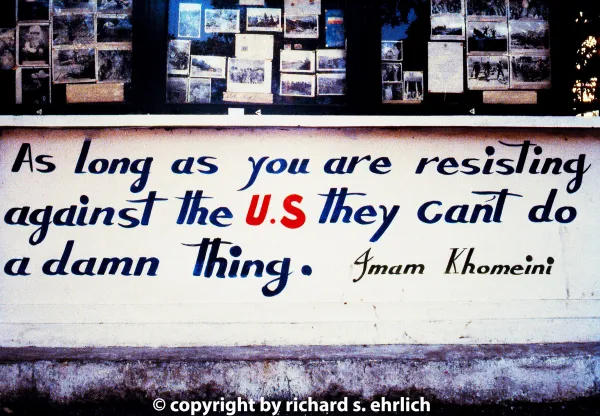
In the 1980s, Iran's embassy in New Delhi publicly quoted Ayatollah Khomeini's defiant boast. credit: Photo copyright by Richard S. Ehrlich
BANGKOK, Thailand -- Immediately after parliament reelected Anutin Charnvirakul as prime minister last week, he focused on rescuing three Thai crewmen trapped on a Thai ship in the Strait of Hormuz and Thailand's economy which has worsened due to the U.S. and Israeli war against Iran.
"The [Iranian] attack on the Thai-flagged vessel was not appropriate," Mr. Anutin ("AN-oo-tin") said after the assault set ablaze and crippled the Thai cargo ship in the Strait of Hormuz on March 11.
"The safety of Thai citizens is the government's foremost priority," Prime Minister Anutin said.
Oman's navy rescued 20 crew members, but three more remained onboard unable to escape.
Thailand's foreign ministry summoned Iran's ambassador in Bangkok to receive a diplomatic protest and coordinate a rescue.
"Regardless of the captain's questionable judgement, the ship bears the flag of a country that has been a good friend of Iran," a Bangkok Post editorial said.
"Thailand has kept a neutral stance in the long-standing conflict between Iran and Israel, with successive governments cultivating good ties with both nations," it said.
The immediate challenge for Mr. Anutin, his Bhumjaithai (Proud to be Thai) party, and their coalition partners is how to lead Thailand through the repercussions of the Iran War.
"Yes, tourism will be impacted, which will have a ripple effect through the broader economy, as up to 20 percent of jobs in Thailand are directly or indirectly supported by tourism," Sally Tyler, author of "The Durian Chronicles: Reflections on the U.S. and Southeast Asia in the Trump Era," wrote in a published commentary.
Thailand reportedly imports about 50 percent of its crude oil, and about 30 percent of its liquefied natural gas, from the Middle East through the Strait.
Suffering shortages from the war, Mr. Anutin's administration asked Russia, Iran, the U.S., and Angola to supply Thailand with crude oil and petroleum products to lessen scarcities.
The effects are far reaching.
For example, some of Thailand's Buddhist temples are having problems cremating the dead according to tradition, because gas stations are now unable to supply them with fuel.
Thailand's Buddhist temples usually include a crematorium with a tall, slender chimney within the temple's walled grounds next to a cemetery for ashes to be interred.
Depending on the size of the oven, it takes about 50 liters of fuel to burn a body.
Bangkok said it stockpiled about 100 days' worth of crude oil.
Meanwhile, an Iranian missile killed a Thai worker on March 18 just north of Tel Aviv, according to Thailand's embassy in Israel.
The Thai foreign ministry advised all of its citizens to leave vulnerable areas of the Middle East.
"The situation in the Middle East remains violent, and attacks are expanding from military targets to infrastructure,” warned a Thai foreign ministry spokesman Panidone Pachimsawat.
About 50,000 Thais work in Israel, mostly in agricultural and construction projects, Israel's Ambassador to Thailand, Alona Fisher-Kamm, said on March 10.
Thais were also living, working, or studying in Iran and other Gulf countries.
More than 1,170 Thais have been repatriated from the region.
In September, parliament elected Mr. Anutin as a temporary caretaker prime minister when the previous prime minister, Paetongtarn Shinawatra of the once-popular Pheu Thai (For Thais) Party, was ousted in disgrace.
Ms. Paetongtarn was heard cozying up to Cambodia's de facto leader Hun Sen and disrespecting Thailand's military during a leaked phone call after deadly clashes erupted along their 500-mile-long disputed border.
Mr. Anutin however displayed a hawkish stance against Cambodia.
His BJT party won the most parliamentary seats in general elections on Feb. 8 with strong support from conservatives, royalists, the U.S.-trained military, and nationalistic voters.
To complete his return to power, parliament on March 19 reelected Mr. Anutin as prime minister with 293 votes in the 500-seat House of Representatives, awarding a majority to his newly formed coalition comprised of 16 parties.
"There are no large or small parties -- only partners in government," Mr. Anutin said.
Unlike previous elections, Thailand's military-appointed Senate was not allowed to participate in the March 19 confirmation process.
"He now wields something akin to near-absolute power, having effectively seized control of the country's major political mechanisms and institutions," wrote columnist Chairith Yonpiam on March 21.
Mr. Anutin's coalition is expected to continue his policy of balancing relations between the U.S. and China which are trying to increase their military, political, economic, and cultural influence in this rapidly modernizing, Buddhist-majority Southeast Asian nation.
Thailand is a non-NATO treaty ally with the U.S. and recently staged the Pentagon's biggest annual military exercise in Asia, known as Cobra Gold, along with other partners.
Led by his coalition, Bangkok is expected to continue perceiving Washington as militarily reliable but politically confusing and demanding, analysts said.
In contrast, Bangkok will continue to view Beijing as a dependable economic, cultural and diplomatic partner, they said.
"Before 2025, major candidates would have been tilted towards the United States. Now, the U.S. is undergoing a fundamental change, making China appear to be a more reliable country," Kantathi Suphamongkhon, a former foreign minister, said in an interview.
Another former foreign minister, Kasit Piromya, said in an interview: "The overall relationship between Thailand and China, based on mutual respect and moderation, will continue.
"There will be questions about the utility of the long-held Thai-U.S. alliance. The U.S. side pursues its own national interest, and the rest of the world has to adjust and make deals," Mr. Kasit said.
"The Bhumjaithai Party has gained public respect for giving respect and support to the armed forces," Mr. Kasit said.
Most candidates expressed unconditional support for the armed forces to decide how to proceed in Thailand's smoldering six-month-long conflict with Cambodia, including when to open their closed border gates.
Thailand has suffered more than a dozen military coups since World War II, making Thailand's current civilian-led government a rare exception after the latest 2014 putsch.
"The popularity of the military has been enhanced significantly because of the war with Cambodia," Mr. Kantathi said.
"Generally, the Thai public is satisfied with the military's performance during the war," he said.
Mr. Anutin enjoys support from "the military, the Constitutional Court, the Election Commission, and the National Anti-Corruption Commission, all arch-royalist institutions which want a conservative like Anutin," Paul Chambers, an associate senior fellow at Singapore's Institute of Southeast Asian Studies, said in an interview.
"The military has linked itself closer to the Bhumjaithai political party, making clear to everyone that it supports Anutin," he said.
Prime Minister Anutin "has become the military's stooge. He will do almost anything for them. He would very likely persist as the armed forces' crony," Mr. Chambers said.
Mr. Anutin relies on capitalists, technocrats, and a powerful political machine which supported his decriminalization of cannabis in 2022, resulting in a booming, freewheeling market for thousands of registered and unregistered dispensaries scattered across the country.
Mr. Anutin had the best chance to be reelected "because of his leadership position during the clashes between the Thai and Cambodian armies, causing a strong nationalist trend," Wanwichit Boonprong, an advisor to the defense ministry, said in an interview.
"Anutin was strategically chosen by the conservative faction as their representative," Mr. Wanwichit said.
"Thailand's biggest challenges are structural. It trails far behind neighbors in economic competitiveness, education, and GDP growth," Greg Poling, Southeast Asia Program Director at the Washington-based Center for Strategic and International Studies, said in an interview.
Mr. Anutin attended Worcester Academy, a preparatory high school in Worcester, Massachusetts. He achieved a Bachelor of Industrial Engineering degree from Hofstra University in Hempstead, New York, in 1989.
His father established the lucrative Sino-Thai Engineering and Construction Co. which reportedly began by building fences around U.S. military bases in Thailand during the region's 1965-1975 U.S.-led Vietnam War.
For a short time, Mr. Anutin's father became an acting prime minister, and was also in the ministries of interior and health.
Mr. Anutin's ancestry traces back to China, similar to the roots of many Thais after Chinese traveled south to this country during centuries of migration, seeking a better life.
Richard S. Ehrlich is a Bangkok-based American foreign correspondent reporting from Asia since 1978, and winner of Columbia University's Foreign Correspondents' Award. Excerpts from his two new nonfiction books, "Rituals. Killers. Wars. & Sex. -- Tibet, India, Nepal, Laos, Vietnam, Afghanistan, Sri Lanka & New York" and "Apocalyptic Tribes, Smugglers & Freaks" are available at
https://asia-correspondent.tumblr.com