
‘Macron – Whose Wife Treats Him Extremely Badly’: Trump’s Iran War Unraveling
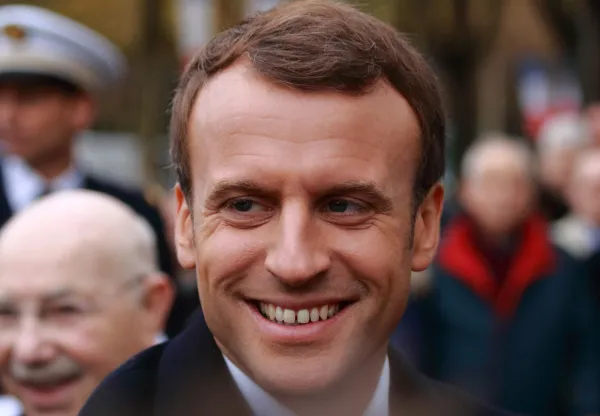
Emmanuel Macron: Remi Jouan, CC BY 4.0 <https://creativecommons.org/licenses/by/4.0>, via Wikimedia Commons
“I call up France, Macron – whose wife treats him extremely badly. Still recovering from the right to the jaw.”
It is not the first time that Donald Trump has resorted to this kind of language. But the timing, as always, is everything.
His remarks about Emmanuel Macron, delivered during a private lunch in Washington, were crude and personal, yet also deeply political.
Macron’s response—measured but unmistakable—was to dismiss them as “neither elegant nor up to standard,” adding that they did not merit a reply.
But to treat this as merely another episode of improvised rhetoric is to miss its significance.
Trump’s attack on Macron did not emerge in a vacuum. It came as part of a broader complaint, one that placed France—and by extension other NATO allies—at the center of a narrative of absence.
“We didn’t need them, but I asked anyway,” Trump said, before mocking Macron’s supposed refusal to provide immediate military support in the Gulf.
France, in this framing, is no longer an ally acting according to its own calculations. It becomes something else: an explanation.
This, too, is not new. Trump has long directed extraordinary time and energy toward attacking individuals, often in language that is not only unfit for a president, but for any public figure claiming seriousness or dignity.
At various moments, this behavior was dismissed as style, as bluntness, or even as political theater. Critics pointed to belligerence, bullying, harassment. All true, of course—but not sufficient.
Because there is more to the story.
Another defining aspect of Trump’s political conduct is his relationship with truth. In US media, this is often softened as “contradiction.” But contradictions and lies are not the same. Contradictions can be strategic, even deliberate, aimed at confusing opponents.
What has emerged instead is something far less controlled.
Over time, a different kind of political literacy developed around Trump. His words were not taken at face value, but interpreted. When he lashed out, it was often read as a sign of weakness or insecurity. When he contradicted himself, it was not always confusion—but sometimes fear, or inexperience, or both.
In the early stages of the war with Iran, this unpredictability appeared to work in his favor. Negotiations were opened and undermined. Deadlines were set and broken. Strikes were launched in moments that suggested surprise, even deception. Iran, at least initially, was forced to react.
But that phase is now over.
Trump’s Wednesday speech was meant to restore clarity. Instead, it exposed the problem. He claimed that the war was “nearing completion,” suggesting that it could end within “two to three weeks.” At the same time, he pointed to the extensive destruction of Iran’s military capabilities, presenting the campaign as already successful.
Yet in the same breath, he warned of further escalation, including possible strikes on Iran’s critical infrastructure. The contradiction was not subtle. A war cannot be both nearing its end and preparing to expand.
Even before the speech concluded, events on the ground were moving in a different direction. Iran intensified its operations, expanding both the scope and coordination of its strikes. The conflict was not narrowing. It was widening—geographically, militarily, and politically.
It is here that France becomes central to the story.
If the war is not unfolding as promised, then the narrative must adjust. And in that adjustment, allies take on a new function. France’s hesitation—real or exaggerated—becomes evidence. Its refusal becomes an explanation of why the war is being lost – or won. Its absence fills the gap between what was declared and what is actually happening.
This is not simply rhetoric. It is a method.
Trump’s remarks about Macron were not incidental. They were corrective. They attempted to redistribute responsibility at a moment when the war itself was becoming harder to justify on its own terms. If victory has already been achieved, why does the war continue? If the war must continue, can victory really be claimed?
With his approval ratings declining and public support for the war weakening, Trump has increasing incentive to redirect attention. France, in this context, is a relatively safe target—an ally, but one that can be criticized without immediate political cost at home. By contrast, acknowledging strategic failure or miscalculation would carry far greater consequences.
Thus, the focus shifts. Not to Iran’s expanding capabilities, nor to the unresolved objectives of the war, but to the supposed shortcomings of allies.
This is how narratives are preserved under pressure.
Trump’s language, then, must be read not simply for what it says, but for what it does. It does not describe reality; it reorganizes it. It does not resolve contradictions; it moves them elsewhere.
Over time, this pattern has become increasingly visible. The insults, the contradictions, the shifting targets—all point to a presidency that governs through reaction rather than strategy. Each new statement attempts to impose coherence on events that resist it.
In the case of Iran, this effort is becoming more difficult to sustain. The war was framed as decisive, controlled, and necessary. It is now unfolding in ways that challenge each of those assumptions. The gap between rhetoric and reality is no longer subtle. It is structural.
Future historians are unlikely to write this history based on Trump’s own words. Not because those words are unimportant, but because they cannot be taken at face value. Instead, they will read them against events, against patterns, against the broader trajectory of a political moment defined by volatility.
What they will find is not simply a record of insults or contradictions, but a deeper logic: a presidency attempting to rewrite its own circumstances in real time.
In that effort, even allies are recast as obstacles, and mockery becomes a political weapon.
The attack on Macron is not an insult—it is a confession. Trump is not managing a war; he is managing its failure. What cannot be won on the battlefield is now being displaced onto allies, rewritten in real time, and stripped of any remaining coherence.
- Dr. Ramzy Baroud is a journalist, author and the Editor of The Palestine Chronicle. He is the author of six books. His latest, ‘Before the Flood,’ was published by Seven Stories Press. His other books include ‘Our Vision for Liberation’, ‘My Father was a Freedom Fighter’ and ‘The Last Earth’. Baroud is a Non-resident Senior Research Fellow at the Center for Islam and Global Affairs (CIGA). His website is www.ramzybaroud.net
--
Dr. Ramzy Baroud
PO Box 196, Mountlake Terrace, WA 98043
E: info@ramzybaroud,net - ramzybaroud@gmail.com
Twitter: @RamzyBaroud. Website: www.RamzyBaroud.net