
Peace Means We're Not Alone
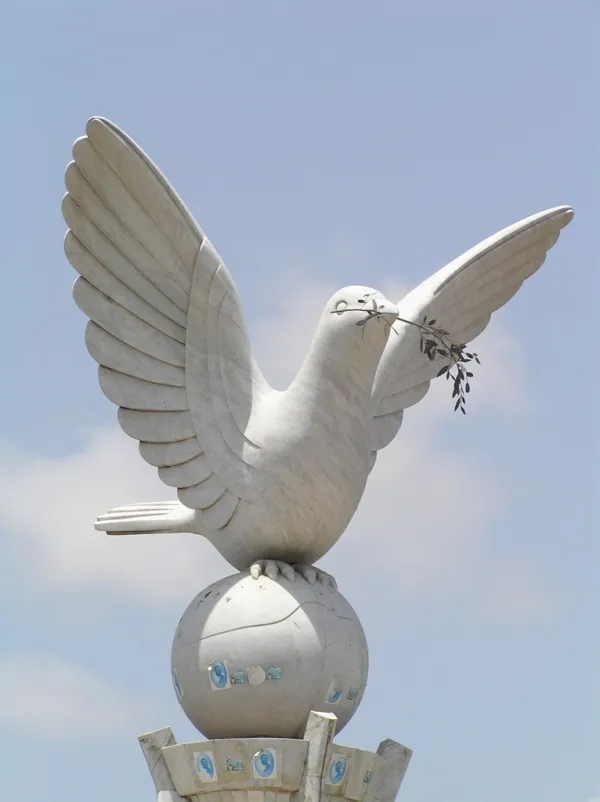
Jeff Attaway from Abuja, Nigeria, CC BY 2.0 <https://creativecommons.org/licenses/by/2.0>, via Wikimedia Commons
Breathe deep, sigh, embrace the next word: W-A-R.
It doesn’t go away. I write about it far too often, and every time I do I feel torn inside . . . even though I remain personally safe from it (at least for now). Words can so easily turn the actions and consequences of war into abstractions, while failing to question why it exists at all. War is simply who we are. This is a hard certainty to shatter. But . . .
“Nothing exposes the bankruptcy of America’s approach to Iran more clearly than its return to more war as the answer to its own failures.”
So wrote Sina Toossi and Nancy Okail recently in the Nation. Their words start opening a deeper level of understanding, one that I’m groping for. They go on:
“It is tempting to dismiss the war resumption as another example of Donald Trump’s impulsiveness. It is something deeper. Trump is less breaking with America’s approach to Iran than taking it to its logical conclusion.”
The logical conclusion, as far as I can tell, is to declare victory and then start looking for the next enemy . . . the next evil that threatens us. This is “peace”: that brief moment of silence while everyone reloads, as someone once put it. In other words, war is inevitable and ongoing. It solves nothing. It changes nothing, except to intensify people’s hatred, toward “someone,” and their desire for revenge. It shatters connection. It shatters healing.
War’s primary function is to perpetuate itself. It’s a collective addiction to power: power over others, not with them. The enemy is always present and always dehumanized. And war doesn’t always manifest itself through militarism. Consider the criminal justice system, a.k.a. the prison system, for instance.
So let me restart this column. The word I want to embrace is: P-E-A-C-E.
Peace equals evolution. Peace means power with others, not over them. And it manifests in numerous, and often unnoticed, ways. Peace is complex and rarely produces great headlines. Over the years I’ve written about many different peace organizations, which exist in many different contexts.
In essence, peace means embracing conflict, understanding it – through non-judgmental communication between everyone involved – and looking for ways to heal, rather than punish, any harm that has occurred.
Here’s part of a column I wrote about ten years ago, after I had attended a conference on “soul repair” in Des Moines, Iowa:
“The community was out of control – the children, oh my God, the children, were sniffing gasoline and pretty much abandoning any pretense of a future – and the social and criminal-justice systems were just adding to the problem. Nothing was working.
“‘Our children slammed us against a brick wall,’ Burma Bushie said.
“This is the story of a culture in shambles. It was the early ’80s. Bushie’s community is called the Hollow Water First Nation Reserve, a village of about 900 people in eastern Manitoba, more or less at the end of the highway. There was one road in and one road out.
“They may have felt utterly isolated in their troubles, but what a few of them started to do – in synchronicity with people in other indigenous communities – has spread hope and awareness across the planet. They began reaching beyond the known (i.e., Western) world, deep into their souls and into the roots of a lost way of life, to save their children and the future. . . .
“‘Our children were acting out – not learning. That was our beginning,’ she said. ‘We couldn’t hide anymore. The Indian reservation-school system, the child welfare system – all these systems that came to help us more or less became our enemies.’
“The committed team of change-bringers began talking to one another about their own lives, as well as the troubles around them. They began addressing the issue of alcoholism, an obvious surface manifestation of far deeper matters. ‘Each time we cleared up one level, we found another,’ Bushie said. “When we got to sexual abuse – we knew that’s what we had to deal with. . . .’”
And it became a community process. When someone has been harmed, people sit in a circle as equals – victim, perpetrator, any others who are affected – and everyone has a chance to talk. When they’re not talking, they listen. There is only one goal: healing
Rupert Ross, who was at the conference with Burma Bushie, wrote about all this in his remarkable book, Returning to the Teachings. He had been a Canadian crown (i.e., prosecuting) attorney, and Hollow Water was part of his coverage area. His job was to prosecute offenders, send them to prison. He began to realize all this was doing was creating more damage to the community, and that Western “justice” had nothing to do with healing. It broke connections. It created bad guys and proceeded to dehumanize them.
He wrote, in his book: “The word ‘healing’ seems such a soft word, but, as I will show later, Hollow Water’s healing process is anything but soft. In fact, jail is a much easier alternative, because it does not require the victimizer to face the real truths about abuse.”
And this is peace: not a simplistic lull while enemies reload – that is to say, nothing at all – but the ongoing creation of a world that belongs to all of us. It’s also known as evolution.