
Podcast: Kucinich on The Duran - Debt, Decline and Iran. Why America Cannot Afford Another Forever War.
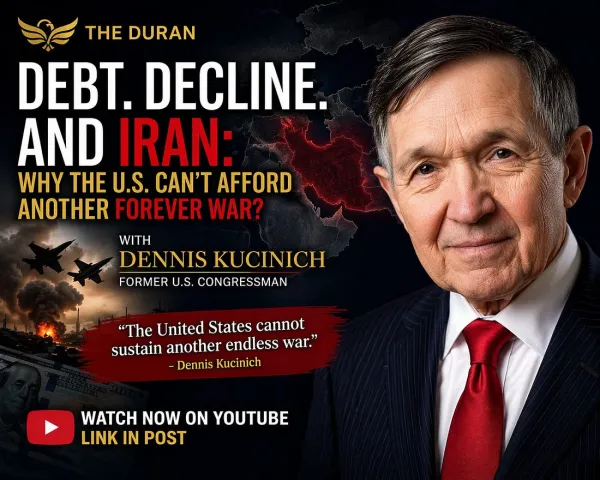
Drawing on decades of experience in Congress and his consistent opposition to U.S. military interventions, Kucinich situates the current conflict within a longer historical arc of American foreign policy defined by overreach, deception, and mounting human and economic cost.
Click HERE to watch the interview
At the heart of his analysis is a simple but urgent truth: This is a war of choice, not necessity. Kucinich argues that the conflict does not arise from core American interests, but rather from external pressures, geopolitical entanglements, and the enduring influence of allied political forces, particularly those aligned with Benjamin Netanyahu. He describes a dynamic in which U.S. policy is shaped less by national interest and more by political leverage, lobbying power, and strategic manipulation.
A Familiar Pattern: From Vietnam to Iraq to Iran
Kucinich draws direct parallels between the current moment and past wars, particularly Vietnam and Iraq. He recalls how the United States entered those conflicts without fully understanding the consequences, only to become trapped in prolonged, costly engagements that failed to achieve their stated aims. The language of “quagmire” and “credibility gap,” once associated with Vietnam, is now resurfacing, signaling a repetition of history rather than a departure from it.
The Iraq War, which Kucinich led the opposition to while in Congress, serves as a particularly stark warning. Built on false premises and sustained by political inertia, it cost trillions of dollars and countless lives. He suggests that the rationale for confronting Iran, including renewed fears around weapons programs, echoes those earlier justifications, raising serious concerns about truth, accountability, and intent.
The Economic Breaking Point
Beyond the battlefield, the conversation turns to the profound economic implications of war. The United States now carries a staggering national debt, estimated at $38 trillion, with roughly $1 trillion annually required just to service that debt. Against this backdrop, the prospect of an additional $200 billion war appropriation, alongside a proposed $1.5 trillion military budget, signals a dangerous escalation.
Kucinich is unequivocal: The United States is becoming a militarized economy. Public spending is increasingly diverted toward defense and war-making, while essential domestic programs such as healthcare, childcare, and social support systems are deprioritized. This shift, he argues, is not sustainable. It places immense strain on ordinary Americans, who are already grappling with rising inflation, increasing fuel costs, and higher food prices.
He also highlights the global ripple effects. Disruptions to oil supply, fertilizer availability, and critical materials like helium are already impacting agriculture, technology, and supply chains. Family farms, already under pressure from market consolidation and lack of access to capital, face even greater instability in this environment.
The Myth of War as Economic Engine
A central theme of the discussion is the persistent myth that war stimulates economic growth. Kucinich dismantles this idea, noting that modern warfare is no longer labor-intensive. Unlike the industrial mobilization of World War II, today’s military economy is driven by advanced technology and capital investment, not widespread job creation.
The result is a concentration of wealth and resources within the military-industrial sector, with fewer benefits for the broader population. War, in this context, becomes a drain on productive economic activity rather than a catalyst for it. It weakens civilian industries, reduces living standards, and accelerates structural decline.
Silencing Dissent and the Rise of Public Resistance
One of the more striking observations in the conversation is the relative absence of large-scale public protest against the war, especially when compared to the Iraq era. Kucinich points to a growing suppression of dissent, particularly on university campuses, where criticism of U.S. foreign policy can carry significant personal and professional consequences.
Yet beneath the surface, he sees signs of awakening. Recent nationwide protests, involving millions of Americans, reflect a broader unease with the direction of the country. Economic hardship, combined with concerns about authoritarian governance, is beginning to galvanize public opposition. Kucinich believes this latent dissent will continue to grow, potentially reshaping the political landscape in upcoming elections.
A Changing World Order
The conversation also situates the conflict within a shifting global context. The United States, Kucinich argues, is operating under the illusion of a unipolar world, even as new alliances and economic blocs emerge. The expansion of BRICS nations and the move by countries like Iran to conduct trade outside the U.S. dollar signal a gradual erosion of American economic dominance.
This transition has profound implications. As global power becomes more distributed, the costs of unilateral military action increase, and the ability of the United States to sustain its economic model comes into question. The war in Iran, rather than reinforcing American leadership, may accelerate its relative decline.
A Moral Reckoning
Perhaps the most powerful dimension of Kucinich’s message is moral. He speaks with visible anguish about the human cost of war, particularly the deaths of civilians, including children. These are not abstract statistics but lived realities that demand accountability.
He challenges the fundamental purpose of American governance, asking whether it has drifted from its founding principles into something unrecognizable. The pursuit of power, resources, and geopolitical dominance, he argues, has come at the expense of ethics, compassion, and the well-being of both Americans and people around the world.
A Choice Before the Nation
The conversation closes with a stark but hopeful proposition. The trajectory of the United States is not fixed. Change is possible, but only if the American people demand it. Kucinich calls for a reorientation of national priorities, away from endless war and toward care for domestic needs, international cooperation, and a renewed commitment to peace.
He envisions a United States that is no longer a nation above others, but a nation among them, grounded in mutual respect and shared humanity.
The question that remains is whether the country will heed this call, or continue down a path that history has already shown leads to decline.
The Kucinich Report is a reader-supported publication. To receive new posts and support our work, consider becoming a free or paid subscriber