
Sigo Aquí En Columbus
Identity, Faith, and Education
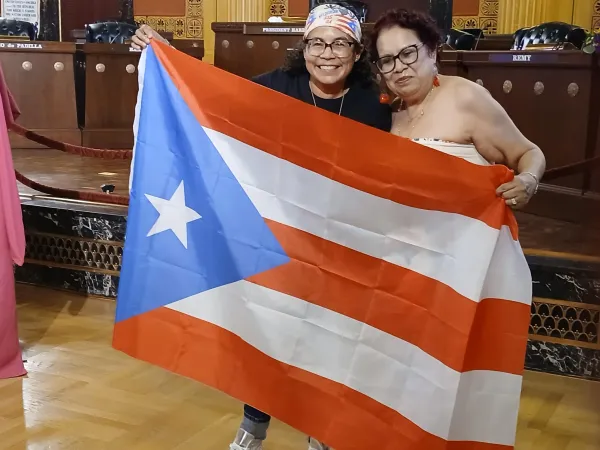
My Puerto Rican, Boricua, and Nuyorican—or New York Rican—identities are all part of what makes me a Hispanic American woman. I come from a blend of three cultural traditions shaped further by the American culture. As the first generation in my family to complete both high school and college, I know that progress is possible, but it is rarely easy.
No matter where I walk I see poverty, but also people working and exploiting others to earn money and live a comfortable life. The places I work and walk many shy away. My upbringing and being a raised by a single Spanish speaking mom taught me the value of faith in God. The one who created diversity in the sky, land, in the deep waters lives inside of me. Therefore, I need to recognize not everyone is honored to share the pain and suffering like Jesus did.
Like many Hispanics, my family and I believe in Intelligent Design: that God created the earth and humanity is His greatest masterpiece and made in His image. We understand each person as a unified being composed of three essential dimensions: the soul, spirit, and mind. Together, these dimensions shape the physical body. When one is harmed or neglected, the health of the whole person suffers.
Columbus: Diversity and Division
For me, Hispanic heritage is worth celebrating every month. Although my schedule is busy, I want to recognize my friend and business partner, Anamaria Perales-Lang, a longtime advocate for underserved communities and contributor to 1DIVINELINE2HEALTH. A Columbus resident for more than 30 years, she manages an apartment complex and often helps tenants navigate services. She was chosen as Columbus’s Hispanic Heritage Month Madrina, or godmother—a role that, in many Hispanic and Latin American cultures, represents a second mother, mentor, and lifelong protector who provides guidance, care, and support beyond a child’s baptism or presentation to God.
We have been in several conversations with leaders who hear our concerns and yet ignore our recommendations. I enjoy being in those types of conversations. People can clap and snap fingers but one thing people can say about us is we are not talkers of justice we live out justice daily. We feel Hispanics need to follow rules in whatever country they live in.
As I have grown older, witnessing Columbus’s transformation has become increasingly difficult. Although the city is more ethnically diverse, it remains deeply segregated. Some people pursue the American Dream, while others exploit individuals or public systems for financial gain.
Meanwhile, many American families—especially in inner-city neighborhoods—struggle to raise their children with little or no additional support from local government. Long-term reliance on public benefits has also strained community resources and, in some cases, encouraged a sense of entitlement. These effects are visible across generations:
- Children go hungry.
- Adults avoid employment, relying on waiver programs to cover rent.
- Grandparents, aunts, and uncles take on the responsibility of raising children.
- Families cope with the effects of human and drug trafficking visible in the economic impoverished neighborhoods.
Neighborhood Change
The Hilltop and Linden community face similar challenges. As Columbus continues to welcome Somali refugees and other new communities, these neighborhoods have become more culturally diverse. We see large pockets where they are living comfortably and easily have access to public assistance. Newly arrived refugee families qualify for cash and medical assistance, while some working Americans earn slightly more than the federal poverty limits and therefore disqualify for EBT or public health coverage and rental assistance. This contrast raises questions about whether eligibility rules treat struggling households fairly.
Classification and Data Transparency
Franklin County data classify African refugees within the broad Black or African American categories, even though some individuals may identify differently. Hispanic residents also have varied experiences, and many work, build businesses, and do not rely on public assistance. Because the U.S. Census Bureau and Franklin County agencies do not publish detailed public-assistance data by ethnicity, it is difficult to compare outcomes. Does this lack of transparency point to a broader problem?
According to the US Census Franklin County has approximately 1.36 million residents: 62.4 percent are White, 25.1 percent Black or African American, 6.2 percent Asian, and 8.9 percent Hispanic or Latino of any race. About 13.9 percent–14.7 percent of residents—191,600 people—live in poverty.
Ohio’s agricultural economy depends heavily on Hispanic workers who maintain lawns and harvest produce. Many immigrants come to work, establish businesses, invest locally, and support family members abroad. Recent scrutiny of public spending in Minnesota and New York raises broader questions about how assistance is distributed and monitored. Homecare agencies, daycare centers for both children and adults, and other types of businesses need to be investigated. Public funds should be administered responsibly, but grandparents raising grandchildren on fixed incomes also face significant challenges. Why do grandparents raising grandchildren not qualify for greater assistance or targeted tax credits? Something must change.
Across Columbus, new apartment complexes continue to rise, yet many remain unaffordable. With electricity rates increasing this month, more households may be forced to choose which bills to pay. Long-term public-assistance recipients may also need part-time work to cover basic expenses. Meanwhile, many shelters are unsafe and unsuitable for families unless private foundations or nonprofits provide additional support. It is heartbreaking that an illness can cause someone living paycheck to paycheck to paycheck to miss one month’s rent and face eviction, especially when assistance remains scarce across metropolitan Columbus.
Ohio Puerto Ricans
According to Neilsberg.com, Franklin County is home to more than 13,000 Puerto Ricans, while Northeast Ohio has over 78,000. From 1945 to 1965, Puerto Ricans migrated to Northeast Ohio for jobs in steel mills, Ford and Chevrolet plants, and agriculture. We are here to make Columbus more warm-blooded and culturally united. I admonish our leaders to stop protecting and elevating certain races. Politically it has become a race between Blacks and White leaders who leave colored folks out. The Black leaders get in power and have their own cliques and do not represent their own folks or other ethnicities. They get richer and mismanage both personal and public funds.
Despite these political concerns, the growth of Ohio’s Puerto Rican community offers an opportunity to strengthen local neighborhoods through work, culture, and civic engagement. It is encouraging to see more Puerto Ricans moving to Ohio for employment and enriching the state with Caribbean warmth and compassion. Many reject Black and White supremacy and are welcomed as contributing members of the communities they call home.
Julia de Burgos—a renowned Puerto Rican nationalist, teacher, poet, and advocate against prejudice—has deeply shaped my understanding of injustice. Born and raised in Puerto Rico, she lived briefly in Cuba before spending much of her later life in Spanish Harlem, New York City. She confronted racial and gender oppression both on the island and in New York, using writing as her primary means of resistance. Her life was difficult: she endured two failed marriages and died alone in New York City. Yet she refused to remain silent.
Like many Puerto Rican nationalists, Julia challenged imperialism and the status quo while remaining committed to truth, dignity, faith, and opposition to racism and injustice. Even changing her last name to include “de” expressed self-possession: she belonged to herself. I stand in solidarity with her and with Puerto Rican nationalists who resisted oppression without abandoning their principles.
I want to be remembered as a Puerto Rican woman who loved God and people, opposed injustice, dishonesty, and entitlement, defended underserved communities, and protected children affected by poverty. My confrontations with leaders have sought to expose hidden truths and the discrimination faced by people like me who do not fit neatly into Black or White categories. We are a part of the human race shaped by many cultures, and we must work hard, promote peace, reject exploitation and fraud, and treat one another with gratitude, respect, and mercy. Those who receive help should use it as a path toward independence, and those who break the law should accept the consequences.
True freedom depends on responsibility, compassion, and respect for all people. We are 100 percent human and spiritual beings. The four human virtues depicted by Plato and Aristotle are to be cultivated through reason and human effort, are prudence, temperance, justice, and fortitude. The three spiritual virtues are faith, hope, and love. In contrast to the seven deadly sins that destroy a person and a nation. In Proverbs 6:16-19 King Solomon identify the seven deadly sins: pride, greed, lust, envy, gluttony, wrath, and sloth. So, let the torch of justice guide us to uphold the Golden Rule about love and defend the rights of women, children, and men in Columbus, Ohio, and the world. As Julia de Burgos so eloquently wrote:
” The ashes of injustices, burnt, left behind,
And when with the torch of the seven virtues,
The throng to the seven sins gives chase,
I will be against you and against all
That is unjust and inhumane.
Upholding the torch... I shall be among the throng.”