
"Undefeatable" Medieval Nerve-Center
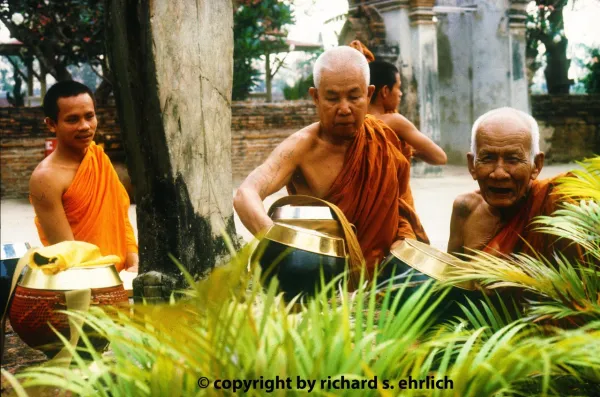
Ayutthaya is a major pilgrimage site for tourists, archeologists and Buddhist devotees, thanks to an ambitious slicing away of dense vines and other foliage which covered its treasures. Photo © copyright by Richard S. Ehrlich
AYUTTHAYA, Thailand -- Here in Ayutthaya, Buddhist shrines, temples, and tombs emerge from the jungle amid the wreckage of a war 260 years ago.
Fortunately, during the past few decades, the damaged royal city of Ayutthaya ("eye-YOO-tee-ah") has blossomed into a major pilgrimage site for tourists, archeologists and Buddhist devotees, thanks to an ambitious slicing away of dense vines and other foliage which had covered its treasures, threatening to gobble them up forever.
Only 86 kilometers north of Bangkok, Ayutthaya once-upon-a-time rivaled London and Paris in its heyday, until the fateful year 1767 when Burmese invaders obliterated the city.
Thai forces eventually staged a counter-attack and ousted the Burmese, but by then it was too late.
Fifteen years later, heart-broken Thais abandoned Ayutthaya and decided to head south where they built Thailand's current capital at Bangkok.
Today, as you walk through Ayutthaya, you'll see "prangs" and "chedis" -- spires with rounded or pointed tops -- popping up everywhere now that the hacked-away vegetation has revealed where they were hidden or inaccessible.
The richness of the sites shouldn't be too surprising because, after all, old Ayutthaya liked to flaunt its wealth.
Many of its marvelous structures and statuary were built as a competitive display of status and power, as well as a humble effort to make spiritual Buddhist "merit" for one's own journey towards reincarnation.
Everyone who was anyone in Ayutthaya -- or at least anyone with treasure to spare -- built temples here along the twin rivers and canals, when monarchs, merchants, and mystics splurged on constructing temples to Lord Buddha.
Ayutthaya's grand palaces symbolized the city's status as a nerve-center for some of the finest art and cultural displays of its time as Thailand's capital from 1350 to 1767.
International trade routes linking Europe, India, China and Japan criss-crossed Ayutthaya amid an exchange of porcelain, silk, silver, animal hides, teak, tin and sugar.
Alas, Ayutthaya fell victim to pillaging by several Burmese military assaults, especially in the 1500s, and was finally destroyed when it fell into the hands Burmese invaders in 1767 after a year-long siege.
Victorious Burmese allegedly melted Buddha statues for their gold, and enslaved 90,000 citizens who were taken back to Burma along with royal family members.
The tragedies of 1767 are still rued by many Thais who learn in school about the wars with their western neighbor, and still wince at the vengefulness of the attacks.
Seen through the eyes of Burmese at the time however, the total destruction of Ayutthaya was a priority to dominate Thailand and checkmate the city's rapidly growing strength and sophistication.
Today, however, such real politick maneuverings are met with regret by Thais and tourists who flock to Ayutthaya to wander amid the traces of what the Burmese could not destroy -- both in stone and spirit -- and which are being lovingly cherished by the people who live here.
As you wander among the ruins and some of the restored temples where Buddhist priests and believers are offering prayers, you'll quickly realize why this former capital has become a National Historical Park protected by the Thai government, and was named in 1993 as a World Cultural Heritage site because of its history, culture and art.
You'll also see craftsmen busily repairing various domes, steeples and statues as part of a restoration project which hopes to quality Ayutthaya as Thailand's first "Historic City," which will give it more prestige and much-needed funds to conserve the sites.
An amazing maze of canals and waterways meanders through Ayutthaya, serving as transport routes and to protect the ancient city.
You can glide on the canals with the help of boatmen who offer rides on their "long-tailed" boats, which are chopstick-thin motor boats powered by twirling blades at the end of unusually long rear pole. Hence the name.
Floating along, you can enjoy a fish-eye view of the ancient architecture and raucous present-day life along the rivers and canals where Thais lives, bathe, wash clothes, fish for meals, or simply relax and wave as you drift by.
Catch boats from a platform near Chandrakasem Palace, and agree on a fare before boarding.
When your long-tailed boat carries you away, you'll pass giant Wat Phanan Choeng which contains a big sitting Buddha and displays Chinese influence, echoing the Chinese traders who prayed here at the beginning of long and sometimes dangerous journeys.
Travel upstream where you'll pass other religious structures including Wat Buddhaisawan, and the Catholic Cathedral of St. Joseph which was favored by past British, French, Dutch and Portuguese residents.
You'll also see Wat Chai Wattanaram which is protected by a Buddha atop a tall pedestal.
Monasteries appear amid monks' burnt-orange colored robes hanging out to dry.
Villagers will wave hello as you pass, while children splash about in fun.
Ayutthaya is a man-made island.
Phya U-Tong, a king also known as Ramatibodi the First, had arrived here looking for a place to build Thailand's capital safe from a raging cholera epidemic.
He selected this site because it was protected on three sides by the Chao Phraya, Pasak, and Lopburi rivers.
After sketching a few maps and consulting with canal-makers, Phya U-Tong discovered he could turn Ayutthaya into an island by connecting a loop of the Chao Phraya with a bit of canal digging.
The new island-city was named Ayutthaya which is the legendary home of the Hindu deity Rama in India's epic Ramayana text, and can be translated from Sanskrit to mean "undefeatable."
Thirty-three Siamese kings of different dynasties ruled here until its defeat.
Today, modern Ayutthaya and its railway and highways surround the ersatz island.
Frustratingly, many of the remaining canals have suffered the same fate their counterparts in Bangkok -- as smelly sewers, choked by weeds.
If watery traveling makes you sea sick, then hop aboard an ubiquitous "tuk tuk" taxi which resembles a three-wheeled golf cart.
Your driver will be delighted to zip you to all the main sites, and wait while you view them.
Ayutthaya boasts nearly 300 sites, reflecting Cambodian, Indian and Thai styles.
One of the most famous sites is the former royal palace, Wang Luang, which was destroyed by the Burmese.
Amid the remaining foundation stumps, you'll see the standing royal temple of Wat Phra Sri Sanpet with its three central chedis proudly restored amid the desolation.
This is also a great place to rest and soak in the history amid shady trees and green expanses of lawn amid the ruins.
If you're hungry, dine at the nearby market place which offers food and souvenirs, including religious items.
Thailand's biggest bronze Buddha, 12.5 meters tall, stood in Ayutthaya for centuries and is now enclosed by Wat Mongkon Bopit, where Thais light incense and candles while praying and putting donations in small Buddhist alms' bowls which are arranged in front of various Buddha statues according to the day of the week.
Figure out which day of the week you were born and make a small offering to one of the seven bowls.
Handkerchief-sized cloth bearing woodcut prints of Buddha and other icons are also on sale here.
Thais carry the rectangular, sacred "yant" cloth to protect them, especially when going on a journey.
The printed cloth is also beautiful to frame and hang on your wall for divine inspiration.
Other key temples to visit include Wat Phra Ram, which dates back to 1369 and displays majestic elephant gates set in old walls, plus interesting statues and stuccoes.
Wat Dhamik Raj's ruins are protected by stone lions.
Wat Raj Burana was one of the biggest temples and you can still see partially-smashed Buddha statues -- evidence of the invaders' fierceness.
Ambitious restoration work rescued several temples.
Wat Suwan Dararam is highly decorated and continues to function as a temple today, filled with monks who chant devotional prayers.
Many visitors also marvel at the gigantic reclining Buddha at Wat Lokaya Sutha.
Earlier the entire 28-meter-long statue was encased within walls, but today it stretches gracefully in the open air, enabling you to see it from various angles.
Inexpensive hotels are available in Ayutthaya, but most visitors only stop for a day trip.
If you stay until evening, be sure to watch the sunset behind Wat Chai Wattanaram.
Major temples such as Wat Chai Wattanaram and Wat Phra Sri Sanpet are lit up at night.
*****
Richard S. Ehrlich is a Bangkok-based American foreign correspondent reporting from Asia since 1978, and winner of Columbia University's Foreign Correspondents' Award. Excerpts from his two nonfiction books, "Rituals. Killers. Wars. & Sex. -- Tibet, India, Nepal, Laos, Vietnam, Afghanistan, Sri Lanka & New York" and "Mindfucking DeepSeek: Pushing China's AI to the Extreme" are available at https://asia-correspondent.tumblr.com