
War and the Iranian Opposition: Competing Visions of Anti-Imperialism and Democracy
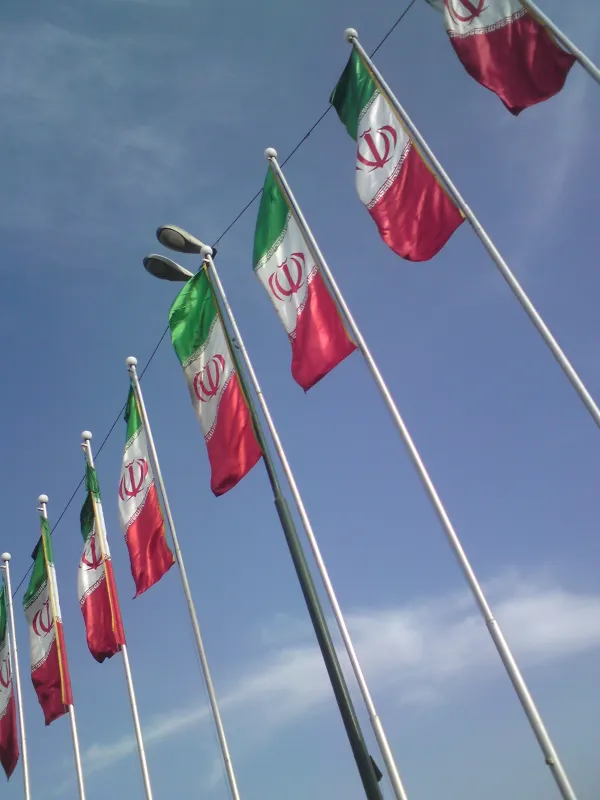
Iranian flags: Alborzagros, CC BY-SA 3.0 <https://creativecommons.org/licenses/by-sa/3.0>, via Wikimedia Commons
In a previous article, I argued that opposing the war against Iran by the United States and Israel is not equivalent to supporting the Islamic Republic. This distinction remains essential because the current conflict has increasingly been presented as a choice between supporting foreign military intervention or defending the Iranian regime. Such a binary obscures a more fundamental reality: one can simultaneously oppose external military aggression and reject the authoritarianism of the Islamic Republic. The continuing war has not only intensified regional instability but has also exposed deep ideological divisions within the Iranian opposition itself. While these groups have long shared opposition to the Islamic Republic, the conflict has revealed profound disagreements over the causes of the war, the responsibility of different actors, and the political consequences that may follow. Debates that once focused primarily on Iran's political future have increasingly shifted toward competing interpretations of the war itself.
At the center of these disagreements are several fundamental questions. Should the conflict be understood primarily as a consequence of U.S. and Israeli military aggression and their pursuit of regional strategic dominance? Or should responsibility rest principally with the Iranian government, whose regional interventions, support for armed proxy groups, and pursuit of an advanced nuclear program have contributed to escalating tensions? A third perspective rejects this binary altogether, arguing that the war itself should be condemned because the policies pursued by both sides have inflicted enormous human suffering while serving neither the interests of ordinary Iranians nor those of the American people.
The current conflict has forced the Iranian opposition to confront a question that had often remained implicit: what should take priority when external military intervention coincides with domestic authoritarianism? Before the war, opposition groups could largely unite around criticism of the Islamic Republic. The outbreak of armed conflict transformed that broad consensus into competing political strategies. Some prioritized defeating the regime, even if that required foreign military assistance. Others insisted that resisting external military intervention and opposing authoritarian rule are inseparable political commitments. The war therefore did not create these ideological divisions so much as expose and intensify differences that had long existed beneath the surface.
These competing interpretations are reflected across the Iranian opposition. Supporters of the Pahlavi movement were, from the outset of the conflict, championed military action against the Islamic Republic. Many viewed military pressure—including targeted strikes against the regime's leadership—as a means of weakening or even toppling the government, thereby creating an opportunity for political transition. Underlying this position is the belief that external military pressure can accelerate regime change by weakening the state's coercive apparatus and creating space for democratic forces to emerge. Critics, however, argue that this expectation rests on an optimistic reading of externally induced regime change, despite historical evidence suggesting that military intervention rarely produces stable democratic outcomes.
The Iranian left, by contrast, has responded in a far less unified manner. Some leftist individuals and organizations have focused primarily on condemning the United States and Israel for initiating military action, portraying Iran chiefly as the victim of imperialist aggression. Others, while opposing foreign intervention, argue that the Islamic Republic's domestic repression, regional policies, and nuclear ambitions contributed significantly to the conditions that made war increasingly likely. From this perspective, the regime bears substantial responsibility for the destruction and human suffering that has followed.
These differences reflect deeper ideological divisions over the meaning of anti-imperialism itself. One current within the left adopts what critics describe as a campist worldview, interpreting international politics primarily through the lens of geopolitical rivalry between the United States and states that challenge Western dominance. Within this framework, the Islamic Republic is often viewed principally as an anti-imperialist actor resisting American hegemony, despite its authoritarian political system and extensive record of domestic repression. Consequently, some adherents are inclined to interpret much of the Iranian opposition as being influenced or supported by Western governments, while giving comparatively less attention to the agency of Iran's democratic movements and the regime's systematic suppression of political dissent.
Other leftists reject this campist framework. While remaining firmly opposed to U.S. military intervention and Israeli military operations, they argue that anti-imperialism cannot be reduced to opposition to American foreign policy alone. Rather, they maintain that opposition to imperial domination must also entail consistent opposition to authoritarian rule, regardless of whether it is exercised by Western powers or by governments that define themselves as anti-Western. In this view, the Islamic Republic can simultaneously be an authoritarian regime that oppresses its own population and a target of Western military pressure. Meaningful solidarity therefore requires resisting both forms of domination rather than subordinating one struggle to the other.
This distinction reflects two competing conceptions of anti-imperialism. The first defines anti-imperialism primarily as geopolitical opposition to the United States and its allies. The second understands it as a universal democratic principle that opposes military aggression, authoritarian rule, and violations of human rights irrespective of the state responsible. The divergence between these perspectives extends beyond the current conflict and reflects a broader debate that has shaped left-wing politics internationally since the end of the Cold War.
A central issue underlying these disagreements concerns the source of democratic change itself. Advocates of military intervention assume that external pressure can create the conditions necessary for democratization by weakening or removing authoritarian regimes. Their critics argue that durable democratic institutions cannot be imposed through foreign military force but must emerge from domestic political struggles. They point to decades of labor activism, student movements, women's rights campaigns, and repeated waves of popular protest inside Iran as evidence that meaningful political transformation ultimately depends on the agency of Iranian society rather than geopolitical intervention. From this perspective, foreign military action risks undermining precisely those social forces capable of producing lasting democratic change by strengthening nationalist sentiment, expanding state repression, and narrowing political space for independent civil society.
This skepticism toward military intervention is reinforced by historical experience. For many critics of the war, foreign interventions in countries such as Iraq, Libya, Afghanistan, and, in different ways, Syria demonstrate that external military action often produces prolonged instability, strengthens authoritarian or armed actors, and weakens indigenous democratic movements rather than fostering stable democratic transitions. While none of these cases is identical to Iran, they caution against assuming that military intervention is a reliable path toward democracy or political stability.
The disagreement also reflects different understandings of the objectives pursued by external powers. Critics of the war argue that the strategic priorities of the United States and Israel—including limiting Iran's regional influence, constraining its missile capabilities, and restricting its nuclear program—are distinct from the aspirations of many Iranians for democracy, political freedom, social justice, and accountable government. Although these objectives may occasionally overlap, they are neither identical nor necessarily mutually reinforcing. Conflating geopolitical strategy with democratic transformation risks misunderstanding both.
Despite these internal disagreements, much of the Iranian left continues to share a broader analytical framework that distinguishes it from other opposition currents. Many characterize the conflict as an imperialist war while simultaneously recognizing the authoritarian nature of the Islamic Republic. Rather than aligning themselves with competing state actors, they reject both. They oppose foreign military intervention as well as the Iranian government's domestic repression and regional policies, arguing that neither project advances the interests of ordinary people in Iran, the United States, or the wider Middle East. This position reflects a long-standing anti-war and democratic socialist tradition that seeks political independence from both external powers and authoritarian states.
Ultimately, the divisions within the Iranian opposition are not simply disagreements over who bears greater responsibility for the current war. They reflect fundamentally different understandings of international politics, democratic change, and the relationship between anti-imperialism and authoritarianism. At stake is not merely the interpretation of a single conflict but the political principles that should guide opposition to both foreign domination and domestic tyranny. The war has therefore become a catalyst for a broader ideological debate: whether opposition to U.S. power alone is sufficient to define an anti-imperialist politics, or whether a genuinely emancipatory politics must oppose domination in all its forms. How these competing visions evolve will shape not only interpretations of the present conflict but also the future direction, legitimacy, and intellectual coherence of the Iranian opposition itself.