
War Comes Home . . . Again
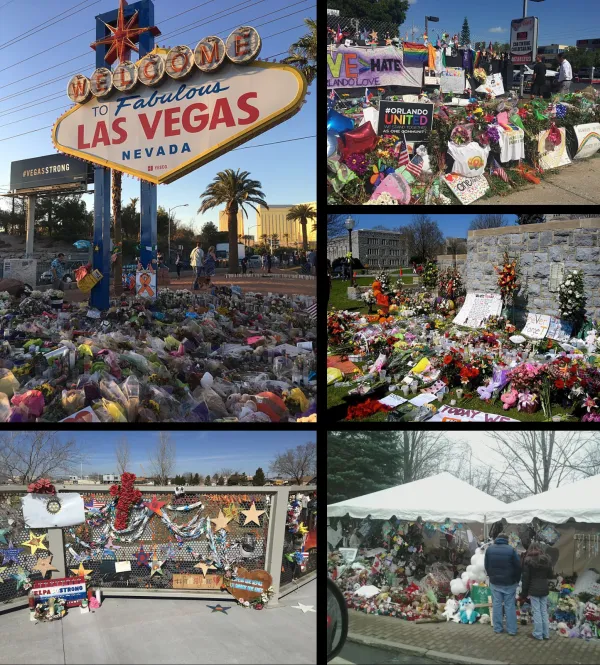
I stare blankly at the news. Little men with guns once again stir the country – the world – into a state of shock and grief and chaos. Attention: Every last one of us is vulnerable to being eliminated . . . randomly,
On Saturday, Dec. 13, there’s a classroom shooting at Brown University, in Providence. R.I. Two students are killed, nine others wounded. A day later, in Sydney, Australia – in the midst of a Hanukkah celebration at Bondi Beach – two gunmen fire into the crowd of celebrants. Fifteen people are killed. The shock is global. The grief and anger flow like blood.
So do the questions: Why? How can we stop this? How can we guarantee that life is safe?
Usually, the calls for change after mass shootings focus on political action: specifically, more serious gun control. Ironically, Australia does have serious gun control. And, unlike the U.S., mass shootings there are extremely rare, but they still happen, which indicates that legal efforts can play a significant, but not total, role in reducing violence.
But that ain’t gonna happen in the USA – not until God knows when, which seriously expands and intensifies the nature of the questions we must start asking. Yeah, there are an incredible number of guns in the United States. Some 400 million of them. And embedded into American culture along with the presence of guns is the belief that they are necessary for our safety, even as they also jeopardize it. Only a good guy with a gun can stop a bad guy with a gun. What a paradox.
And here’s where the process of change must begin. Good guy vs. bad guy – good violence vs. bad violence – is the essence of linear thinking. One person wins, one person loses. And if I draw my gun first, yeehaw, I’m the winner. This simplistic mindset is, and has long been, part of who we are – ultimately resulting, good God, in stockpiles of nuclear weapons, giving humanity the opportunity to commit mass suicide.
And while nukes may be declared to be simply deterrents for our enemies—threatening mutually assured destruction (oh, the MADness) – the global, and especially the U.S., non-nuclear military budget is itself almost beyond comprehension: larger by far than what we spend on healthcare, education, diplomacy or environmental salvation, a.k.a., human survival.
As Ivana Nikolić Hughes writes at Common Dreams: “But I think that the problem is far deeper than lack of gun control. The problem lies in having a state, a society, a world, in which violence is not only excused and sanctioned on a regular basis, but celebrated both as a matter of history, but also the present and the future.”
And this thinking isn’t sheerly political. It permeates our social and cultural infrastructure. And it gets personal. “We live in a culture of violence, where weapons are a symbol of power,” Ana Nogales writes in Psychology Today. And having power – over others – also means having the ability, and perhaps the motive, to dehumanize them. And this is the source of human violence – both the kind we hate (mass killings) and the kind we worship (war).
All of which leads me to a quote I heard the other day, in regard to the Bondi Beach shootings, which left me groping for sanity. The speaker was Indiana Republican Sen. Jim Banks, speaking on Fox News. “In America,” he said, “we have to do more to deport terrorists out of the United States to make sure this doesn’t happen in the homeland, and root out antisemitism around the world as well.”
Flush ’em out! All of them – you know, the ones that are different from us. Skin color, whatever. This is the essence of dehumanization, and it’s how we govern. Rather than embrace human complexity, we choose to create enemies and declare them . . . deportable, and if necessary, killable. This mindset is infectious. Just ask the students at Brown University or the Hanukkah celebrants at Bondi Beach.