
Who Decides What Is Legitimate? Power, Democracy, and the War on Iran
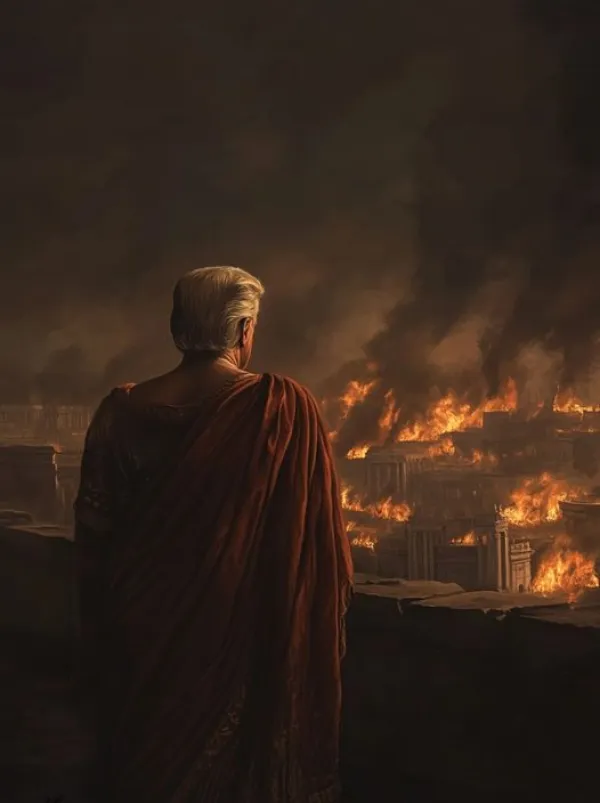
Image via social media. (FB)
Democracy is invoked as moral legitimacy in war, while Iran’s authority rests on layered political, religious, and historical foundations.
Democracy, however, is not the enemy. Its manipulation is.
For decades, Western political discourse has equated legitimacy with elections—numbers counted on a single day, certified by institutions that themselves operate within systems shaped by immense financial power. The result is a troubling reduction: legitimacy becomes procedural rather than moral.
In the United States, democracy functions within a political economy deeply influenced by corporate financing, lobbying structures, and concentrated media ownership. Public opinion is not merely informed; it is engineered. Electoral competition exists, but within boundaries drawn by wealth and institutional continuity.
Yet when Donald Trump wins an election, legitimacy is treated as absolute. It matters little that he faces accusations that range from criminal misconduct to constitutional overreach. It matters little that his policies may violate international humanitarian law. It matters little that his administration’s military actions result in civilian deaths abroad.
He is legitimate because the vote totals aligned.
The assumption is clear: democracy automatically sanctifies power. But electoral success does not neutralize war crimes. It does not erase violations of international law. It does not transform contested policies into moral truths.
Democracy is valuable. But it is not a moral deterrent.
Israel’s Democratic Shield
Nowhere is this branding more visible than in Israel.
Israel’s claim to being “the only democracy in the Middle East” has long served as diplomatic armor. The phrase is invoked not merely as a political description but as an insulation from scrutiny.
Benjamin Netanyahu, despite facing international legal action and accusations related to the Gaza genocide, continues to present Israel’s democratic framework as evidence of moral standing. Elections are cited as proof of legitimacy. Parliamentary debate is offered as evidence of healthy political balance.
But democracy does not nullify military occupation. It does not legalize collective punishment. It does not absolve grave violations of international humanitarian law. And it does not make genocide permissible.
The issue is not that Israel holds elections. The issue is how the language of democracy is deployed to marginalize accusations of genocide and to recast military aggression as the behavior of a civilized state defending itself.
Since World War II, democracy has often been mobilized rhetorically to justify regime change, invasions, and “preventive wars.” Iraq was invaded in the name of liberation. Afghanistan was occupied under the banner of freedom. Interventions across Latin America, Africa, and the Middle East were routinely framed as efforts to defend democratic values.
The problem is not democracy. The problem is democratic exceptionalism—the belief that a state’s electoral structure grants it moral immunity.
The Iran Narrative
The same logic shapes the war discourse surrounding Iran.
Iran is routinely described as illegitimate because it does not conform to Western liberal democratic standards. Calls for regime change are framed not simply as strategic calculations but as moral imperatives.
Even critics of Trump or Netanyahu frequently operate within this framework. They may oppose specific policies but accept the broader premise that Western democracies possess inherent moral authority, while non-Western systems must prove their legitimacy.
This binary is deeply flawed.
When moral superiority is assumed, civilian casualties become unfortunate but tolerable. Sanctions that devastate economies become tools of discipline. Military escalation becomes principled defense.
International law becomes selective—binding for adversaries, flexible for allies.
The language of democracy, when weaponized, transforms into a rhetorical shield behind which power operates with diminished accountability.
Iran’s Legitimacy
To understand Iran’s endurance, one must move beyond caricature.
Iran is not a liberal democracy in the Western sense. But it is neither a simplistic autocracy sustained solely by coercion. Its legitimacy operates through a layered political system rooted in history, religion, and institutional design.
At the apex stands the Supreme Leader, chosen by the Assembly of Experts—a constitutionally mandated body composed of elected Islamic jurists. The Assembly itself is selected through nationwide elections and holds the authority to appoint and supervise the Supreme Leader.
This structure reflects the doctrine of Wilayat al-Faqih—the guardianship of the Islamic jurist. In Shi’a political thought, this doctrine fuses religious authority with political oversight, emerging from both jurisprudential tradition and revolutionary ideology.
Yet Iran’s system is not exclusively clerical.
The president is elected through popular vote. The parliament (Majles) is elected. Political factions compete within defined constitutional parameters. Institutions such as the Guardian Council oversee legislation and elections to ensure constitutional and ideological continuity.
Critics argue that these mechanisms restrict pluralism. Supporters contend that they preserve coherence and sovereignty.
Regardless of one’s position, legitimacy in Iran derives from multiple sources:
Revolutionary legitimacy from the 1979 Islamic Revolution.
Religious legitimacy rooted in Shi’a jurisprudence.
Electoral legitimacy through recurring public participation.
Nationalist legitimacy strengthened by resistance to foreign pressure.
These forms do not mirror Western liberal templates. But legitimacy is culturally and historically contextual. It is not a universal mold.
Inside Iran, these structures command sufficient acceptance to sustain political continuity—even under immense external strain.
Survival as Evidence
Over four decades, Iran has endured a devastating war with Iraq, decades of sanctions, economic isolation, cyber operations, assassinations of senior officials, and repeated military threats.
States devoid of structural legitimacy collapse under such cumulative pressure. They fragment internally or disintegrate institutionally.
Iran has not.
This does not imply unanimity. Protests have erupted. Political divisions exist. Economic grievances are real.
But legitimacy is not the absence of dissent. It is the presence of sufficient cohesion.
When external confrontation intensifies, national consolidation often strengthens. In existential contexts, populations rally around sovereignty, even when they critique governance.
Western discourse frequently assumes that regime collapse in Iran is inevitable if pressure is intensified enough. This assumption has repeatedly proven incorrect.
The Question of Legitimacy
The debate is not democracy versus non-democracy. It is authenticity versus manipulation.
Democracy is a meaningful system of governance when it operates transparently and within the bounds of law. But when democratic branding is used to justify war, shield leaders from accountability, or normalize violations of international law, it becomes a rhetorical instrument of power.
The United States and Israel invoke electoral legitimacy to frame military escalation as morally grounded. Iran, meanwhile, derives legitimacy from a hybrid model that merges religion, revolution, and republican institutions.
One system is globally marketed. The other is globally delegitimized.
Yet endurance tells its own story.
- Dr. Ramzy Baroud is a journalist, author and the Editor of The Palestine Chronicle. He is the author of six books. His latest, ‘Before the Flood,’ was published by Seven Stories Press. His other books include ‘Our Vision for Liberation’, ‘My Father was a Freedom Fighter’ and ‘The Last Earth’. Baroud is a Non-resident Senior Research Fellow at the Center for Islam and Global Affairs (CIGA). His website is www.ramzybaroud.net