
Will the US-Israeli War on Iran Open the Road to Palestinian Freedom?
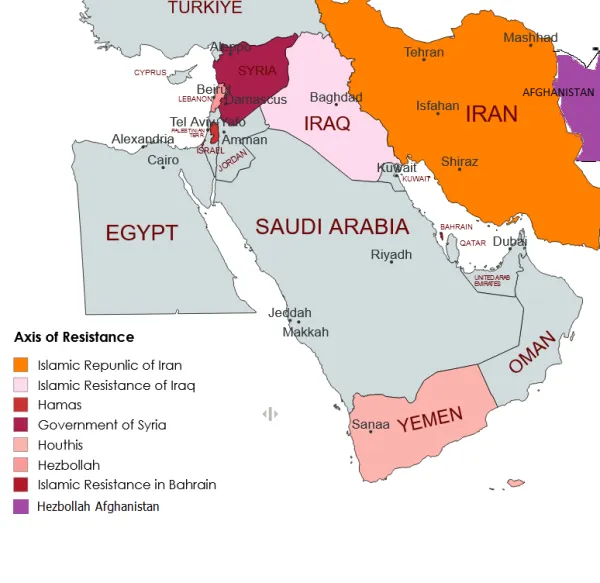
Axis of Resistance map: Kharbaan Ghaltaan, CC0, via Wikimedia Commons
Some are expressing frustration that Iran’s conditions to end the war have not explicitly and unequivocally included a demand to end the Israeli occupation of Palestine and dismantle the apartheid regime.
Among the conditions circulated in Iranian and sympathetic media—though not formally confirmed by Tehran—is the proposition that any resolution must include an end to Israel’s war across all fronts: Gaza, Lebanon, Syria, and beyond. However, these conditions did not specifically prioritize the freedom of Palestine as a precondition to ending the war.
That frustration is neither misplaced nor marginal. For many, Palestine is not one issue among others, but the defining axis of the conflict itself. Precisely for that reason, however, it cannot be approached in isolation. To treat the current war solely through what has or has not been explicitly stated risks narrowing a profoundly complex confrontation into a single dimension, when in fact it is through this broader, interconnected struggle that the question of Palestine is ultimately being shaped, contested, and potentially resolved.
Several strands of analysis capture elements of this reality, but few sustain it. Some focus narrowly on Israeli domestic politics, arguing that Israeli Prime Minister Benjamin Netanyahu is prolonging the war to preserve his coalition, delay accountability, and avoid legal consequences that could end his political career.
Others shift to a broader strategic reading, situating the war within Israel’s long-standing pursuit of regional dominance—neutralizing adversaries, expanding normalization, and consolidating its position as the central power in the region.
A third line of analysis, closer to the mainstream, continues to operate within the declared framework of Washington and Tel Aviv. Even when it introduces criticism, it remains anchored in the language of Iran’s nuclear program, Israeli “security,” and the familiar architecture of justification.
This framework is not neutral. It systematically evades assigning responsibility to Israel for the war, just as it has persistently refused to confront the genocide in Gaza. Even its criticisms of US President Donald Trump remain procedural—focused on the White House's unclear objectives, poor coordination, and contradictory messaging—rather than on the political and moral logic driving the war itself.
Between narrowly internal explanations and an increasingly hollow mainstream narrative, the broader historical trajectory disappears from view.
The truth lies elsewhere.
The Middle East has not entered a crisis suddenly. It has been shaped—deliberately—for instability. What we are witnessing is not an abrupt rupture, but the acceleration of a long-standing historical process that is now reaching a decisive phase.
The Sykes-Picot Agreement of 1916, concluded between Britain and France, did not simply divide territory; it engineered fragmentation. Arbitrary borders were imposed with little regard for historical, cultural, or social realities, ensuring that the region would remain politically fractured and externally manageable.
This colonial framework was later reinforced through post-World War II arrangements that transferred effective control of the region to the United States. A defining moment came in 1945, when US President Franklin D. Roosevelt met Saudi King Abdulaziz aboard the USS Quincy, establishing a strategic formula: American security guarantees in exchange for stable access to oil resources.
That arrangement evolved, particularly in the 1970s, into the petrodollar system, whereby global oil transactions were denominated in US dollars. The consequences were structural. Global demand for the dollar was secured, and the strength of the US economy became directly tied to its influence over Middle Eastern energy flows.
From that point onward, US dominance in the region was not merely strategic—it was foundational to the global economic order.
When did this begin to shift?
A common answer points to the 2003 US invasion of Iraq. Intended to consolidate American control, the war instead destabilized the region in profound and lasting ways, exposing the limits of direct military intervention and accelerating forces that Washington itself could not fully contain.
By 2011, the United States began to recalibrate. The Obama administration’s “pivot to Asia” reflected a strategic reorientation toward China, while in the Middle East, Washington adopted a more indirect model of engagement—often described as “leading from behind.”
This approach was evident in Libya in 2011, where NATO forces, under US coordination, intervened militarily without a large-scale American ground presence, resulting not in stability, but in state collapse.
Across Syria, Iraq, Yemen, and elsewhere, the United States increasingly relied on proxies, regional alliances, and hybrid forms of warfare. It sought to maintain influence while reducing the political and financial costs of direct occupation.
Within this evolving framework, Israel assumed a more central role. It was no longer simply an ally, but a pillar—positioned as a regional guarantor of security within a US-led order. Arab states, particularly in the Gulf, were incorporated into this arrangement as economic partners, their normalization with Israel framed as both pragmatic and inevitable.
The Abraham Accords, signed in 2020, formalized this shift. They were not merely diplomatic agreements but components of a broader project to reorganize the Middle East in alignment with US and Israeli strategic priorities.
While widely described as a betrayal of Palestine—and rightly so—the Accords were also designed to bypass the Palestinian question altogether. Jared Kushner articulated this logic explicitly, arguing that regional cooperation and economic integration could proceed independently of resolving Palestinian rights.
The discourse itself began to shift accordingly. Israel adopted and expanded the language of a “new Middle East,” advancing a vision in which it occupies a central, uncontested position.
This vision was made unmistakably clear in September 2023, when Netanyahu addressed the United Nations and presented a map of the region that excluded Palestine entirely—a political statement as much as a visual one.
Yet even the genocide in Gaza did not fundamentally disrupt this trajectory. Several Arab governments, despite rhetorical condemnation, continued to prioritize the preservation of this emerging order, investing political capital in its survival while offering little meaningful support to Palestinians.
This posture is not accidental.
Many Gulf states were not the product of anti-colonial liberation movements, but of colonial arrangements. As former British protectorates, their political and security systems remain deeply intertwined with Western power. Their limited population size, territorial depth, and strategic autonomy render them dependent on external guarantees for survival.
With China still cautious in projecting military power, and unwilling—at least for now—to replace the United States as a security patron, these states remain anchored to Western political validation, military protection, and technological infrastructure.
From their perspective, the collapse of the existing order is not liberation—it is risk.
This helps explain the absence of any serious shift in their stance toward Israel, even when Israeli leaders openly articulate expansionist ambitions. Netanyahu himself has repeatedly framed Israel’s role in terms that suggest a broader regional project—namely “Greater Israel”—one that extends beyond partnership into dominance.
Such statements, while alarming to some, have not fundamentally altered the calculations of Arab regimes. They have long understood the nature of Israeli power, yet continue to operate within a system that rewards alignment with stronger actors, not resistance to them.
With all of this in mind, the US-Israeli war on Iran cannot be understood as a series of isolated decisions or short-term calculations. It is the outcome of a layered and cumulative historical trajectory.
Yes, Netanyahu seeks political survival. Yes, US policy remains deeply shaped by pro-Israel influence. But to reduce the war to these factors alone is to miss its structural function: the attempt to impose a new regional order.
It is precisely within this broader context that the Palestinian resistance in Gaza must be understood. It was never intended to defeat Israel in conventional military terms. Rather, its objective was to widen the scope of the conflict, disrupt Israel’s ability to unilaterally reshape the region, and challenge what can be understood as an emerging ‘Sykes-Picot II’—this time centered on Israeli dominance.
Israel is fully aware of this dynamic. Hence its constant framing of the war as existential, equating it with its founding moment in 1948—the Nakba, and the ethnic cleansing of Palestine.
Yet Iran’s powerful response, the sustained role of Hezbollah, the involvement of Ansarallah, and the broader consolidation of the Axis of Resistance suggest that Israel may not achieve its strategic objectives after all.
And this is precisely where much of the prevailing analysis falls short.
For the Axis of Resistance, victory does not require a decisive military triumph. It requires endurance. Not losing, in this context, is itself a strategic victory.
Such an outcome would not simply interrupt the existing trajectory; it would begin to reverse it. The strategic arc that followed the Iraq war—reinforced by the ‘pivot to Asia’, the collapse of the Arab uprisings, and the normalization process—would be fundamentally unsettled. Israel’s role as a regional ‘security’ guarantor would be weakened, compelling Arab regimes to reassess their alignments and, potentially, to explore new forms of regional coexistence—not with Israel, but with Iran.
In that same moment, the United States would face a narrowing set of options: either deepen its entanglement in a region it has been attempting to recalibrate away from, or accept an altered geopolitical landscape in which Iran and its allies are no longer peripheral actors, but entrenched and unavoidable forces in shaping the region’s future.
While this alone will not liberate Palestine or dismantle apartheid, it would nonetheless open new political, geopolitical, and legal spaces for Palestinians to operate—spaces made possible by shifting regional balances and a loosening of long-standing constraints.
If the US-Israeli war on Iran fails, the implications will extend well beyond the battlefield. What will begin to unravel is not only the existing balance of power, but the very language and assumptions that have governed the region for decades.
In that context, global powers such as China and Russia are likely to position themselves more assertively as alternative economic and strategic partners, seeking to capitalize on a changing regional landscape.
At the same time, some European states—already signaling discomfort with US policy—may attempt to negotiate new arrangements, particularly given the strategic centrality of the Strait of Hormuz and its direct implications for global energy flows.
Countries across the Global South may also draw lessons from this moment, exploring forms of regional cooperation that challenge inherited colonial frameworks and long-standing hierarchies of power.
Taken together, these shifts do not resolve the ‘Palestinian question’—but they do create openings. They expand the terrain on which Palestinians and their allies, including the global solidarity movement, can act, organize, and exert pressure.
With support for Israel declining among ordinary Americans, and with global solidarity for Palestine reaching unprecedented levels—including within Western societies—the contours of a broader political shift are already emerging.
The challenge now is not simply to recognize that change is underway, but to understand its depth and direction, so as not to remain confined to partial readings of the war on Iran. It must instead be engaged as part of a larger struggle over the future of the region, in which Palestine remains central.
- Dr. Ramzy Baroud is a journalist, author and the Editor of The Palestine Chronicle. He is the author of six books. His latest, ‘Before the Flood,’ was published by Seven Stories Press. His other books include ‘Our Vision for Liberation’, ‘My Father was a Freedom Fighter’ and ‘The Last Earth’. Baroud is a Non-resident Senior Research Fellow at the Center for Islam and Global Affairs (CIGA). His website is www.ramzybaroud.net