
Arts

After seeing her dance to Sia’s “Chandelier” at the Grammys, I’ve come to the conclusion that Kristen Wiig can do just about anything.
She excels in sketch comedy (Saturday Night Live). She can carry a big-screen comedy (Bridesmaids). She can handle cinematic drama (The Skeleton Twins).
Now, with Welcome to Me, Wiig shows she can play a mentally unstable character without turning her into a stereotypical freak. Even more impressively, she does it in a dramatically unstable movie that would collapse into a messy heap without her presence.
Wiig plays Alice Klieg, a woman with what she describes as a “borderline personality disorder,” or what once might have been called manic depression. When she’s not having state-mandated sessions with her psychiatrist (Tim Robbins), she seems to spend her days watching and memorizing taped episodes of Oprah.
Then two things happen that upset her reclusive existence: She goes off her meds, and she wins the lottery. And, I mean, she really wins the lottery, to the tune of $86 million.

The Salt of the Earth may be the most gut-wrenching journey you’ll take this year. Also, the most moving.
The documentary is about Sebastiao Salgado, a Brazilian-born photographer who has devoted most of his career to recording the struggles and sorrows of humanity. The quest has made him the witness to famines, wars and genocides, along with their painful aftermaths.
Like Joseph Conrad, he and his camera have peered into “the heart of darkness,” a task that inevitably has shaken his faith in mankind. “We are a ferocious animal,” he says, speaking in subtitled French.
Narrating his own photos of some of recent history’s worst examples of man’s inhumanity to man, Salgado adds that everyone should view these images “to see how horrible our species is.”
At times like these, one might well wonder whether The Salt of the Earth is titled ironically. Thankfully, life eventually finds a way to uplift Salgado’s spirit—along with ours, making the documentary the cinematic equivalent of a fire-and-brimstone sermon that ends with the joyous promise of redemption.


Once again, a sci-fi flick is asking the burning question: Is romance possible between man and machine?
In 2013, Her made the prospect seem inviting, especially since the machine was represented by the warm (if disembodied) voice of Scarlett Johansson.
Ex Machina offers a darker look at the same topic. This time around, we can see the machine, a personable and gorgeous robot named Ava (the FX-enhanced Alicia Vikander). But the protagonist meets her under circumstances so threatening that he’s justifiably leery of giving in to the feelings she arouses.
Writer/director Alex Garland (28 Days Later…) has devised a suspenseful film that keeps the protagonist—not to mention the viewers—guessing until the final moments.
Caleb (Domhnall Gleeson) is a young computer geek who has won a contest thrown by his company’s wealthy owner, Nathan (Oscar Isaac). His prize is a visit to Nathan’s secluded estate and the chance to take part in a scientific breakthrough.

This is a good time to be a Marvin Hamlisch fan.
Not only can you see A Chorus Line, the late composer’s best-known musical, but you can follow it up with a visit to the photo exhibition “Remembering Marvin Hamlisch: The People’s Composer” at the Columbus Museum of Art.
Though the exhibition may have sentimental appeal, I suspect most Hamlisch devotees will prefer the musical, which has been a popular and critical hit since its 1975 Broadway debut. The winner of no fewer than nine Tony Awards, it’s the appealing story of a ragtag bunch of dancers trying out for an upcoming stage show.
The show-within-a-show’s director/choreographer, Zach (Nick Lingnofski), runs the dancers through their paces as he tries to determine which ones deserve a spot in the chorus line. The dancers do their best to learn the moves, all the while wondering just how many of those spots are available.

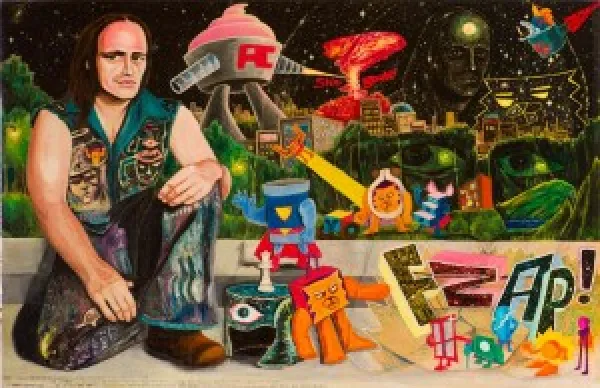
While the ridiculous Ameriflora exhibition took up residence at Franklin Park in downtown Columbus in 1992 – inexplicably there to commemorate the 500th anniversary Columbus “discovering America” – then-President George Herbert Walker Bush paid it a visit. Thankfully, Goblinhood was present to exorcise the spirit of the ex-CIA director from the park and restore it to its natural state that we enjoy today. He did so with stalks of broccoli, knowing that the President would recoil from his most hated vegetable, that had been banned from the White House.
Goblinhood, his suitcase, and cosmic weevil dolls, were creatures commonly found in the Short North during the 1990s, especially at the Acme Art Company gallery and performance space run by the late Lori McCargish. Wearing a spider-covered face mask, cape and clothes adorned with art, Goblinhood recited poetry at political events, performed on Comfest stages, and could be found giving tarot cards readings at a Free Press Second Saturday salon.

It happened on August 29, 1786. Protestors, many of whom were veterans of the Revolutionary War, were angry about the distressed economic circumstance that developed in the aftermath of the war. Hard currency was in short supply, and this caused a credit squeeze. The government had come down hard on citizens in an effort to ameliorate the debt problem, and there were court hearings for those who could not or would not pay their taxes or other debts. Led by Daniel Shays, a veteran, protestors shut down courts in five cities, bringing the hearings to a halt. Shays’ followers also began raising an army. When some of the rebels were captured, their colleagues began arming; in response, a militia unit raised a private army and routed most of the rebels. Although there were scattered protests into the next summer, the rebellion was pretty much over by February 1787.

An issue-driven documentary like The Hunting Ground aims to spur viewers into action. A common related goal is to make viewers angry.
On this latter point, director Kirby Dick succeeds.
The film focuses on sexual assault on American college campuses. Even if you come into the theater already convinced that campus rape is a major problem, the featured victims’ stories are guaranteed to make your blood boil.
As more than one interviewee states, the attack itself was bad, but what happened to them afterward was far worse. The victims—mostly women but also a few men—went to school authorities for help, only to be discouraged from reporting the crimes.
The problem, experts on the issue charge, is that officials are more concerned about protecting their schools’ reputations than they are about protecting their students. And sexual assault is clearly not good for a school’s reputation.

Shadowbox Live has had a series of triumphs over the past few months.
A Tribute to Joe Cocker: Mad Dog and Englishman was a joyous celebration of the iconic performer. The recently concluded Sex at the Box was the funniest theme show the troupe has offered in years.
And though I haven’t seen Shadowbox’s current staging of American Idiot, various critics have hailed the production even as they acknowledged the limitations of the musical itself.
But you can’t crank out as many shows as Shadowbox does without the occasional stumble. Ladies and gentlemen, may I present Reckless.
I’ll start by accentuating the positive. The cover songs are good, as usual, though I wish so many of them didn’t share an angry, screaming personality. Sure, that fits in with the show’s theme, but how about a little variety?