
Arts
Image

I was leaving a preview screening of All Is Lost when a disappointed film buff commented that it was no Life of Pi.
That’s for sure. There’s no digital tiger and no otherworldly 3-D photography. For 99 percent of the film, there’s not even any dialogue. There’s simply a man struggling to survive after his sail-powered yacht is damaged in a mid-sea collision.
Fortunately, that man is played by Robert Redford. If anyone of less stature had starred as the unnamed shipwreck victim, the film would be far less watchable. Not only is he compelling in a role that alternates between grunts and tense silences, but his age and familiarity add depths of meaning to what is otherwise a deliberately paced adventure.
In the first scene, we hear the man’s voice apparently reading from a journal of his trip while the man himself is seen floating in the ocean. “I think that you will all agree that I tried…” he says.
Is this Redford himself talking, we wonder. Is he praising himself for founding the Sundance Film Festival?
Image

With its presence and attendance continuing to climb, the country’s longest-running film festival is receiving the stretch treatment.
The 61st Columbus International Film & Video Festival (CIF&VF) will run for two weeks next month. Assorted screenings, manifesting throughout Columbus at different times, will play from November 3rd through November 17th.
“Entries have been pouring in from every part of the planet. It’s always a very multicultural event,” said Susan Halpern, executive director of the Columbus Film Council, which puts on the festival.
Image
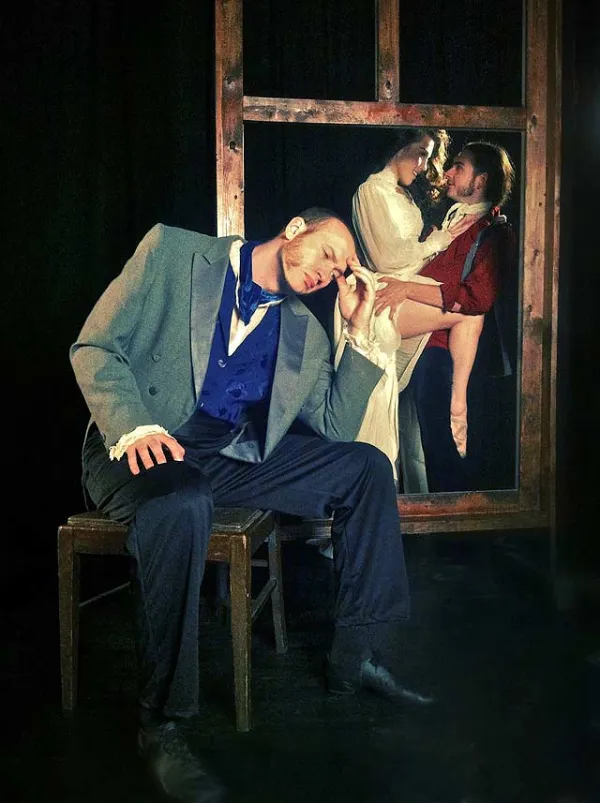
When Available Light Theatre premiered its stage adaptation of Jane Eyre earlier this year, it gave me a new appreciation for Charlotte Bronte’s original novel.
When Shadowbox Live premiered its dance adaptation of Wuthering Heights last week, it gave me a new appreciation for Katy Psenicka’s choreography. It also reminded me that, when she’s not being one of the funniest people who ever graced the Shadowbox stage, Amy Lay is a fine dancer.
As for Emily Bronte’s novel, it’s almost a no-show. Titled Madness & Lust, the new work focuses on the Victorian tale’s torrid emotions without explaining the characters who experience them.
We surmise that young Catherine (Lay) and Heathcliff (JT Walker III) are devoted to each other, but Wuthering Heights virgins will have no idea why. Since Heathcliff spends most of his time wallowing in self-pity and generally acting like a jerk, it’s particularly hard to figure out what Catherine sees in him.
For the many viewers who haven’t read the novel—or who read it too long ago to remember the details—Catherine and Heathcliff’s tortured relationship would make more sense if Shadowbox offered a prologue.
Image

The Free Press Fourth Tuesdays Screenings return to the Drexel Tuesday with an Early Bird Screening of the Columbus International Film & Video Festival Early Bird Screening of:
Love Hate & Propaganda: The War On Terror
90 minutes
Tuesday, October 22 @ 7.30pm
Admission is free, donations encouraged.
Propaganda is a powerful force which has helped shape events of the 20th century. This documentary examines how propaganda influenced significant moments in history, and the lives of the people who lived through them.
Hosted by George Stroumboulopoulos, Love Hate & Propaganda is a primer on the art of mass persuasion aimed directly at a media-savvy generation. Nine days after the 9-11 attacks on the US, President George W. Bush declared War on Terror.
Image

Despite all the awards it’s won, Sunday in the Park With George received both praise and brickbats when it opened on Broadway in 1984. One complaint was that the second act was an inferior and unnecessary addition to its predecessor.
After seeing the Stephen Sondheim work for the second time, I’ve come to the opposite conclusion: I find the musical a satisfying experience precisely because Act 2 completes the emotional and artistic journey that began with the sometimes cold and unfocused Act 1.
“The art of making art,” as Sondheim declares in one of the show’s best-known songs, “is putting it together.”
With a book by James Lapine, who directed the Broadway premiere, the musical is a fictionalized account of French painter Georges Seurat’s creation of A Sunday Afternoon on the Island of La Grande Jatte in 1884.
In Act 1, Georges (Matt Clemens) is so intent on finishing his pointillistic masterpiece that he neglects his lover and model, Dot (Laura Griffith). Around them, various characters observe Georges and are sometimes observed by him as he sketches figures he plans to incorporate into the painting.
Image

Although I am an adoptee rights activist I seldom read adoption books outside of topics I have a specific interest in. I almost always avoid memoirs. To be honest, most are awful. It may be good therapy to write your adoption story, but please leave it in your desk drawer!
Michael Allen Potter's The Last Invisible Continent: Essays on Adoption and Identity is quite a different story. I've been familiar with Mike's work for several years. I knew this book (currently on Kindle) would be important.
Unlike the typical weepy adoption memoir this one is hard and gritty. It's of the street, but also of the heart. Mike doesn't pull any punches about his mother's mental illness, his battle with alcohol, or his rotten adoption, which he discusses almost in passing, though it it obviously the core of his essays.
He calls his work "brutal yet equatable.”
In "The Re-education of Michael Potter," he recounts his rescue of his mentality ill birth mother from the crack house she's been tossed into when rockhead neighbors decide to forcibly switch their dump for her government funded apartment—and charge her exorbitant rent for their dump to boot.
Sadly I report that Mrs. Peaves has sprouted a bunion. The result of which is, yours truly has lingering Dyspepsia. I realize that will require some explaining.
If you don't know, bunions can be quite painful. In Mrs. Peaves' case, the pain is “excruciating” ( her words). The bunion has put her off her game, so to speak.
She cannot spend time on her feet and that has kept her out of the kitchen. Because she is not cooking our meals, I am left to fend for myself, which means I have been eating an overabundance of, oh dear me, fast food.
Ordinarily I do not consume such rubbish. But with Mrs. Peaves on the bench, I have been forced to turn to clowns, pig-tailed little girls, chihuahuas and other such creatures for sustenance.
It pains me. And I mean that. Specifically it pains me in the gastrointestinal area.
Image

If last year’s film version didn’t convince you that Les Miserables belongs on the stage, maybe Otterbein will.
Sure, the film was beautiful, and yes, Anne Hathaway was magnificent as Fantine. But after she took her leave, the rest seemed anti-climactic.
On the Otterbein stage, though, director Dennis Romer and his cast rediscover the heart that’s needed to make the Alain Boublil/Claude-Michel Schonberg musical touch us all over again. Meanwhile, the music soars thanks to a slew of good singers and a full-sized orchestra performing under Lori Kay Harvey’s sensitive baton.
Set before and during France’s June Rebellion of 1832, Les Miz begins just as Jean Valjean (Jordan Donica) is being released after serving 19 years on a chain gang for stealing a loaf of bread. But he’s not completely free, as he soon discovers his status as an ex-con prevents him from finding work.
Valjean retaliates by stealing from a bishop (John Henry Carter) who shows him kindness.
Don't ask, please, why I decided to do it, but I did. I started my own business on the side. Truth be told, I have an abundance of idle time in my work here at the Free Press (please don't say anything to Mrs. Peaves or the nasty little cuss who is the managing editor, neither of whom read what I write).
And so, with that time, I went into business for myself. What that business is, isn't important. It was the motions I had to go through to start that business that is at issue.
Like any new business owner, I assumed I would need a business phone and, of course, a calling card. I believe you Americans refer to them as business cards. Either way, I needed some, or so I thought.
An acquaintance designed and printed my card, though not exactly in the timely manner he had described. Eventually he proudly delivered them to me.
At the time he brought them around, I was on hold with the telephone company, had been for 20 minutes.
Image

Bill Cook has become known for plays that unfold like dreams rather than real life. With his latest, State of Control, he’s graduated from dreams to nightmares.
At its center is Stan (Ben Gorman), an accountant who’s just been hired as the controller for an investment firm. The job title carries a whiff of irony because from the moment he enters the office, his life is out of control.
The boss (Mark Schuliger) keeps him off-balance with compliments and cocktails and keeps pushing him to sign documents he hasn’t had time to read. Co-worker Melissa (Amy Anderson) plies him with come-ons that even Helen Keller couldn’t miss, all the while ignoring Stan’s protestations that he’s married.
Things get even more uncomfortable when Stan and Melissa are sent on a “rainmaking” trip to Las Vegas and she encourages him to risk thousands on a shaky bet.