
Arts



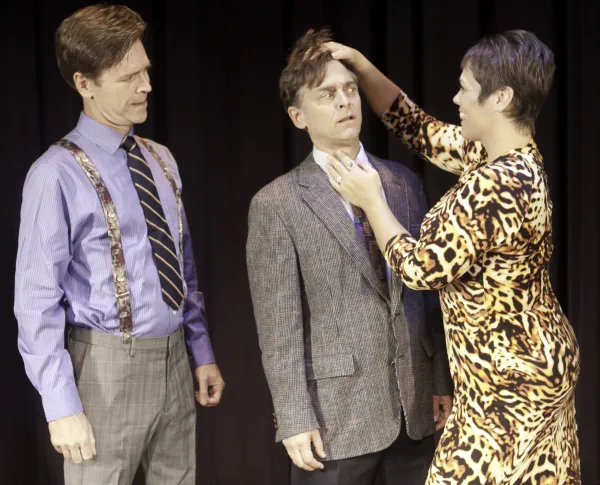
Though he now teaches humanities at Columbus State, Bill Cook has spent time behind bars. He called on that experience while writing his latest play, State of Control, the story of a man who blunders his way into a prison cell.
Speaking about the play last week, Cook explained that his own prison experience was as an employee, not an inmate.
“I worked at the Franklin County jail back in the ’70s,” said Cook, 62. “I sold candies and so on to prisoners from the commissary. I would take it up on the various floors and pass it through the bars.”
While he was not serving a sentence, Cook remembers the sensation of being trapped after passing through two locked doors in order to do his work. “I got this odd feeling I was locked into my job.”
Directed by Matt Hermes and presented by Cook’s own troupe, A&B Theatricals, State of Control begins a two-week run on Friday. At the center of the tale is Stan (played by Ben Gorman), an accountant who becomes the fall guy for an embezzlement scheme and pays for it with a prison sentence.
In the playwright’s eyes, being imprisoned is the average American’s greatest fear, surpassing even cancer.
Imagine you’re in your final audition for a role you’ve always wanted to play. Standing fewer than 40 feet away judging your performance is the character you’re supposed to be playing.
That was the challenge facing Jason Kappus, who plays Bob Gaudio in the musical Jersey Boys. Kappus and company present the two-and-a-half hour musical Sept. 17-29 at the Ohio Theatre (39 E. State St).
Gaudio, who wrote most of the lyrics for the show based on the lives and times of the Four Seasons, played an active role in the casting of the show.
“That was a little bit nerve wracking having him look on while I was trying to be him,” Kappus says. “The best advice I got was right before my final audition. The associate director told me the role Bob cares the least about in the show is Bob Gaudio. It’s his wife Judy that you have to impress. Apparently that went well.”
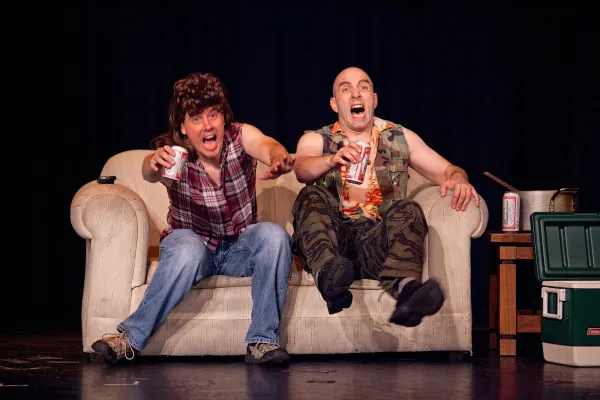
It’s September, which means it’s time for Nightmare on Front Street, the latest version of Shadowbox Live’s annual Halloween show.
What’s that you say? You’re not ready for Halloween yet? Well, don’t feel bad, as it seems to have crept up on Shadowbox, too. The show has funny moments here and there, along with some smokin’ rock tunes, but this is not one of the troupe’s better efforts overall.
For starters—or rather, finishers—Shadowbox ends the show by interrupting a typical Dr. Mystery episode with an attempt at political commentary. As longtime patrons know, Dr. Mystery is a silly combination of narration, puppets and live action that is usually good for a laugh, a chuckle or at least an eye roll. It’s probably possible to add politics to the mix if it’s done on the sly, but the current skit does it in a heavy-handed way that only succeeds in bringing the whole thing to an awkward halt.
Actually, most of the show’s second half is much better.

Watching a movie about sex, like engaging in the act itself, is more fun if you can avoid distractions. Unfortunately, it’s hard to watch a new movie about sexual addiction without being distracted by memories of two earlier films.
The newcomer is Thanks for Sharing, directed and co-written by Stuart Blumberg. The first earlier film was The Kids Are All Right (2010), an unconventional family drama that also was co-scripted by Blumberg. The other was Shame (2011), a dark work about a man whose sexual addiction controlled his life.
Though Thanks for Sharing isn’t bad, it pales in comparison to these earlier films. It lacks the naturalness and unpredictability of the first, and it lacks the sheer power of the second.
Think of it as Shame Lite.
Set in Manhattan, the comedy-drama centers on three men who attend 12-step meetings in an attempt to control their dictatorial desires.
P { margin-bottom: 0.08in; direction: ltr; color: rgb(0, 0, 0); font-family: "Times New Roman",serif; font-size: 12pt; font-style: normal; font-weight: normal; line-height: 100%; text-align: left; widows: 2; orphans: 2; text-decoration: none; page-break-before: auto; page-break-after: auto; }
New York Drama Critics’ Circle Award. Outer Critics Circle Award. Pulitzer Prize finalist. All this, plus a rave review in The New York Times.
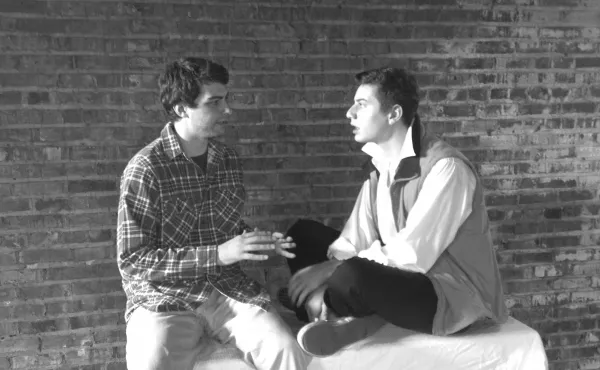
Stephen Karam’s Sons of the Prophet picked up lots of praise after opening off-Broadway in 2011. In subsequent regional productions, however, its reviews have been more mixed. After seeing Evolution Theatre Company’s production last weekend, I suspect the tragi-comedy is a tricky piece that benefited from a brilliant premiere production but has been less fortunate ever since.
Here in Columbus, ETC’s production definitely leaves one wondering what all the fuss was about. Though director Mark Phillips Schwamberger elicits good performances here and there, they aren’t enough to distract viewers’ attention from the overall lack of coherence and energy.
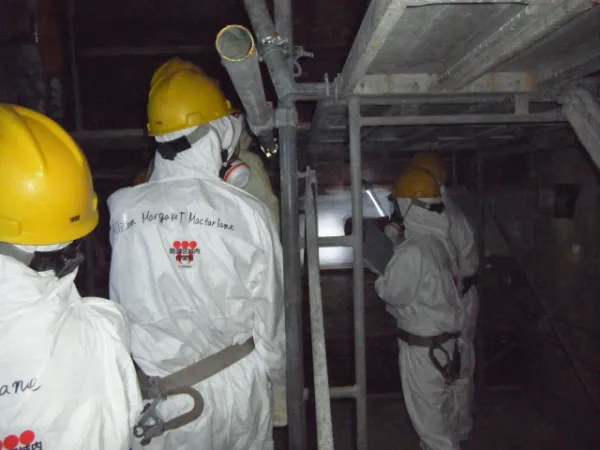
Just when it seemed things might be under control at Japan's Fukushima Daiichi nuclear power plant, we find they are worse than ever.
Immeasurably worse.
Massive quantities of radioactive liquids are now flowing through the shattered reactor site into the Pacific Ocean. And their make-up is far more lethal than the "mere" tritium that has dominated the headlines to date.
Tokyo Electric Power Co (Tepco), the owner/operator, and one of the world's biggest and most technologically advanced electric utilities, has all but admitted it cannot control the situation. Their shoddy performance has prompted former US Nuclear Regulatory Commissioner Dale Klein to charge: "You don't know what you are doing."
The Japanese government is stepping in. But there is no guarantee, or even likelihood, it will do any better.
In fact, there is no certainty as to what's causing this out-of-control flow of death and destruction. Some 29 months after three of the six reactors exploded at the Fukushima Daichi site, nobody can offer a definitive explanation of what is happening there or how to deal with it.