
Editorial
I was sorting the postal delivery recently when I opened an envelope addressed to my wife. It announced a “national campaign” and “citizen opinion survey” from the right-wing activist group Faith & Freedom Caucus’s “founder and chairman” Dr. Ralph Reed, PhD (redundantly and insecurely using both Dr. and PhD).
Aware of the group and its negative reputation among the legitimate media and public interest groups, I noticed these bold-typed statements leading the pitch and request for donations: “To Teach Millions of Young Americans What Made America Great and Train the Next Generation of Patriotic Leaders for America” and “Concerning the Assault on America by the Media, Our Nation’s Educational Institutions and Today’s Democratic Party.” I also noted that Reed boasted a “PhD in American History from Emory University” and writing “a number of books on America’s history and politics—including three national best-sellers.”
Fearing for his political life, at the end of August, Gov. DeWine joined the right-wing blinded parade in opposing teaching critical race theory in Ohio’s K-12 schools. Not only would this be anti-democratic (small d), unconstitutional, and a threat to the maturity of Ohio’s children, but it is based on a lie. [“Mike DeWine opposes teaching critical race theory in Ohio's K-12 schools” Columbus Dispatch, Aug. 31, 2021 (https://www.dispatch.com/story/news/2021/08/31/ohio-gov-mike-dewine-doesnt-support-teaching-critical-race-theory/5647715001/)]
I continue my examination of The Ohio State University. In this essay, I focus on several dimensions of public health. Ohio State has a large medical center and various public health programs. Yet they are not involved with the university’s public health endeavors. See my previous essays: “Colleges can learn from sports figures about mental health,”Inside Higher EducationSept. 13, 2021; “For Ohio State, bigger is not better,” Columbus Free Press, Sept. 16, 2021; “The decline of a once vital neighborhood: Columbus’ University District,” Columbus Free Press, Sept 14, 2021; “Columbus’ University District: Students and the institutions that fail them,” Columbus Free Press,Oct.
I continue my examination of The Ohio State University. In this essay, I focus on several dimensions of public health. Ohio State has a large medical center and various public health programs. Yet they are not involved with the university’s public health endeavors. See my previous essays: “Colleges can learn from sports figures about mental health,”Inside Higher EducationSept. 13, 2021; “For Ohio State, bigger is not better,” Columbus Free Press, Sept. 16, 2021; “The decline of a once vital neighborhood: Columbus’ University District,” Columbus Free Press, Sept 14, 2021; “Columbus’ University District: Students and the institutions that fail them,” Columbus Free Press,Oct.
No longer a leader, Ohio Governor Mike DeWine’s failures are clear. (For background see my Dispatch guest opinion piece Opinion: DeWine’s blundered coronavirus response. Vax-A-Million didn't help and Governor Mike DeWine’s continuing Covid failures: The .Ohio tragedy. Despite national attention for early actions and his $5 million vaccination lottery, DeWine is committed to public relations not policy.
DeWine began spring 2020 strongly. His daily press conferences were memorable because of state Department of Health director Dr. Amy Acton’s knowledge and articulateness. Acton ran the show with her popular appearances and mandates to limit the “first wave” from March into June. Science ruled as Ohio was briefly a national leader in partial lockdowns, restrictions on gatherings, and mask mandates. Despite right-wing condemnation, these measures were largely successful.
I begin with a partial disclaimer. My knowledge about the failures of Columbus city government comes largely from the middle-to upper-middle-level officials with whom I have the pleasure of speaking with. They strive to make a deeply flawed “system” work as well as it does.
My efforts since last winter to stimulate more responsive and responsible actions, including enforcement and revision of existing laws, led to my collaboration with City Council legislative aides, the City Attorney and his office, Neighborhoods Engagement, Zoning/Code Enforcement, 311, and the Columbus Police Department (CPD).
The connections are primarily through personal contacts with individuals and their programs; they are selective and not systematic. The degree of disconnection, however, defies comprehension. City Councilmember and city departments are poorly aligned. Departments are not well connected. Therein lay multiple clues to the problems.
Two and a half months ago, I published this letter to the editor in the Toledo Blade, Aug. 29, 2021:
Where is the Ohio Democratic Party?
“Where is the Ohio Democratic Party? Commentators like me address Ohio’s unusually severe gerrymandering and the outpouring of partisan, often dark-money and questionably legal campaign contributions for the right-wing Republican dominance in the state. This is certainly true.
“But there is another reason: the seldom discussed absence of the state Democratic Party. To speak for myself: I am literally bombarded with emails and postal mailings (despite the failings of USPS) for the national Democratic Party (in many different forms), progressive advocacy groups (MoveOn and CommonCause, for example), and more traditional groups like the ACLU. I have never heard from the Democratic Party of Ohio. I receive mailings, including personal notes, from only one elected Democrat, Sen. Sherrod Brown.
“I have attempted to contact the state party and reached out to candidates ranging from Tim Ryan and Nan Whaley to District 15’s Allison Russo. I have never received a response.”
Note: My apologies for misspelling Chase Meola’s last name. No offense was intended. To other readers, I am not minimizing the very real crime problems. As a retired professor, University District homeowner, and critic of the institutions involved, I do not speak directly for students. I am advocating for a serious, sound, honest, and responsible set of crime reduction and safety policies and their enactment by Ohio State, the City, and Columbus Police Department (CPD). We have not seen that.
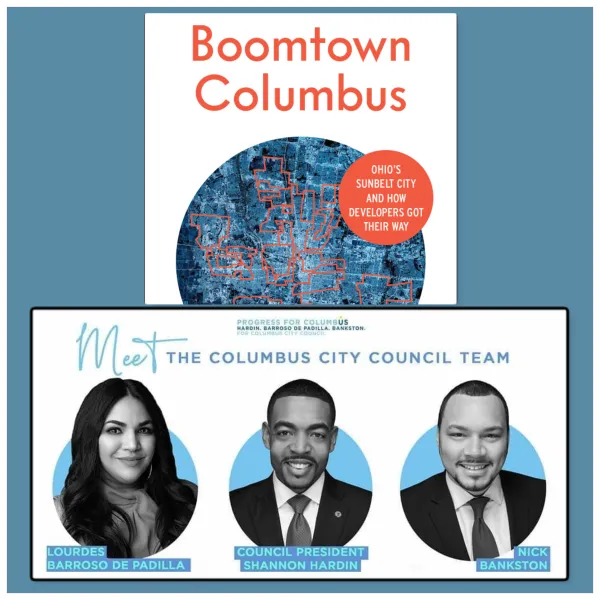
The following is from the author of Boomtown Columbus, Ohio’s Sunbelt City and How Developers Got Their Way
Joe Motil’s article in the Free Press published November 1st makes some excellent points. He is absolutely correct on how Columbus City Council is a closed shop; a case for breaking and entering, though it is very hard to do. What concerns me most here is Joe’s reference to City Council’s incestuous relationship with the developers. How to resolve this subordination isn’t clear, except that discouragingly, the solution is unlikely to be local.
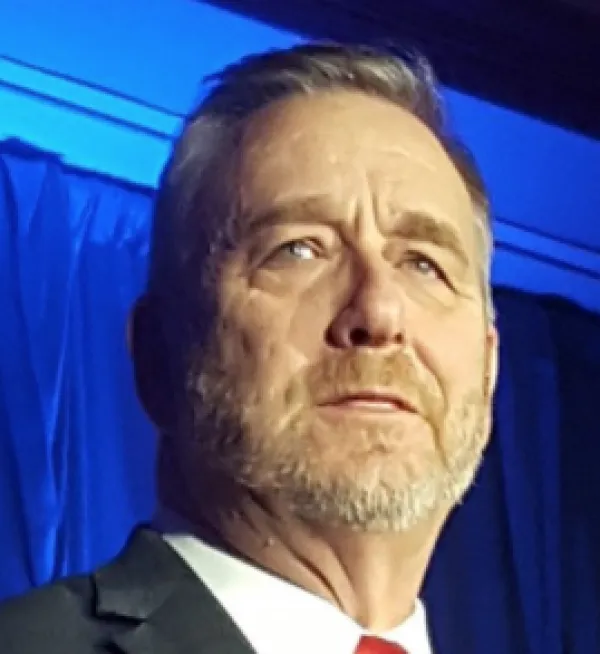
Ohioans across the political spectrum should appreciate Attorney General Dave Yost for fighting the corruption that has been exposed by the historic HB 6 scandal, but he should go even further. Occasionally in Ohio politics, it’s okay to give credit where credit is due –– Yost’s office has filed a landmark civil racketeering lawsuit against all of the indicted parties (and a few others who are in hot water) which prohibits them from lobbying or holding public office for eight years. “Everyone involved in this sordid matter needs to pay a price,” Yost has said. “The goal is to leave no doubt –– among politicians, the powerful and the rich –– that engaging in public corruption will ruin you."