
Human Rights

On June 24, Donald Trump issued an Executive Order (EO) under the title, Strengthening the Child Welfare System for America’s Children.Except for those whom the EO affects, it has already been stuffed down the Trump memory hole. It is, however, an important document with negative far-reaching ramifications for child welfare in the US. To the casual reader, the Executive Order can look benign, positive: a plan for expanded federal child welfare assistance programs to enhance sibling retention, family preservation, unification, permanency, aging out as well as strengthening trauma-informed training and best practice and better reporting standards. It appears to concede a fractured child welfare system, but…
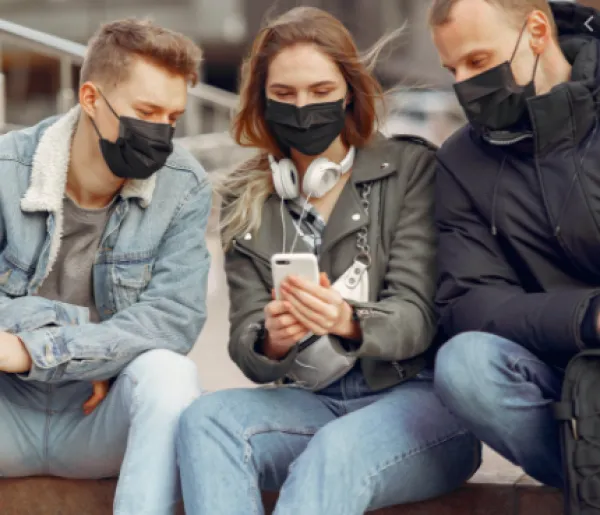
Franklin County’s health department made national news in May after apologizing for issuing mask-wearing guidelines widely denounced as racist. The story was carried in newspapers from the Washington Post to the Seattle Times, in the national magazine The Week and by CNN.
A place the story didn’t make big news, though, was Franklin County itself. Neither the county’s daily newspaper, the Columbus Dispatch, nor the city’s television stations covered it. WOSU Radio carried a small story, for whatever tiny percentage of the county’s residents follow that.
The guidelines stemmed from the April 3 announcement by the Centers for Disease Control and Prevention (CDC) encouraging the public to wear masks to contain the spread of COVID-19. Some racial minorities voiced concerns they could be profiled by wearing masks. Their anxiety presented the health department with an opportunity to educate central Ohioans to shun racist attitudes.
The department instead told racial minorities they were the ones needing to change, advising them:

In response to sustained pressure from students, parents, alumni, teachers, employees, and community members, the Columbus City School Board opted to let their contract with the Columbus Police Department expire without the usual renewal. That contract expired on June 30, which has led to the recent announcement that CPD is “abolishing” 22 officers from Columbus Public Schools.

As the vast majority of companies rush to reopen and people rush back to public life, they’re falling into the trap of “getting back to normal.” They’re not realizing we’re heading into a period of waves of restrictions once again, due to many states reopening too soon.
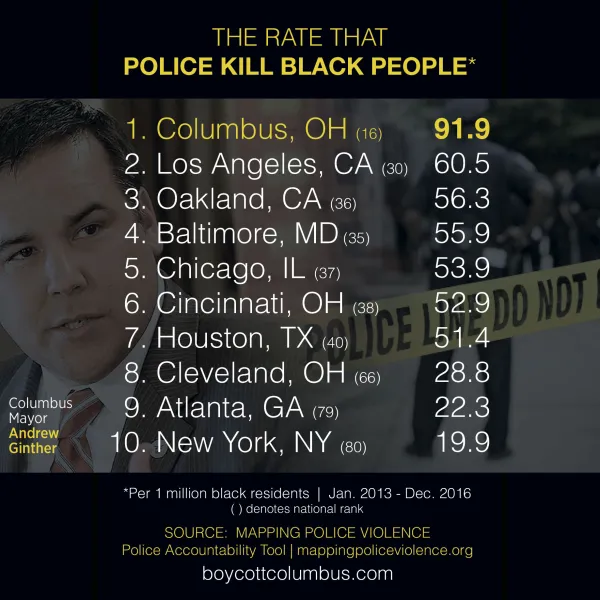
With the recent killings of Black citizens by police that made national and international headlines, Columbus’ troubling history on this topic has resurfaced. A graphic that originally circulated via social media four years ago after the killings of Henry Green and 13-year-old Ty’re King went viral in the past couple of weeks. On June 10th, The Columbus Dispatch posted an article, “Fact Check: Is Columbus the Most likely place in America for police to kill black people?” Their ruling of the graphic is that the information presented is false, however the analysis in this article is deeply flawed.
Let’s start with the title.

A new analysis from the Ohio Immigrant Alliance shows that during the COVID-19 pandemic, the Morrow County Correctional Facility failed to follow its own Infectious Disease Control Program (IDCP), as well as the National Detention Standards (NDS) required in its contract with Immigration and Customs Enforcement (ICE). Because of this, the Morrow County Correctional Facility is now the first county jail in Ohio, and the first ICE detention center in the United States, to be 100% COVID-positive.

Joe Motil, a former City Council candidate and outspoken critic of the Columbus Police Department states that, “ It really should come as no surprise that Black America and others who have lost all faith and hope with how police officers continue to avoid being properly prosecuted, have begun displaying their built up anger with combative protesting.”
Motil states that,” Here in Columbus and other cities across the country, the media’s attention is once again centered on the actions of protesters and not where it should be. The media should be questioning city leaders and police chiefs about what they are doing to ensure that rogue police officers shall be properly prosecuted and justice to Black victims and their loved ones will be served.”

As Wendy’s greenhouse defense crumbles, allies look to hold company accountable at tomorrow’s annual shareholder meeting…
Rabbi Rachel Kahn-Troster to Wendy’s: “Given the life-or-death stakes of unsafe working conditions under COVID-19, how can Wendy’s justify its continued failure to join the Fair Food Program?”
Last week, we posted a reflection on the news of a massive COVID-19 outbreak at a greenhouse in upstate New York owned by Mastronardi Produce, one of the largest greenhouse growers in North America and, according to an article from 2019, a supplier to Wendy’s. The overcrowded housing conditions – with workers staying in budget hotels “where they lived four to a room and slept two to a bed” – were the perfect Petri dish for the rapid spread of the novel coronavirus. The outbreak was so severe that it is even being blamed for the death of the husband of one of the hotel employees who cleaned the farmworkers’ rooms and contracted the virus as a result.
Here’s an excerpt from last week’s reflection:
A growing number of Ohio employers have discovered a tool to scale back operations while avoiding layoffs: Worksharing. Ohio’s shared work program allows employers to reduce employee hours by up to half. Workers then receive unemployment compensation proportionate to the hours they don’t work. Employees keep their jobs and benefits, employers avoid hiring and training new workers when demand recovers.
The Ohio Department of Job & Family Services (ODJFS) said May 7 that some 511 Ohio employers are participating, covering 24,247 employees. Altogether, ODJFS has approved 827 plans, up from just 67 on March 15. Another 95 plans covering 2,819 employees are pending. An employer may have more than one plan, and cut hours by different amounts in different operations.
“This mini-explosion demonstrates that shared work could be a valuable tool for employers of all kinds,” said Zach Schiller, Policy Matters Ohio research director. “Moreover, it can also be used by employers to bring workers back to work.”
Tough times call for tough headlines. We at the Free Press can oblige and rightfully so.
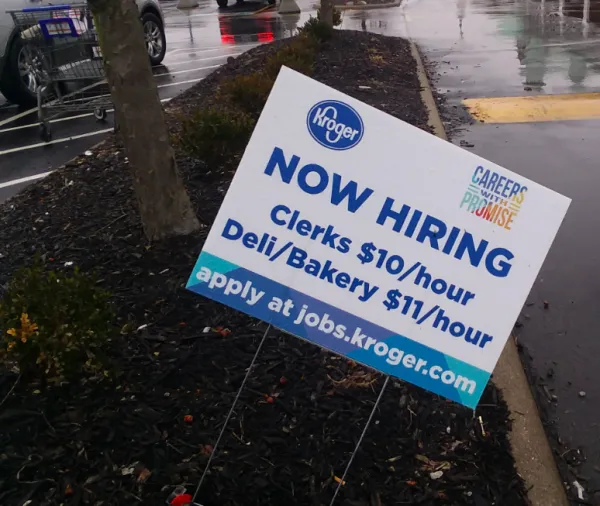
Kroger is the nation’s largest supermarket chain, and arguably Central Ohio’s most popular grocery store.
Yet earlier this week, Cincinnati-based Kroger announced it is ending their $2 more-an-hour “Hero Pay” after May 16th, even as it continues to run expensive commercials thanking its store employees.
Also this week their corporate office released a proxy statement for their June 2020 (virtual of course) shareholders meeting, as reported by the national political news site Popular Information, which is authored by journalist Judd Legum. The Securities and Exchange Commission (SEC) requires companies to provide a proxy statement to shareholders.
Proxy statements reveal CEO compensation, and the Popular Information article states: