
News

According to the Freedom Flotilla Coalition, “All the Freedom Flotilla and Thousand Madleen boats were pirated in the early hours of October 8, 2025.”
Among the crew on the flotilla is Tom Hayes, a documentary filmmaker and Associate Professor of Instruction in the School of Film at Ohio University, currently serving as a media volunteer.
Hayes was sailing on a boat called the Conscience, carrying dozens of international journalists and medical professionals from 25 countries. The Conscience was on a mission to break Israel‘s illegal siege of Gaza, challenge Israel’s media blackout of Gaza, and affirm the Palestinian people’s right to live in freedom and dignity.
Ohio University Faculty and Staff for Justice in Palestine join the Freedom Flotilla Coalition in demanding the following:
· An end to Israel’s illegal and deadly blockade of Gaza;

Banned Books Week (October 5–11, 2025) is an opportunity to celebrate literature and a reminder that reading is resistance in our fight for the freedom to learn.

US Energy Storage Sets New Record
The U.S. energy storage market set a record for quarterly growth in the second quarter of 2025, with 5.6 GW of installations, according to the latest U.S. Energy Storage Monitor report released today by the American Clean Power Association (ACP) and Wood Mackenzie.
The utility-scale market led the way, setting a record with 4.9 GW installed, enough capacity to power 3.7 million American homes during average peak load demand.
The residential storage market expanded 608 M. This represents a 132 percent increase year-over-year and an 8 percent jump quarter-over-quarter.
Most of the growth was driven by California, Arizona and Illinois,Residential storage is expected to outpace solar due to stronger policy resilience, high attachment rates in key markets and continued investment tax credit access through third-party ownership."
Wood Mackenzie projects that these record levels of additional storage capacity will continue into the foreseeable future.
Renewable Energy Jobs grew 3X faster in 2024

We Have a New Resource for Central Ohio Recyclers!
Recycling can be confusing — the details of what can be recycled and how we recycle keep changing in Central Ohio as advances in technology allow us to do more! That’s why Simply Living created a Household Recycling Resource Page
How to Recycle Household Items in Central Ohio.
We hope this cheat sheet, brought to you by volunteer Ann Marie Condo and Board Member Vilvi Vannak here at Simply Living, serves as a great resource. And we promise to keep it updated as new information becomes available.

I’m not going to say there’s a falling out among the thieves, because I don’t want to cast aspersions, but there’s a thunderstorm in heaven, there’s a break in the ranks, there are flies in the anointment, or whatever expression you want to choose, it’s not trivial, and perhaps very important, that there is finally some proof of life within the Republican caucus in the Senate and the US House of Representatives over the wild and crazy dictates of cabinet members and appointees trying to outdo themselves in fealty to Trump’s whims and wishes. After allowing Trump and his people to roll over elected members of Congress, this is might be a finger in the wind for change. Additionally, where the conservative ecosystem has essentially been an obsequious amen corner on almost every Trump connect outrage, finally there’s a stirring of complaint.

Sunday, September 21, from 2:30 to 4:30 p.m.
Corban Commons, 3426 Corban Commons Drive, Columbus, OH 43219
Sun Day is a nationwide celebration of clean energy progress and a call to accelerate the transition that's already underway. We'll be joining communities across the country to showcase the businesses, organizations, and families that are already leading the way to a clean energy future. Corban Commons is an affordable senior living center in Columbus that recently added a large rooftop and ground-mount solar array.
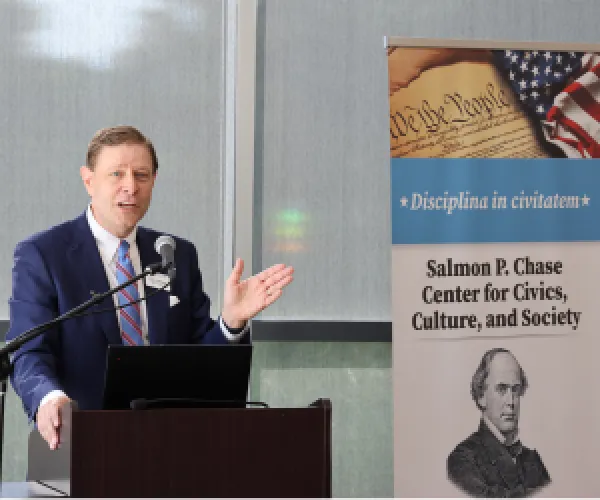
Is a lack of intellectual diversity causing university faculty to self-censor? That’s a central claim made by advocates of Ohio State University’s Salmon P. Chase Center for Civics, which is one example of a slate of new “viewpoint diversity” centers established recently on college campuses. In an era of dwindling state support for higher education, Ohio State’s version was created by the state legislature (over the objection of the Faculty Senate) at an initial cost of $24 million.

Monday, September 15, Columbus City Council President Shannon G. Hardin and Columbus Mayor Andrew J. Ginther announced that the city is now accepting applications for the newly formed LGBTQ+ Affairs Commission.

Columbus’ political establishment is being forced to reckon with a new generation. On Sunday afternoon, the nonprofit Columbus Stand Up! hosted its second annual youth-led candidate debate at Fort Hayes Education Center, where students as young as 15 grilled candidates for Columbus City Council District 7 and the Columbus City School Board.
In a city where partisan politics often feel scripted, the event broke the mold: teens and twenty-somethings set the agenda, filled the auditorium, and put candidates on notice that the next generation is watching.
A Race Defined by Nepotism and Party Politics
This year’s contests are already thick with insider maneuvering. District 7’s council race — representing Downtown and surrounding neighborhoods — has been shaped less by policy and more by partisan endorsements.
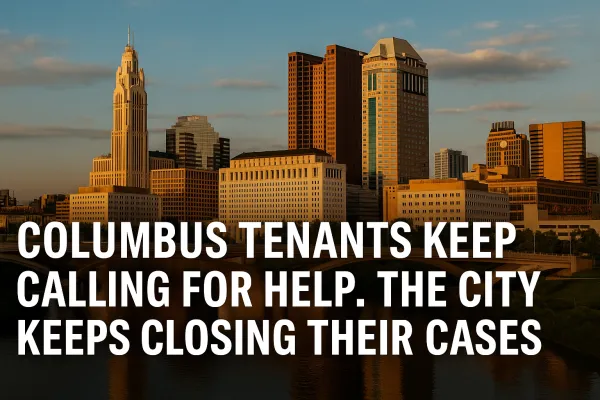
Columbus is in the middle of a building boom. Sleek apartment towers climb skyward, marketed with rooftop lounges and pet spas. Rents stretch past $1,500 for one-bedroom units. But a very different Columbus exists on the other side of the leasing office glass: one where families tuck their children into bedrooms streaked with black mold, where winter nights are endured with broken furnaces, and where cockroaches scurry across kitchen counters.
These tenants aren’t silent. They are doing exactly what the city says they should — calling 311, filing code complaints, and showing up in Environmental Court. Since January 2024, Columbus renters have filed more than 7,000 housing complaints, and the court has opened nearly 2,600 cases. Judges have ordered more than $1 million in fines against landlords.
Yet the same addresses keep appearing in 311 logs, the same landlords keep showing up in court dockets, and the same families keep waiting for repairs that never come. Columbus’s enforcement system documents the crisis in detail, but rarely fixes it.
Thousands of Complaints, Few Consequences