
News
The Ohio Secretary of State, Jon Husted, declared that the citizens of Medina, Fulton, and Athens Counties may not vote on their own county charter initiatives, despite meeting requirements to place those initiatives on the November ballot.
In a statement released yesterday, Mr. Husted – elected by the citizens of Ohio – made clear that his interests lie with the oil and gas industry, rather than We the People. Despite the people’s constitutional right to alter or reform their own government, Mr. Husted claims “unfettered authority and being empowered by the Ohio Revised Code” to deny the people their constitutional right.
This summer, Medina, Fulton, and Athens County residents secured the necessary signatures to place county charter initiatives on the November ballot. Each of these counties faces fracking wastewater injection wells, LNG pipelines, and other infrastructure projects that threaten to pollute clean air and pure water, regardless of community wishes.
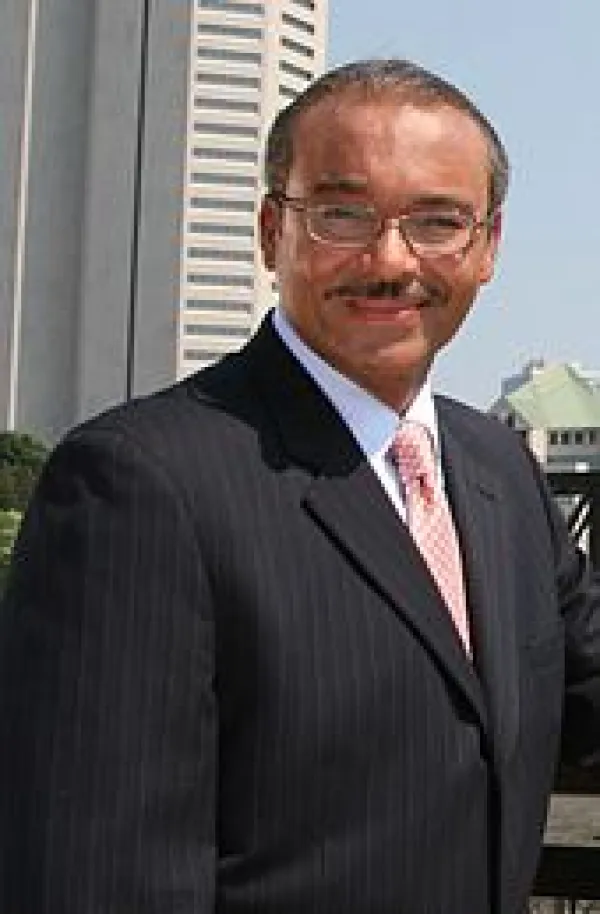
As the FBI continues to scrutinize the relationship between Mayor Michael Coleman and Chinese business woman Jianhua Li, their investigation has exposed a tiny window into how local power brokers are wooing foreign nationals to ship their foreign-manufactured goods into Columbus’ booming and secretive Foreign Trade Zone hub at Rickenbacker airport. Where the corporate taxes are low and a significant number of workers are temporaries who “pick pack” the imported goods and paid $9-an-hour while being treated like second-class citizens, say local labor activists.
The Free Press earlier this year wrote about Rickenbacker’s “Free Trade Zone #138,” an FTZ that by all accounts is growing into a juggernaut. In 2013 over $6.3 billion worth of merchandise was imported into Rickenbacker, ranking it in the top-ten for the nation’s 177 FTZs.
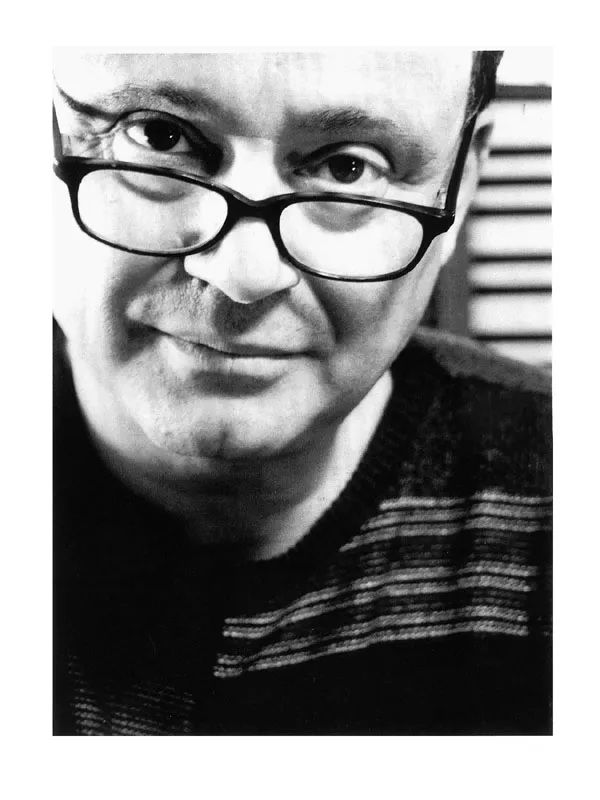
Rocco Di Pietro is a renowned composer and pianist based in Columbus, Ohio. He is also a writer (among whose many publications is Dialogues with Boulez) and educator (currently teaching at Columbus State Community College). Visit www.dipietroeditions.comfor some of his works available online.
Q. What is the title of your latest work reflecting upon the 70th anniversary of the atomic bombings of Hiroshima and Nagasaki?
My latest work is called Taubes VII (Hiroshima Set). It is part of an ongoing series of interactions between photographs and other visual elements with a programmatic, even syncretic, interplay between music and visual art, which I relate to ectoplasms in sound extracted from a visual presence.

What conditions bring peace? What conditions bring war? How do people address them? Many families and communities have split over these topics, as they can bring a great divide of opinion and historical recollection.
This year, August 6 marks the 70th anniversary of the U.S. atomic bombings of Hiroshima and Nagasaki. The bomb “Little Boy” was dropped on the Hiroshima population of 255,000, causing 135,000 casualties: 66,000 dead and 69,000 injured. On August 9, another bomb “Fat Man” was dropped on a population of 195,000 in Nagasaki, causing approximately 64,000 casualties: 39,000 dead and 25,000 injured. These are the Manhattan Engineer District's best available figures.
Mark Stansbery is president of the Columbus Campaign for Arms Control, a local affiliate of Peace Action. He does not believe that a large military society brings peace.
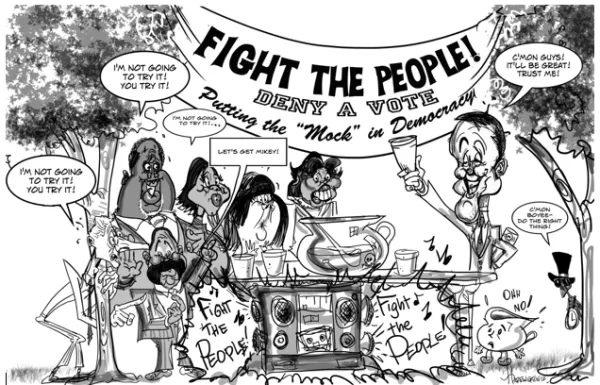
Under the state constitution and the Columbus City Charter, everyday citizens have the right to propose legislation using the citizen initiatives process. In short, if citizens can collect 10 percent of valid signatures from registered Columbus voters, the Columbus City Council is required to put the question on the ballot for a vote. Two groups have recently sought to use those provisions. In a tough year for citizen initiatives, both have failed for lack of sufficient signatures – but those failures exposed apparent manipulations of city government seemingly designed to make the process even more arduous – if not impossible for citizens to exercise their constitutional rights.
City Council President and Mayoral Candidate Andrew Ginther is leading the chorus of citizen suppression, with City Attorney Rick Pfeiffer serving as hype man for the new band, launching “yeah boyyyeeee” whenever Ginther clamps down more on local democracy. Pfeiffer has provided legal ammunition to keep citizen initiatives off the ballot and has tried to strengthen Ginther’s claims that he was not bribed as a Redflex executive said in her federal guilty plea.

“Since many of today’s best-known manufacturers no longer produce products and advertise them, but rather buy products and ‘brand’ them, these companies are forever on the prowl for creative new ways to build and strengthen their brand images…This requires an endless parade of brand extensions, continuously renewed imagery for marketing and, most of all, fresh new spaces to disseminate the brand’s idea of itself,” Naomi Klein, No Logo: Taking Aim at the Brand Bullies

Human traffickers do not discriminate when it comes to their victims, according to Amy O’Grady, director for criminal justice initiatives for the state Attorney General’s Office (AGO).
“They are targeting anyone who is vulnerable, and anyone they think that they can gain control over,” she said.
According to the Ohio Human Trafficking Commission, a preliminary report on the scope of the problem in the state cited 13 as the most common age for youth to become victims of child sex trafficking. From the study’s sample of 207 individuals, 49 percent were under 18 when they were first trafficked. Nationally, over 100,000 children are thought to be involved in the sex trade.
As a result, state law enforcement officers are conducting more human trafficking investigations and identifying more potential traffickers and trafficking victims than have ever been reported before. And while it may seem like a crime that is more prevalent in Ohio, it is not the case.

Cannabis is like our friend the dog. Seriously. It can be bred to produce a variety of species that appear to be quite different from one another. Large Labrador Retrievers may seem to be an entirely different species than tiny Toy Poodles, but they are both canines nonetheless. Such is hemp to its storied cousin, marijuana, better known by its scientific name, Cannabis. It is but one plant with many uses.
As a species of the genus Cannabis sativa L, hemp is characterized not only by its tall, strong stalks, but also by its trace amounts of the THC that produces the well-known high. Still, hemp carries much of the same baggage as its well-known cousin, inhibiting development of those many uses. Via the courts, state legislatures and other regulatory bodies, hemp and its constituent products are finally beginning to establish footholds in the global market place.
Columbus City Council President and Mayoral Candidate Andrew Ginther is seeking to explain away yet another public sector scandal – just as the school data scrubbing scandal he was involved in recedes into the background with the plea bargain of Michael Dodds, the last Columbus City Schools administrator to be charged with a crime. In a new scandal, Karen Findley, an executive of Redflex Corp (the Citys’ red light camera provider) pleaded guilty to conspiracy in federal court in mid-June for bribing Columbus elected officials – including Ginther – to secure the contract in violation of 18 USC 370.