
Politics
Once again, a voter ID bill briefly reared its head again in the Ohio legislature. Ohio House Bill 41 in its original form sought to alter Ohio early voting requirements. State Representative Bernadine Kent (D-25) asked me to analyze the bill and offer testimony on its hearing in the Government Accountability and Oversight Committee.
Here’s my brief analysis. The bill continues a bizarre and undemocratic practice introduced in 2004 by our infamous Secretary of State J. Kenneth Blackwell. That is, if voters are at the correct polling place but is directed to vote in the wrong precinct -- their vote will not be counted. The bill reads in a key section: “If an individual cast a provisional ballot in a precinct in which the individual is not registered and eligible to vote and in the incorrect polling location for the precinct in which the individual is registered and eligible to vote the provisional ballot shall not be opened and the ballot shall not be counted.”
I imagine I’m not the only political and media observer sickened by the dominant (“mainstream”) corporate media’s habitual reference to xenophobic, right-wing, white-nationalist, and neo-fascist politicians like Donald Trump, Geert Wilders, Nigel Farage, and Marine Le Pen as “populists.” Populism properly understood is about popular and democratic opposition to the rule of the money power – to the reign of concentrated wealth. It emerged from radical farmers’ fight for social and economic justice and democracy against the plutocracy of the nation’s Robber Baron capitalists during the late 19th century. It was a movement of the left. As the left author and journalist Harvey Wasserman notes:
“The Morgans, Rockefellers and their ilk had captured the industrial revolution that dominated the U.S. after the Civil War. The farmers of the South and West fought back with a grass-roots social movement…They formed the People’s Party. Its socialistic platforms demanded public ownership of the major financial institutions, including banks, railways, power utilities and other private monopolies that were crushing the public well-being.”

In Columbus, the enormous influence of corporate interests and wealthy campaign donors are reflected in the city's policies and initiatives. As a result of these imbalances, many of the city’s residents, particularly those in poor and minority neighborhoods, have very little impact on decisions made by our city’s political leaders.Although the political leadership in Columbus is dominated by the Democratic Party, this does not necessarily translate into progressive policies.
The Easton tax abatement is not old news and we cannot treat it as such. City officials agreed to a complex, massive tax giveaway worth $68 million to an out-of-state corporate developer (also, a campaign donor to the mayor) to build housing at Easton Town Center. The developer, in return, agreed to provide a mere $5.75 million for infrastructure and revitalization efforts in Linden, most of which will be reimbursed by taxpayers.

The Columbus Dispatch apparently is abandoning its hard-right editorial page slant with the departure of Glenn Sheller, announced March 19. It advertised the vacancy in journalismjobs.com on March 2.
The longtime editorial page editor reflected an ultra-conservative point-of-view that was horribly out of step with the newspaper's core audience in deep blue Columbus and Franklin County, as I have pointed out more than once in this column, Sheller's head in the sand perspective may have been costing the print and web product thousands of subscribers and readers, not to mention advertisers.
In a column announcing Sheller's departure, Dispatch editor Alan Miller quoted publisher Bradley Harmon as saying that the next editorial page editor should reflect the “need for diversity to better mirror the growing, evolving region we serve.”
Harmon's statement could be interpreted to mean that Sheller's views were not congruent with the region's.

Gloria Steinem and Madeleine Albright scolded young women for supporting Bernie Sanders instead of Hillary Clinton before the 2016 presidential primary. They implied that in supporting a candidate based on politics instead of gender, millennials are either ignorant or complacent about the feminist struggle.
On March 8, the International Women’s Day celebration on the Ohio State campus revealed just the opposite. Many of the young women, men, and non-cisgender people who gathered on the Oval had just come from a 1,000-strong solidarity teach-in organized by Columbus Coalition for International Women’s Day. Most were far more in touch with the radical foundations of the women’s movement than its most recognized “icons” are.
“I’m a Marxist feminist, like Angela Davis and Rosa Luxemburg,” said Emily Shaw of the International Socialist Organization.

Bowling Green, OH: The Bowling Green Climate Protectors coalition announced today they are gathering signatures to place their Community Rights to a Healthy Environment and Livable Climate City Charter Amendment on the November 2017 ballot. The measure is the first of its kind in the state. Similar measures are being advanced in Spokane, WA, and Lafayette, CO. Each community is fighting fossil fuel activities.
The Bowling Green amendment was drafted by Bowling Green students and City residents, working with the assistance of the Community Environmental Legal Defense Fund (CELDF). The student-resident coalition formed when Spectra Energy Corporation requested an easement from the City for the Nexus pipeline to cut through City limits. Community members crowded City Council meetings, urging their representatives to deny the easement. While the easement was not granted, residents learned the pipeline would pass under the Maumee River, threatening the City’s drinking water source and located perilously close to the Bowling Green Fault.
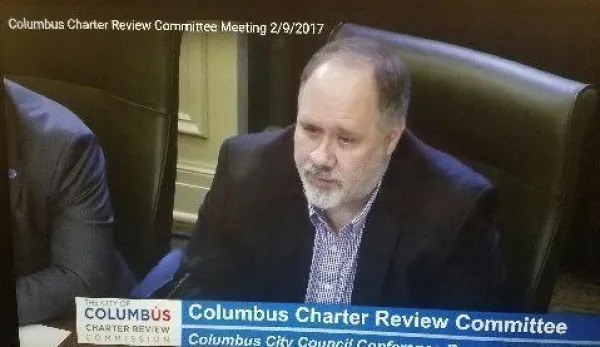
Why did Bryan Clark, who managed the anti-Issue 1 campaign last year, have a seat at the table at Columbus Charter Review Committee meetings? Last year Clark, chief policy advisor for Columbus Mayor Andrew Ginther, took a leave of absence from the mayor’s office to manage the campaign against Issue 1, the citizens’ initiative proposing an expanded City Council with district representation.
Issue 1 was defeated at the Aug. 2 special election. Many activists believed that Issue 1 lost because of an expensive propaganda campaign by the opposition full of blatant distortion about how large Council would get and the costs to taxpayers if Council expanded.
Clark was among several city employees who made repeated presentations at the Charter Review Committee’s 12 meetings. He was continually at the table in front of them to answer questions and make comments. He and J. Edward Johnson, city council’s director of legislative affairs, were so involved with the committee’s final recommendations that one member suggested calling it “The Clark-Johnson Plan.”

The Columbus Charter Review Committee is considering possible recommendations for changing Columbus City Council. City officials announced the committee just weeks before the August 2, 2016 special election on Issue 1. Columbus voters in that election turned down a citizens' initiative to expand the size of council and add district representation. Before the vote, city officials said the committee would use a better process for studying reforms of council.
The committee sees problems with the present council of seven members all elected at large. They recognize that council's size is smaller than in similar cities. They likely think each council member cannot be familiar with all of Columbus' more than 200 neighborhoods. And they're concerned that some areas have had no representative on council for decades.

This week, the Senate will vote to confirm Scott Pruitt, the Oklahoma Attorney General who has spent a sizeable chunk of his tenure as Attorney General organizing other states to sue the very agency he's slated to lead.
This is a problem for America, and Ohio.
The Environmental Protection Agency protects the water, air, rivers, lakes, streams, forests, prairies, mountains, and coastlines we all love. And equally as important, the EPA ensures that big polluters like the fossil fuel industry, big utilities, and their allies, do not abuse our lands and leave the little guy to pay the price either economically or with less secure public health.
Pruitt's place at the helm of the EPA threatens to take all the work we've done to develop this agency off course. He does not believe in science or climate change, and this fundamental lack of understanding is not a good foundation for continuing the work to preserve our clean water, clean air, and preserved lands in the United States.

Donald Trump, who lost the 2016 presidential election by at least 2.8 million votes, has announced an "investigation." He says the federal government will look into his false assertion that some three million illegal aliens voted for Hillary Clinton last fall, allegedly costing him a popular vote mandate.
The assertion is being gleefully rejected by much of the corporate media as "a lie."
If we thought his calls for an investigation of our thoroughly broken election system were serious, we would welcome them.
But Trump's relentless obsession with voter fraud has very effectively shielded the corrupted electoral system that put him in the White House. His loud shouts have completely blacked out any discussion of the massive Jim Crow registration stripping, electronic vote flipping, and slavery-based Electoral College that put him in the White House, and that have effectively neutered American democracy.
Meanwhile, Al Gore, John Kerry and Hillary Clinton, all of whom rightfully won presidential races but then refused to fight for them, have said not a word about any of this.