
Protest Reports
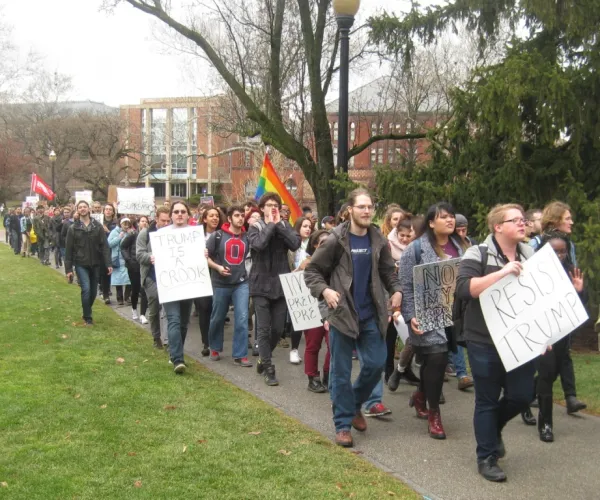
People on the radical left have criticized the 3 million Americans who protested the Donald Trump inauguration for not being radical enough, not being black or brown enough, not being working-class enough. There is some validity to these critiques; a thriving movement against Donald Trump must be centered on the struggles of women of color, working class people, immigrants, and other marginalized groups. But there has been an attitude of shaming people — many of whom are becoming politically active for the first time — for not being “woke” enough.
Keeanga-Yamahtta Taylor has rightly pointed out that this attitude is politically immature and counterproductive. “The movement to resist Trump will have to be a mass movement, and mass movements aren’t homogeneous — they are, pretty much by definition, politically heterogeneous,” she writes in The Guardian. “And there is not a single radical or revolutionary on Earth who did not begin their political journey holding liberal ideas.”
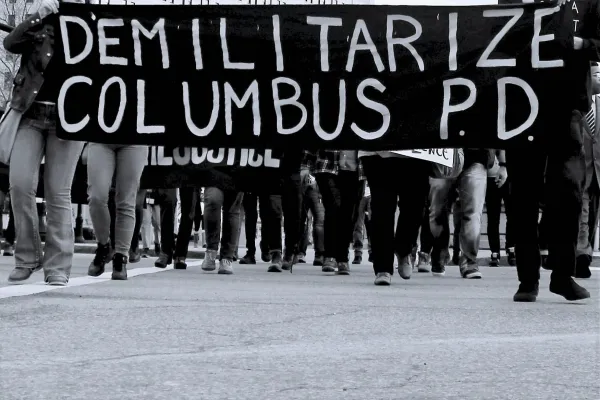
January 20 was marked by protests across the U.S. against the inauguration of Donald Trump. One of several actions in Columbus was a march to the downtown police station and City Hall to call on Mayor Ginther to demilitarize the police force.
“Trump ran on a platform of ‘law and order,’ which we know is nothing but a dog whistle for violent racist policing — something he made abundantly clear throughout his campaign,” said Pearl Morgan, an organizer with Showing Up for Racial Justice (SURJ), a group that organizes white people to fight against racism. “He openly encouraged violence against protesters at his rallies, seeming to view it as entertainment,” she said.
“We fear that Trump will fulfill his campaign promises to financially support and empower local police departments in their crackdown on our communities,” Morgan added. “That is why we demand that Columbus reject Trump’s plans for our police department, just as the voters of Franklin County rejected Trump on election day.”
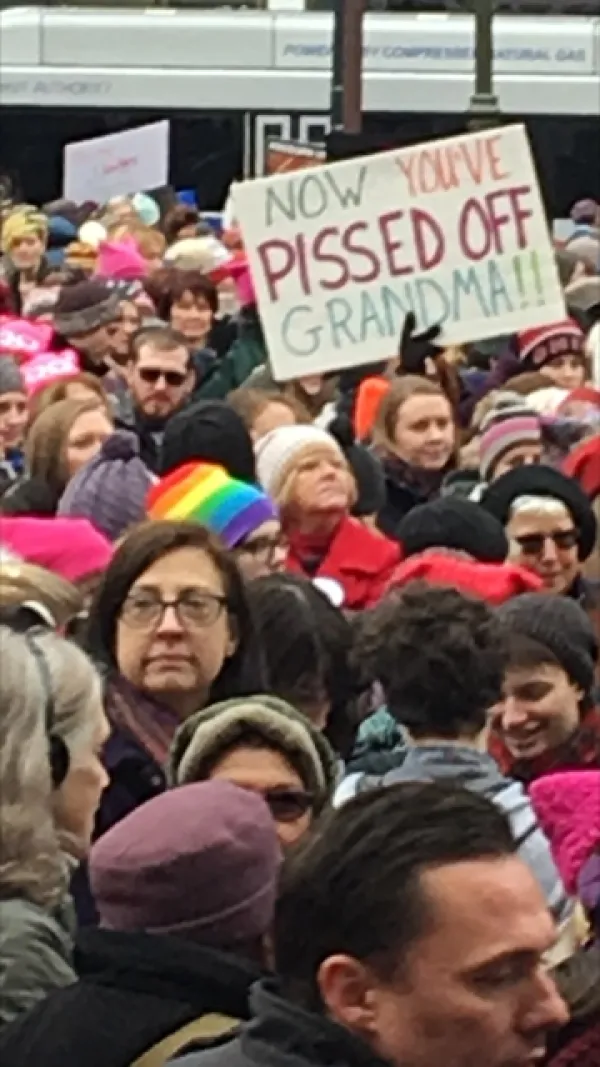
It was as wonderful sight to see thousands of women, men and children completely wrapped around the Ohio Statehouse at Sunday January 15th's Ohio Sister March event, the Ohio version of the Women's March on Washington that will be held January 21.
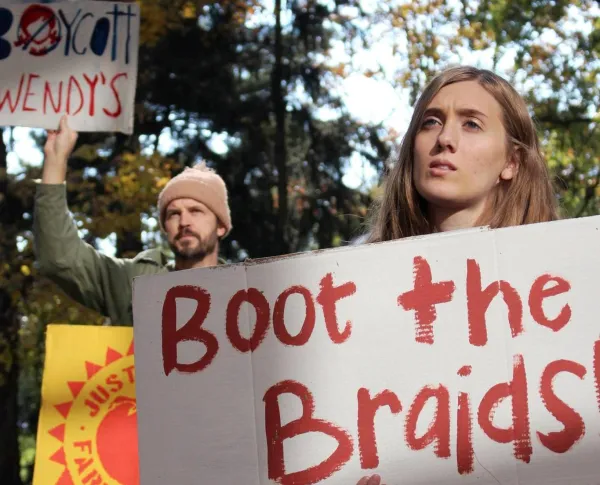
The Student/Farmworker Alliance held yet another protest on the Ohio State University campus on November 15. The student organization is engaged in a protracted struggle with OSU that began in April 2014, when they asked the university to terminate its contract with the Wendy’s Corporation. The fast food chain operates a restaurant in OSU’s Wexner Medical Center.
At issue is the human rights of farm workers in Wendy’s supply chain. Wendy's has refused to join the Fair Food Program developed by the Florida-based Coalition of Immokalee Workers (CIW). Joining the Fair Food Program would alleviate the poverty of farm workers who harvest the fresh tomatoes used in the Wendy's sandwiches and salads. The CIW's program also promotes a safer, more humane working environment, including zero tolerance for sexual harassment and slave labor — abuses still common in the agricultural industry.
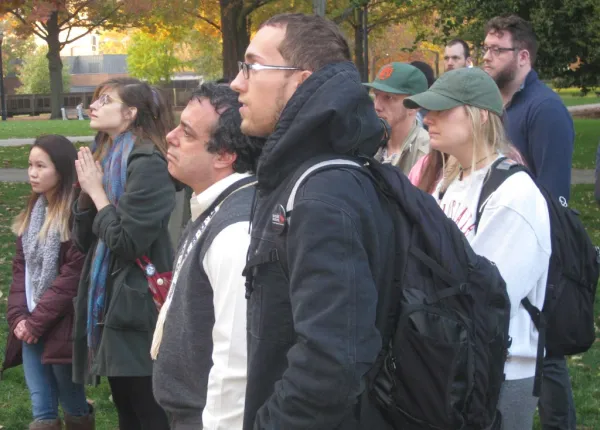
In Columbus, the looming Donald Trump presidency has added urgency and intensity to protests of the Dakota Access Pipeline. On November 16 the student group Socialist Students organized a demonstration on the Ohio State University campus.
“They’re building the pipeline through sacred Sioux burial grounds,” said Socialist Students member Mia Zerkle. “This is the equivalent of destroying somebody’s church, or disrupting the Arlington National Cemetery. This is infringing on their rights and everything they believe in.”
“This isn’t only an issue about the environment,” said Rachel Rouwenhorst, who studies ecology and evolution at OSU. “This is about Native American sovereignty. Corporations shouldn’t be putting pipelines through their burial grounds, prayer sites, and water supply.”
Rouwenhorst called for a boycott of the banks that are investing in the pipeline, including CitiBank, Wells Fargo, Bank of America, US Bank, PNC Bank, JP Morgan Chase, UBS, and Goldman Sachs. “You can close your account with them and use a credit union, or a bank that is not funding this pipeline,” she said.
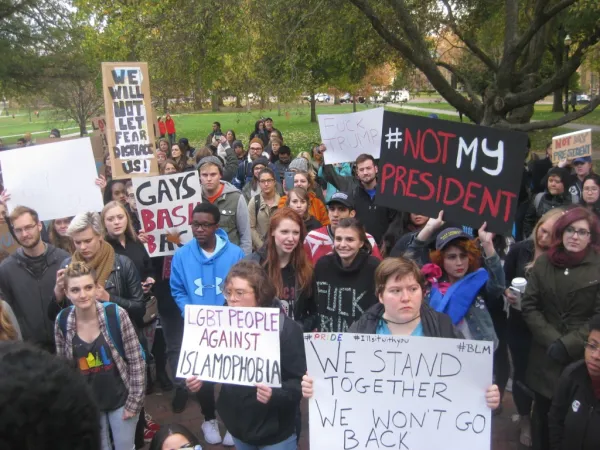
Protests and vigils in Columbus last week focused largely on fear of President-elect Donald Trump, outrage at his supporters, and grief over Democratic candidate Hillary Clinton losing the election. But while over 200 demonstrators had a lot to say against Trump at the OSU Oval on Friday, they also pointed a clear path forward: mass organizing and rejection of establishment politics.
“This is our wake-up call. We’ve been asleep, and we woke up to a nightmare,” said Bilal El-Yousseph, a Palestinian Muslim. “My mother wears a head covering, and she shouldn’t be scared to go to her job.”
El-Yousseph supported Bernie Sanders as the Democratic nominee, who polled better against Trump than Hillary Clinton did. He was angry when the DNC used underhanded tactics to give Clinton the nomination anyway. “The Democratic Party is not here for us,” he said.
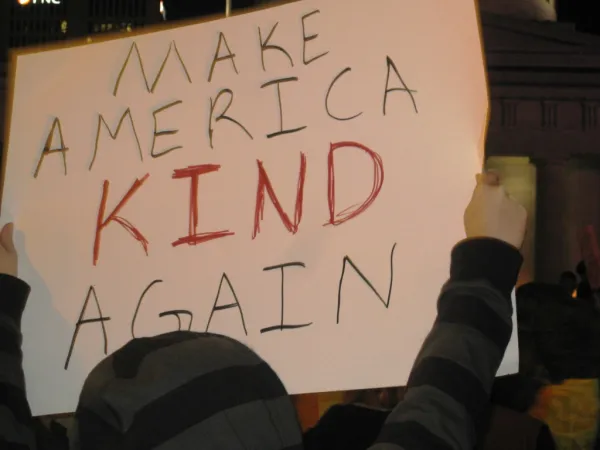
Hundreds joined a protest against President-elect Donald Trump at the Statehouse on November 10. The turnout was encouraging. The messaging probably gave protesters a needed catharsis. But more needs to be done to direct the momentum into building a fighting movement of the 99%.
Protesters chanted about how awful Trump is. They bemoaned that Hillary Clinton didn’t win the presidency. And hey, let’s sign a petition to ask the Electoral College to give Hillary the election.
All of this is easy, and it won’t accomplish anything. What’s needed is a clear path forward. And the way forward needs to be informed by an accurate assessment of why so many working-class Americans have turned away from the Democratic Party. Robert Reich’s article in The Guardian is a good place to start.
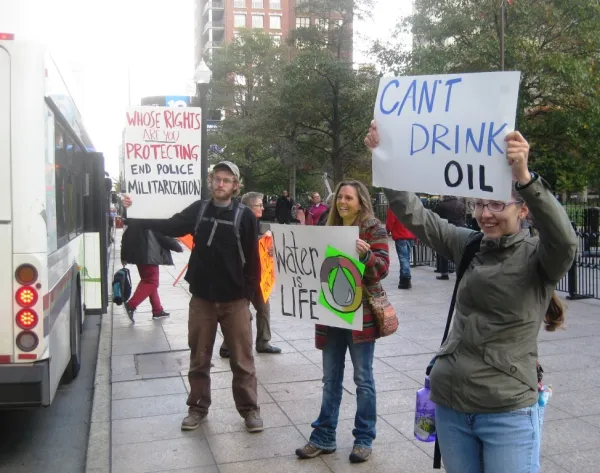
On November 4 supporters of the North Dakota Sioux from across Ohio gathered at the Statehouse to call on Governor Kasich to recall state troopers from Standing Rock. The demonstrators chanted, “Mni Wiconi!” (Lakota for “water is life”).
The Ohio State Highway Patrol sent 37 troopers to Standing Rock on October 29, ostensibly to “help law enforcement there protect property and to protect everybody’s rights.”
Opponents of the Dakota Access Pipeline understand that law enforcement has been called in to protect property rights. But they don’t believe that everyone’s rights are being protected. Police violence against protesters blocking the path of pipeline construction has been escalating, including the use of pepper spray, tear gas, stun guns, and rubber bullets.
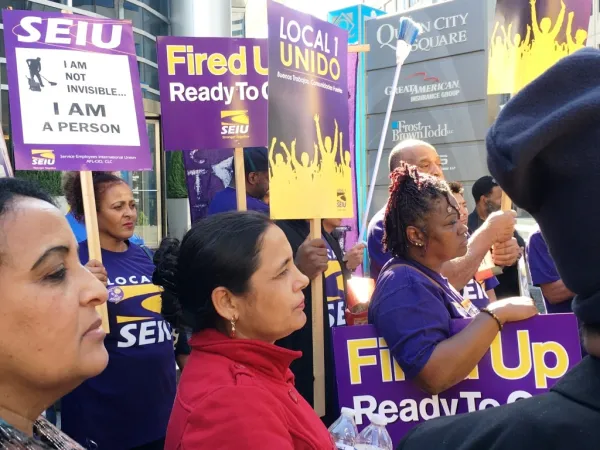
Diane Hudson wants a new union contract that will bring her family out of poverty. She works as a janitor at the Columbus Academy, a private PreK-12 school in Gahanna. Hudson supports her elderly mother and struggles every month to make ends meet. A living wage would mean “we don’t have to be under so much stress, living paycheck to paycheck,” she said.
On October 29 hundreds of janitors held a rally at the Great American Tower in Cincinnati to kick off contract negotiations. The new contracts will affect 1,800 members of Service Employees International Union (SEIU) Local 1 in central and southern Ohio, including 800 janitors who work in the Columbus area. The current Columbus contract, which expires December 31, covers janitors who clean the offices of Columbus’ largest companies, including Nationwide, Huntington, JP Morgan Chase, and AEP.
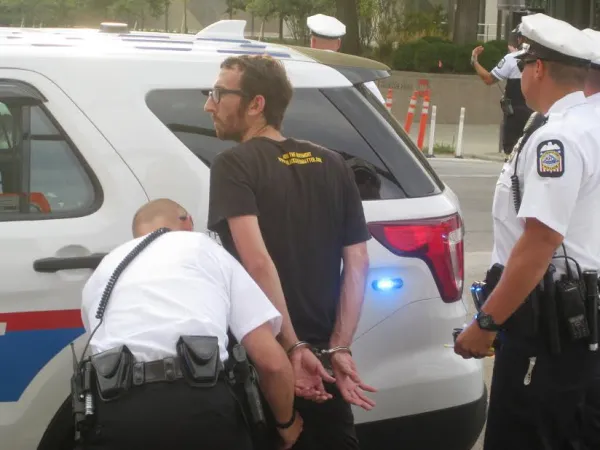
Video footage from the police cruiser where Black Lives Matter protester Tynan Krakoff was taken into custody is raising questions about Columbus police tactics and why he was targeted for arrest. Krakoff is a lead organizer in the Columbus chapter of Showing Up for Racial Justice, a national organization of white people who fight against racial injustice.