
Anti-War
When the hijacked planes hit the twin towers of the World Trade Center, pierced the Pentagon and buried into a field near Shanksville, Pennsylvania, most of our thoughts were about the cruel, horrific shattering of family bonds, the forever severing of deep friendships, the senseless destruction of human life. More than that America was under threat and fear prevailed.
The never-ending heartache of loss was on display in photos with messages that ringed the fence of a church near ground zero in New York: “Have you seen him?” “Please, any information, call…” “Please help us find our wife and mother.”
Hundreds of messages. No responses.
I was in New York a few days after 9/11 and witnessed the devastation. I traveled to the site where Flight 93 impacted. And I had heard the plane hit the Pentagon, as I joined hundreds evacuating the Congressional House Office Buildings in Washington, D.C.
It ought to be easy. Open bank vault, remove weapons dealers, close bank vault. In reality, we need a ton of tools, work, and luck.
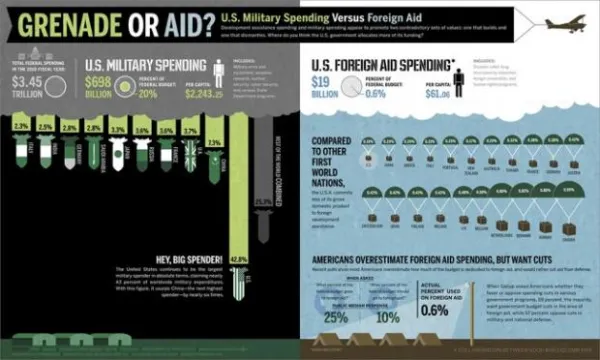
In constant dollar terms, after Korea, Vietnam, Reagan’s second term, and Obama’s first term U.S. military spending went down, just never as much as it had gone up. So, ending wars, including Cold Wars, may help.
We now have a war underway in which the U.S. participation is understood as primarily spending money. Ending that spending could be expanded into reducing military spending more broadly.

BANGKOK, Thailand -- More than 3,800 U.S. troops led 30 countries' forces and observers through Cobra Gold, the Pentagon's biggest Asian military exercise, trying to keep Thailand's coup-empowered army allied with Washington while Beijing increases its political, economic, and cultural influence.
"There has been resentment among Thai military officers and conservative politicians because of what is perceived as [Washington's] high-handed, tutelary policy about what Thailand should and should not do -- with regard to coups," said Paul Chambers, a Southeast Asian Studies lecturer at Naresuan University in Thailand.
"The negative policy in Washington toward coups [in 2006 and 2014]...contributed to some extent in Bangkok moving toward a realist policy of 'hedging' whereby a state creates balance between two great powers, in this case China versus the U.S.," Mr. Chambers said in an interview.
"The Thai military establishment does not like the United States for talking and pressing about military non-intervention in politics, and for the need to return democracy to the Thai people," former foreign minister Kasit Piromya said in an interview.

As is the case of long wars, the warring parties and their affiliated media in the Russia-Ukraine conflict have painted each other using uncompromising language, making it nearly impossible to offer an unbiased view of the ongoing tragedy that has killed, wounded and expelled millions.
While it is understandable that wars of such horror and near complete disregard of the most basic human rights often heighten our sense of what we consider to be moral and just, parties involved and invested in such conflicts often manipulate morality for political and geopolitical reasons.
This same logic is underway in Ukraine. Both sides are adamant that nothing less than a complete victory is acceptable. The Ukrainian view is fully supported by western countries in word and deed - as in tens of billions of modern weapons that have done little, aside from worsening an already bloody conflict.
Here’s how this works each year.
1) Biden proposes a massive increase in military spending — above and beyond both what he proposed the year before and what the Congress increased that to. If you look at U.S. military spending according to SIPRI in constant 2021 dollars from 1949 to now (all the years they provide, with their calculation adjusting for inflation), Obama’s 2011 record will probably fall this year. If you look at actual numbers, not adjusting for inflation, Biden has set a new record each year.
If you add in the free weapons for Ukraine, then, even adusting for inflation, the record fell this past year and will probably be broken again in the coming year.

At last week’s Rage Against the War Machine peace rally in Washington there was no shortage of speakers who denounced the Biden Administration’s hypocritical foreign policy, which essentially judges any violent action undertaken by the United States and its friends as good by definition while anything done by rivals or competitors, sometimes conveniently referred to as “enemies,” as “evil.” In the current context of Ukraine versus Russia, where the US is engaged in proxy warfare, speakers were able to cite and compare the formidable list of America’s armed interventions worldwide since World War Two ended. Neither Russia nor any other nation comes anywhere near the United States in terms of constant bellicosity, conflicts which hardly ever reflect any real vital national interest or imminent foreign threat.
It’s quite a high hurdle to appeal to a country that’s been militarily invaded — after decades of military defense (and offense) preparations and the accompanying cultural indoctrination in the supposed necessity of military defense — to appeal to said country to construct on-the-fly an unarmed civilian defense plan and act on it despite near-universal lack of training or even comprehension.
We’re finding it to be a high hurdle just to get access to bring in an unarmed team to defend a nuclear power plant in the middle of a war.
A more reasonable proposal is for national governments that are not at war to learn about and (if they really learned about it then this would necessarily follow) establish departments of unarmed civilian defense. World BEYOND War is putting together both an annual conference in 2023 and a new online course on this topic. One place to get the very beginning of an understanding that unarmed actions can repel militaries — even without serious preparations or training (so, imagine what proper investment could do) — is with this list of nearly 100 times people successfully used nonviolent action in place of war.

Declaration by the German Initiative Lay Down Your Arms, on the anniversary of the Russian invasion of Ukraine, February 16

Though it was clear that Burkina Faso was eventually going to follow in the footsteps of Mali and the Central African Republic (CAR), Ouagadougou’s decision to break military ties with France was not as simple as media sound bites want us to believe.
The conventional wisdom is that these countries are walking away from their former colonial master, France, to forge alternative alliances with a new ally, Russia. These convenient analyses are largely shaped by the geopolitical tug-of-war between old and new superpowers: The US and its NATO allies on the one hand, and Russia and China on the other.

When I tell some people that the inhabitants of certain mountains in Montenegro are trying to protect their home from being turned into a giant military training ground by NATO, they inform me that the training ground (which, up until that monent, they’d never heard of) in Montenegro (which they’d never heard of) is absolutely required because of Putin.
Needless to say, I think that Putin (and every living U.S. president, and quite a number of other world “leaders”) should be prosecuted for their crimes. But are we supposed to imagine Putin as the enemy of mindless support for militarism we know nothing about? I thought he was supposed to be the enemy of democracy.