
The Free Press is bringing back a Reviews section after some absence. We hope to review plenty of events around town. Check back frequently and if what\'s going on is any good.
Arts & Culture
Image
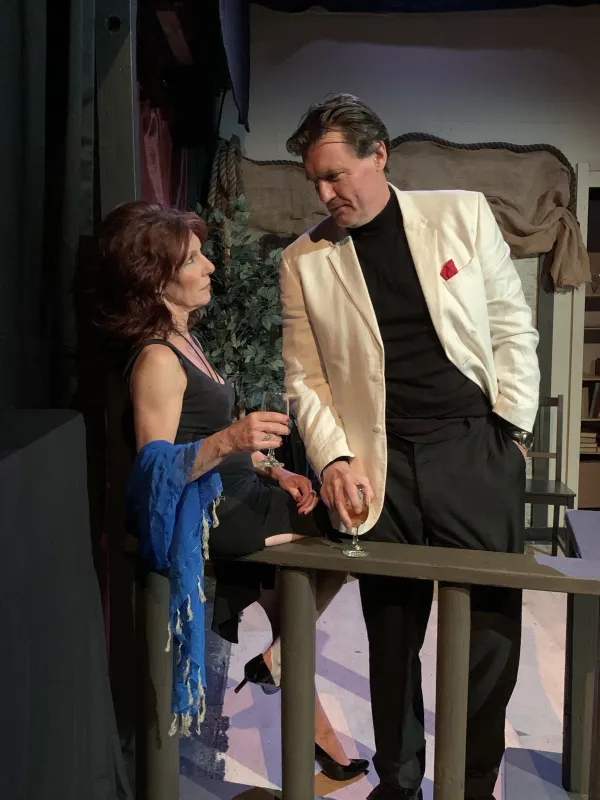
What I loved about playwright Willard Manus’ Show Me a Hero is that it introduced me to Greek freedom fighter Alexandros Panagoulis, a significant historical figure I’d never heard of, and brought back to life the legendary journalist Oriana Fallaci, whom I was somewhat familiar with. The UK’s Independent dubbed her “arguably the most extraordinary journalist Italy has ever produced.” The fabled Fallaci (here called Luisa and played with feisty fire by Lisa Robins) joined the Italian anti-Mussolini resistance when she was only 14.
Presumably due to her early participation in the anti-fascist movement when the college dropout became a journalist Fallaci specialized in interviews with controversial political leaders, often revolutionaries like Vietnam’s Giap, Palestine’s Arafat, Libya’s Qaddafi and Cuba’s Fidel. She also interviewed reactionaries, such as mass murderer Henry Kissinger, who later rued their interaction. (Like Jared Kushner and Stephen Miller, Kissinger’s existential angst is that he wanted to be a Nazi - but was born a Jew.)
Image
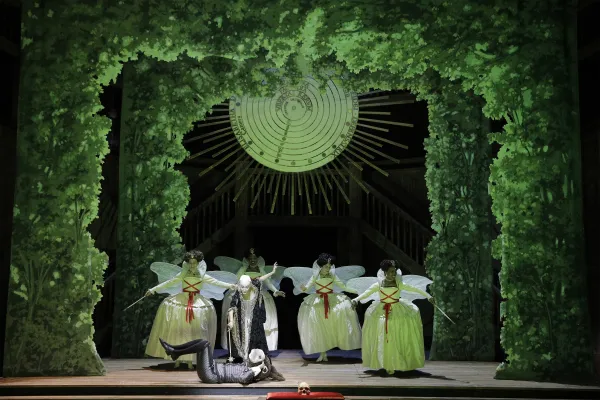
Move over Broadway’s recently opened musical adaptation of the 1960s’ wife-swapping movie Bob and Carol and Ted and Alice, which has nothing on LA Opera’s premiere of Gaetano Donizetti’s opera Roberto Devereux about the 1600s’ kinky hi-jinks of Bob and Liz and Sara and Duke. To be more specific, I’m referring to the ménage-a-quatre (to coin a phrase?) between the titular character, Roberto Devereux (aka the Earl of Essex), Queen Elizabeth, Sara (the Duchess of Nottingham) and the Duke of Nottingham in Elizabethan England.
Donizetti’s tragedia lirica (tragic opera) with Salvadore Cammarano’s libretto, first produced in 1837 at Naples, is loosely based on at least one play and a publication about actual historical personages. This is one of Donizetti’s works depicting England’s House of Tudor, which include the Italian composer’s operas about Anne Boleyn (King Henry VIII’s doomed wife is alluded to in Roberto as she gave birth to Elizabeth) and Mary, Queen of Scots.
Image
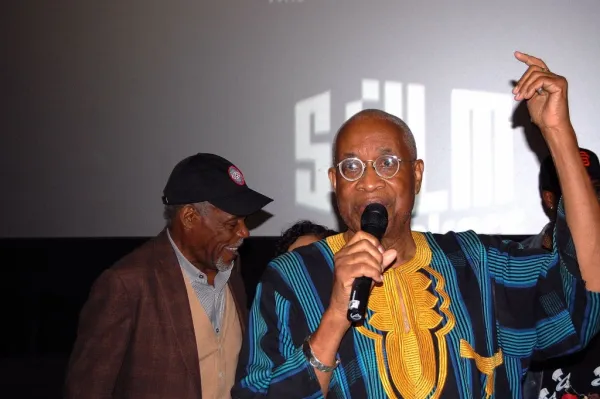
One of the top ways to celebrate Black History Month - and the movie going experience in general - is to attend the Los Angeles-based 28th Annual Pan African Film & Arts Festival. PAFF focuses on Black-themed films, ranging from studio pictures to indie productions, with works from Hollywood, the USA, Mother Africa, the Caribbean, Melanesia (the Black South Pacific Islands, such as Fiji), Australia (this fest remembers that Down Under’s indigenous people, the Aborigines, are also Black) and beyond. The features, documentaries, shorts, animated pictures, etc., from Africa and the Black Diaspora provide movie fans an opportunity to see independent and international films in the world’s entertainment capital that Angelenos may otherwise never get an opportunity to view. This yearly cultural gemstone includes workshops and panels presented by the PAFF Institute, plus an ArtFest centered at Cinemark’s Baldwin Hills Crenshaw Plaza and the adjoining shopping complex.
Image
[NOTE: This review may contain plot spoilers for those unfamiliar with this 2,600 myth.]
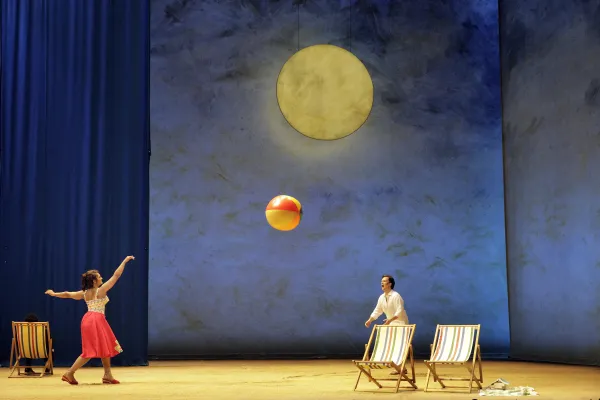
LA Opera’s world premiere of composer Matthew Aucoin and librettist Sarah Ruhl’s sublime Eurydice is an optically and aurally stunning reinterpretation of the ancient Greek myth about Orpheus (Canadian baritone Joshua Hopkins) and the title character (depicted by Angeleno soprano Danielle de Niese and at the performance I experienced, by Rhode Island soprano Erica Petrocelli). Like Romeo and Juliet - consider that Shakespeare’s tragedy inspired the beloved stage and screen adaptations of West Side Story in 1957 and 1961, with a new iteration opening on Broadway this week, with a Steven Spielberg movie remake waiting in the wings - there have been many versions of this immortal romance derived from Grecian mythology.
Image
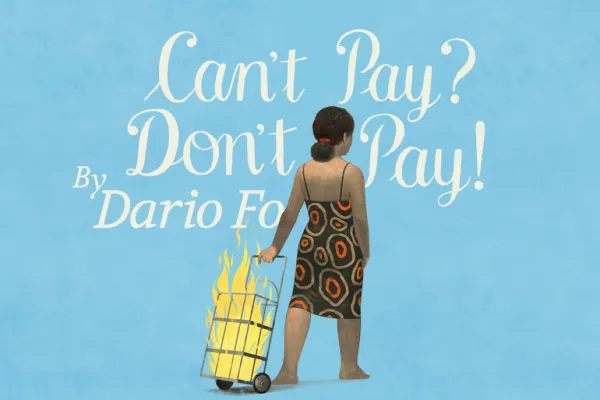
The Actors’ Gang’s production of Can’t Pay? Don’t Pay! is a synergy of Hollywood slapstick a la the Three Stooges and American TV show s like I Love Lucy, The Honeymooners and Roseanne crossed by and infused with the anarchist and socialist politics of Mikhail Bakunin, Pierre-Joseph Proudhon and Karl Marx. This merry madcap Marxist mash-up puts the “commie” into sitcom. To paraphrase the Stooges’ Curley: “Moe! Larry! Che!”
Image
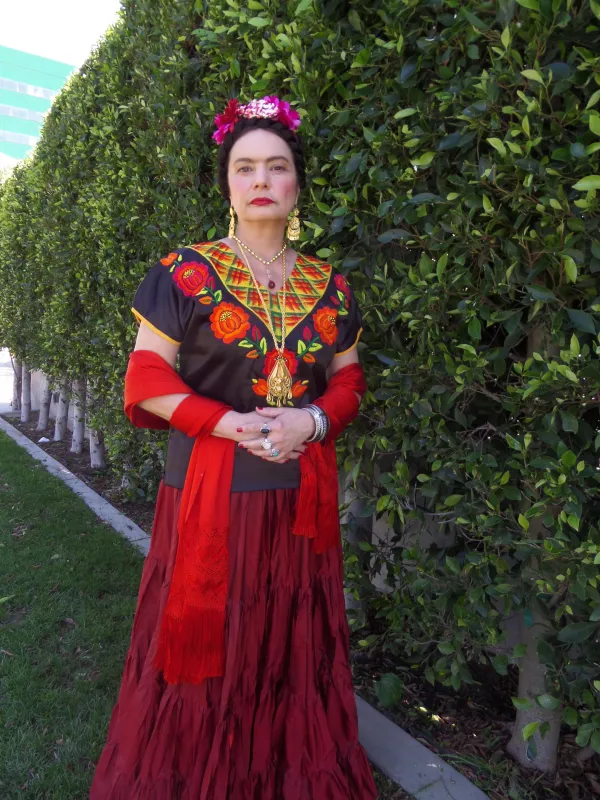
[NOTE: For those unfamiliar with Frida Kahlo’s life, this review may contain plot spoilers.]
If Howard Zinn penned “People’s Histories” and Oliver Stone filmed “Untold Histories,” Latinx playwright Odalys Nanin’s modus operandi is to write (or rewrite?) allegedly biographical plays about famous women revealing their same sex affairs. I previously saw Nanin’s stage exposes purporting that Greta Garbo and Marilyn Monroe indulged in Sappho hanky-panky. Some may regard this as a breakthrough, disclosing the hitherto concealed, unvarnished lesbian truth. Some may react with puritanical disbelief and outrage that their beloved sex goddess has been thusly tarred and defamed. Still others could respond with a collective yawn, musing “that’s so 20th century” and “so what? Who Cares?” Take your pick.
Image
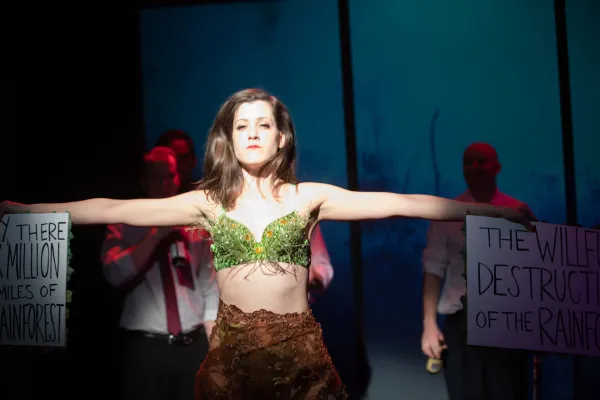
Rogue Machine’s West Coast premiere of award winning British playwright Mike Bartlett’s Earthquakes in London is, according to Rogue’s artistic director and the drama’s co-director John Perrin Flynn, “quite simply, the best play I have read about global warming.” This three hour-ish, UK-set tour-de-force takes a deep dive into the pressing subject of climate - as well as family - crisis. It is an epic play that goes back and forth in time and is mainly for more daring theatergoers and environmentalists who take their drama and politics seriously.
With the caveat that said ticket buyers have slept well the night before and hence can be very alert and pay close attention to the complex characters and storylines that shift on theatrical tectonic plates. For example, the pivotal role of the climate scientist father, Robert, is played by Paul Stanko as a young man and then in his maturity by Ron Bottitta. Robert is being wooed by energy companies, so we see him
before and after - but this might confuse some viewers.
Image
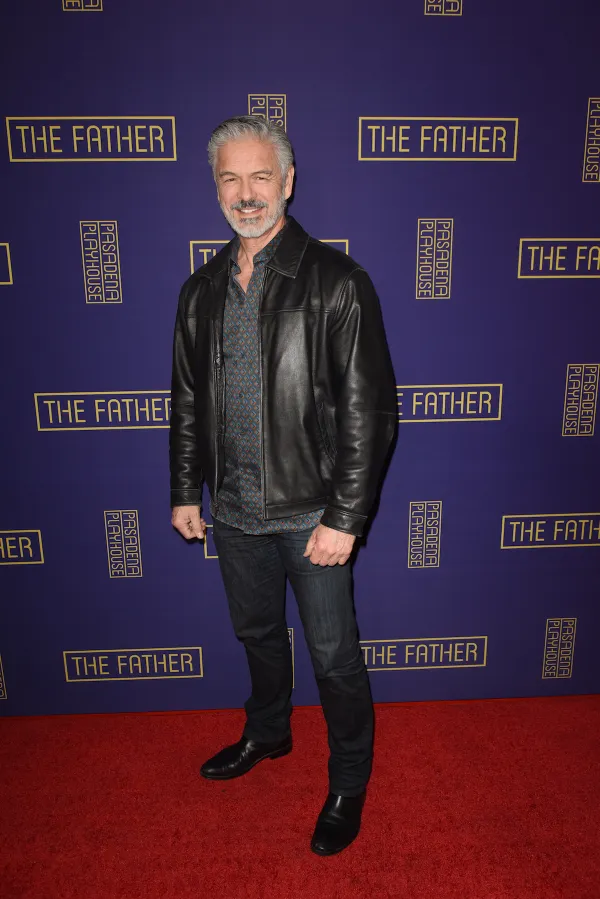
Alfred Molina renders a devastating depiction of dementia in Florian Zeller’s award winning The Father. Ably directed by Jessica Kubzansky, this one-act Alzheimer-palooza is staged in what is usually described as a “cinematic” way, with intercutting and perhaps even montage used to indicate Andre’s (Molina) increasingly fragmented, confused perception of reality. The lighting and sound designers, respectively Elizabeth Harper and John Zalewski, adroitly enhance the loss of his bearings, with David Meyer’s shape shifting sets adding to Andre’s sense of mental mayhem.
At one point race is effectively used for shock value - not in a cultural, ethnic sense but in a visual way that jolts the senses. Andre is also always looking for his watch, which he accuses caregivers (as a convenient ruse to sack them, so he can maintain his ephemeral sense of independence) and others of stealing. But in contrast to, say, Rolexes, Andre’s watches are more akin to Salvador Dali’s melting timepieces, symbolizing the distortion of the passage of time.
Image

The Anti-Blacklist/HUAC/McCarthyism community and free speech champions everywhere have lost two of our historic giants. It has been widely reported that actor/producer KIRK DOUGLAS passed away at the age of 103. It is gratifying that news reports have noted that Kirk played an important, courageous role in breaking the Hollywood Blacklist and cited 1960’s Spartacus as probably his most iconic role.
As you likely know, it was with that epic movie that Kirk helped end the Blacklist by allowing screenwriter DALTON TRUMBO, one of the HOLLYWOOD TEN - who’d been banned from (openly) making movies since 1947 - to publicly have screen credit. Just as OTTO PREMINGER bravely did that same year, for the Trumbo-scripted Exodus.
Image
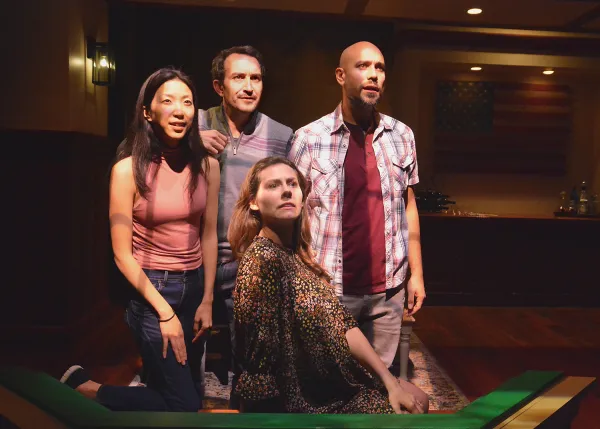
Let me cut (and I mean “cut” in all its meanings) to the “race” - uh, I mean chase: Skylight Theatre Company’s world premiere of playwright Penelope Lowder’s West Adams is a great new play. In about 90 minutes Adams features a searing, scorching look at timely issues in a highly entertaining way full of wit and drama, offering ticket buyers a powerful, wonderful night at the thee-a-tuh.