
Trump's Tyranny

I’m very, very strange. I think democracy would actually be a good thing, not just grounds for bombing other countries. As long as we’re stuck with electing supposed representatives, I want to make that system approximate as closely as possible actual democracy. This attitude results in some bizarre positions. For example, I want candidates to lay out a detailed policy platform with hard commitments to particular actions. Even weirder, I don’t really care what a candidate looks like or what he or she does consensually in bedrooms or what political party, if any, he or she swears obedience to — er, excuse me, belongs to.
U.S. politics is remarkably devoid of content, in general, and especially at the higher levels, and especially on unpopular positions supported by both big parties. Almost never will a candidate for the U.S. Congress outline a basic desired budget. Virtually none has a position on the level of military spending. Very few Democrats, and not that many Republicans, have any foreign policy platform at all. Campaign websites are dominated by personal stories, vague “principles,” and fluff.
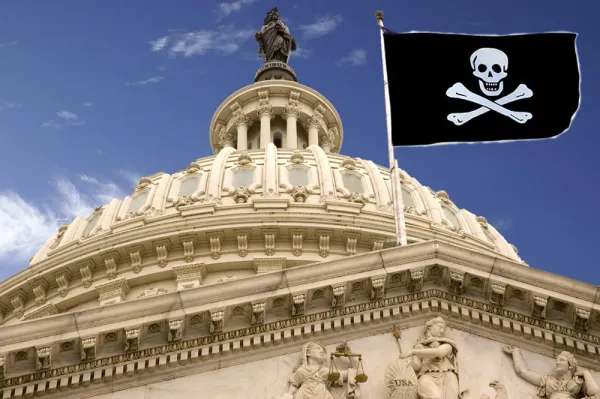
Read this headline: “To Avoid Repeating Catastrophic Mistake of Iraq Invasion, Senate Bill Would Forbid Attack on Iran Without Congressional Approval.”
Consider these facts:
The Senate voted to let Bush attack Iraq.
So did the House.
The pair of them continue to fund the U.S. military occupation of Iraq to this day.
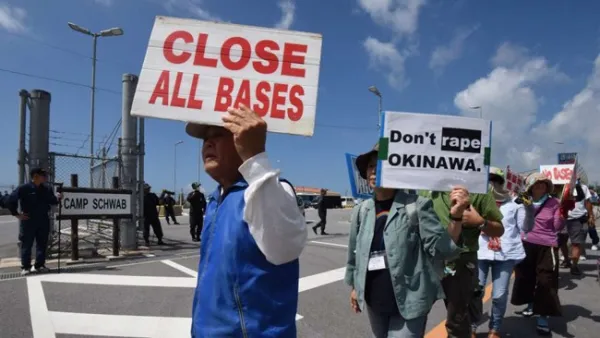
I confess that the idea of fighting for “the soul of the Democratic Party” has always sounded as sensible to my ear as fighting for the soul of a cow plop, and plans to improve the world through the Democratic Party about as strategic as a preemptive compromise. The following statement from the Democratic Party has given me second thoughts:
“We declare again that all governments instituted among men derive their just powers from the consent of the governed; that any government not based upon the consent of the governed is a tyranny; and that to impose upon any people a government of force is to substitute the methods of imperialism for those of a republic.
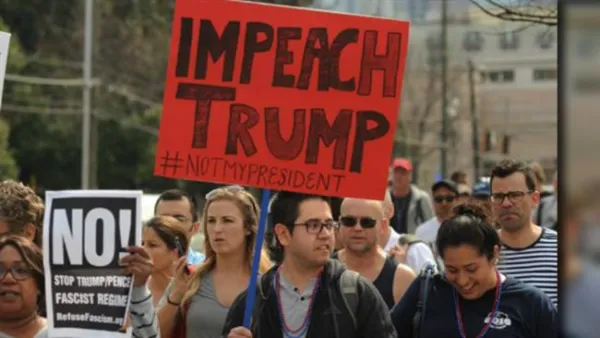
According to an ABC News / Washington Post poll, 49% of a sampling of the U.S. public wants impeachment begun (they don’t specify when, but presumably any moment now) against Trump, while 43% do not. There are almost certainly millions of additional Democrats who would move into the pro-impeachment column if that party’s leaders did so. Same with Republicans. Many more Independents might also jump on board if the case were publicly made and momentum built to make conviction in the Senate seem plausible in an age when absolute loyalty to partisanship goes unquestioned.

Mueller Wave of crony convictions and confessions has barely begun.
But one thing is clear: the term “collusion” vastly understates Trump’s oneness with Vladimir Putin and the Russian Mob.
Collusion implies two independent parties working together.
Trump is not separate from Putin. Trump is Putin’s employee. His debtor. His servant. His baby mama. Or, in CIA terms, Putin’s asset. Since the 1980s.
The tsunami of proof ranges from Craig Unger’s remarkable new House of Trump, House of Putin to David Cay Johnston’s It’s Even Worse Than You Think and much more. (For a full hour of Unger’s narrative, hear this week’s “Green Power & Wellness Show.”)
Here is some of it:

A few days after an over-hyped white supremacist rally in Washington, D.C., was massively outnumbered by people opposed to racism, and one day after 187 organizations (more than that now) publicly committed to turning out people to counter Donald Trump’s planned weapons parade with a parade for peace in celebration of the 100th anniversary of Armistice Day, and less than a day after the U.S.

As with any dangerous tool, impeachment should be used with proper safety precautions. Among these should be taking care not to increase the chance of a nuclear war while trying to start an impeachment.
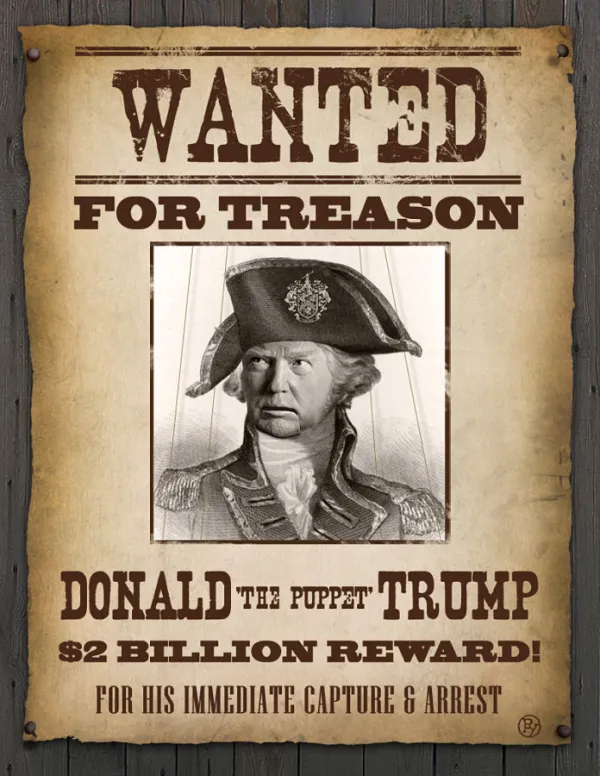
he following collage of more and less hysterical reactions to President Trump’s embrace of President Putin includes cries of “Treason!” without any call to action. What can we do if this is as true as it seems? The answer, such as it is, follows at the end of this piece.
Today’s press conference in Helsinki was one of the most disgraceful performances by an American president in memory. The damage inflicted by President Trump’s naiveté, egotism, false equivalence, and sympathy for autocrats is difficult to calculate…. No prior president has ever abased himself more abjectly before a tyrant. – US Senator John McCain, Republican of Arizona, official statement, July 16
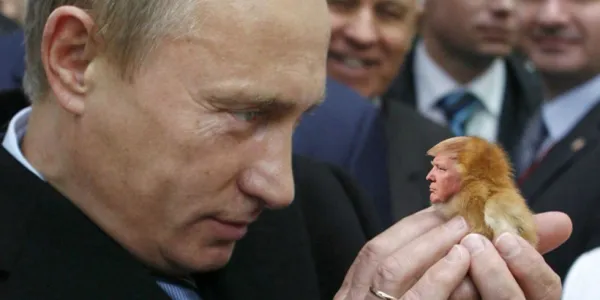
he Manchurian Money-Launderer has just kissed every inch of his mafia don’s anatomy.
The Donald has been washing Russia’s mob cash since the 1980s. The constant stream of ruble injections has funded his many bankruptcies.
In 2016, GOP election thieves like Kris Kobach, Jon Husted, Scott Walker, Rick Snyder, Rick Scott (state secretaries of Kansas and Ohio, governors of Wisconsin, Michigan and Florida) and so many more turned Trump’s 3-million-vote loss to Hillary Clinton into a victory for the Russian mob and America’s corporate 0.01%. They’re set to do it again in 2018 and 2020.
The brutal, ruthless Putin is orders of magnitude more savvy and capable than the orange American. Globally, he is the mob boss Don Corleone, lording it over his addled son Fredo.
Amidst Trump’s Helsinki rant storm against US intelligence, Putin admitted he favored Trump in the 2016 election.
In light of Trump’s invitation to hack the Democrats, Putin magnanimously hinted he might allow American legal representatives to listen in while his KGB consiglieres “question” operatives indicted by Robert Mueller for doing what Trump asked them to do.
Things fall apart; the centre cannot hold;
Mere anarchy is loosed upon the world
The blood-dimmed tide is loosed, and everywhere
The ceremony of innocence is drowned;
The best lack all conviction, while the worst
Are full of passionate intensity.
– William Butler Yeats, The Second Coming, 1919
 pocalyptic thinking has been with us for a long time, and it sometimes ushers in actual apocalypses, albeit at human scale, without biblical finality. For a century now, the Yeats poem above has served as an increasingly common reference point for those who fear apocalyptic events approaching. Today such fears are varied, the threats are real, and reactions range from crisis-mongering to self-serving denial, making any rational, coherent societal response almost impossible.