
THE G-20 IN PITTSBURGH
by Tom Over 9-23-09
<br><br>
On Tuesday, Sept 22, activists from Philadelphia, New York City, Pittsburgh and other cities held a mock funeral procession to demand better policies for addressing the AIDS pandemic, a day ahead of the arrival of delegates for the G-20.
<br><br>
The approximately 50 participants in the New Orleans-style funeral march drew a mix of interest, irritation, and amusement from onlookers in the business district of downtown Pittsburgh.
<br><br>
At the head of the funeral march where pallbearers carried a cardboard coffin, a man shouted into a microphone while someone else carried a portable amplifier, “when people with AIDS are under attack, what do we do ?” and marchers shouted in unison, “fight back!”
<br><br>
Amidst the early afternoon bustle of an weekday, the demonstrators repeated this call-and-answer and similar chants as the funeral march made its way around the perimeter of the David L. Lawrence Convention Center, the site of the G-20 Summit later this week.
<br><br>
Erica Goldberg works with ACT UP Philadelphia. She said global health is not on the agenda of the G-20 Summit.
“One of the things that some of the G-20 nations have promised us is funding for the global fund to fight, TB, malaria, and HIV/AIDS. This is all really important, especially if we want to meet the United Nations’ Millennium goal of eradicating these diseases by 2015. As of right now, this won’t be met. We have to hold our leaders accountable. They are the ones making decisions for the poorer countries,” Goldberg said.
<br><br>
She commented on the timing of the demonstration. “We wanted this to be the first thing they (the G-20 delegates) see. They’re coming here tomorrow. We’re holding them accountable. This needs to be on the agenda.”
<br><br>
She said AIDS activists chose Sept 22, two days before the official start of the G-20 Summit, and one day before the arrival of the delegates, so as to not have to compete with other protests. Also, she said the AIDS activists figured there would be less of a chance of conflict with police if they staged their protest earlier in the week.
<br><br>
“We hope that this will hit the papers tomorrow, that it’s the first thing they see when they walk in, that they have this on their conscience and know we’re not going away,” Goldberg said. She urges people to contact legislators about supporting the Global Fund to Fight AIDS, Tuberculosis, and Malaria.
“President Obama, as much as I love him, went back on his promise to fulfill the funding,” Goldberg said.
<br><br>
She commented on how drug companies factor into all of this. “ Medication does not need to be this expensive. They can definitely lower their prices. We have big drug interests lobbying to prevent AIDS medication from getting” to developing nations.
<br><br>
Goldberg said debt cancellation for developing nations is a factor that comes into play.
“When you don’t cancel debts of nations and they have to pay back loans to the IMF and the World Bank, they won’t have the funds necessary for getting AIDS medication, or they might get the medication but can’t pay the health professional because of their debt.
<br><br>
She said vested interested motivated by huge profits stand in the way of doing a better job of addressing tuberculosis, malaria, and HIV/AIDS. “We have the power, the ability, and the medication.”
World News
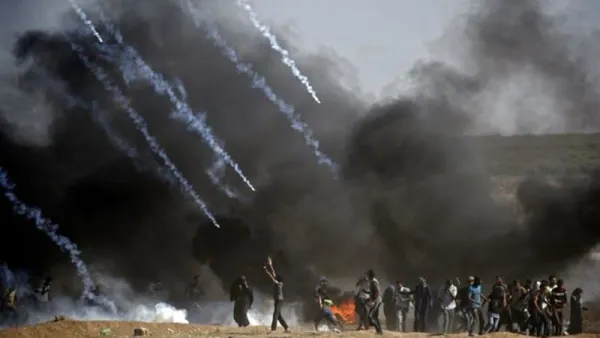
An Israeli attack on Gaza was imminent, and not because of any provocations by Palestinian groups in the besieged, impoverished Gaza Strip. The Israeli military escalation was foreseeable because it factors neatly in Israel’s contentious political scene. The war was not a question of “if”, but “when”.
The answer came on November 12, when the Israeli military launched a major strike against Gaza, killing an Islamic Jihad Commander, Bahaa Abu al-Ata, along with his wife Asma.

BANGKOK, Thailand -- Suspected Muslim separatists attacked poorly
defended road checkpoints killing at least 15 people, including five
women, in the most deadly assault in several years in southern
Thailand where more than 7,000 have died on all sides since 2004.
Authorities fear a new generation of minority ethnic Thai-Malay Muslim
guerrillas have emerged more efficient in deadly tactics and
frustrated with years of pointless negotiations amid allegations of
torture and extrajudicial killings by both sides.
The Islamists' hit-and-run attack during the night on November 5
included the use of improvised explosives and comes after the recent
failure of peace talks between the rebels and Thailand's U.S.-trained
military.
"It is a cruel, barbarian and inhumane act of 'deep south' insurgents
who hurled hand grenades and shot at civilians," said Defense Ministry
spokesman Lt. Gen. Kongcheap Tantrawanit on November 6, according to
BenarNews media which is affiliated with the U.S. government's Radio
Free Asia.
"This is one of the biggest attack in recent times," Col. Pramote
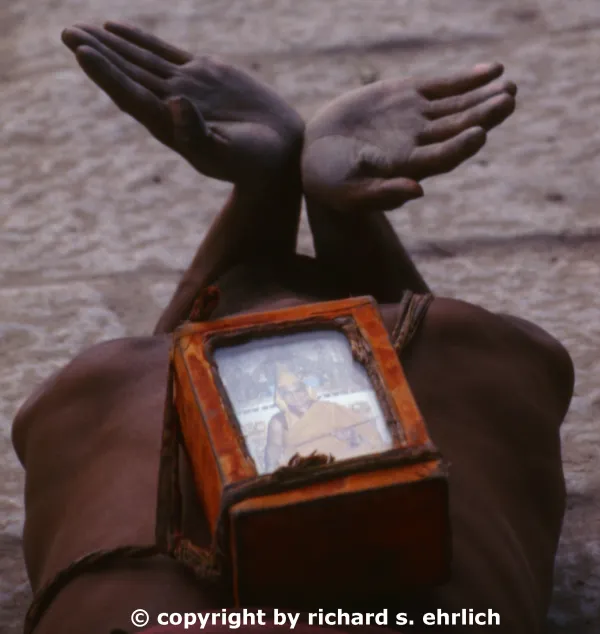
BANGKOK, Thailand -- In a surprise reversal, the Dalai Lama said his
Tibetan Buddhist tradition of reincarnated dalai lamas "should end
now" because the hierarchy created "a feudal system," a description
echoing decades of communist China's condemnation.
The Dalai Lama's public statement comes amid attempts by Beijing to
control who can be legally recognized as a reincarnated lama in Tibet
and what laws they must obey.
"Institutions need to be owned by the people, not by an individual,"
the self-exiled 14th Dalai Lama said in a speech at his residence in
McLeod Ganj, a small town on the outskirts of Dharamsala, India.
"Like my own institution, the Dalai Lama's office, I feel it is linked
to a feudal system. In 1969, in one of my official statements, I had
mentioned that it should continue...but now I feel, not necessarily.
"It should go. I feel it should not be concentrated in a few people
only," he told college students from Bhutan and India on October 25.
"The tradition should end now, as reincarnation has some connection
with the feudal system.

There is a certain irony in President Donald Trump’s frequently expressed desire to withdraw from the endless wars that have characterized the so-called “global war on terror” initiated by George W. Bush in 2001. The problem is that Trump has expressed such sentiments both when he was running for office and also as recently as last week without actually doing anything to bring about change. In fact, the greatly ballyhooed “withdrawal” from Syria turned out to be more like a relocation of existing military assets, with soldiers moving from Syria’s northern border to take up new positions to continue control of the Iraqi oil fields in the country’s southeast. Indeed, the number of American soldiers in Syria may have actually been increased with armor units being transferred from their base in Iraq.

Ed Rampell is a Ukrainian-American L.A.-based freelance writer and author.
Her earliest memories were of endless wheat fields and the sweeping steppes. She also remembered being afraid of the police - and the bitter cold. My babushka advised me: “If your feet stay warm the rest of your body will, too.” Like Tevye, Fiddler on the Roof’s beloved dairyman who dreamed of being “a rich man,” my grandmother Dorothy Kwass was a Ukrainian Jew who migrated to America.
On my father’s paternal side, Samuel Alexander Rampell was born in Odessa. Shortly after Czar Alexander II’s 1881 assassination, vicious pogroms (race riots) were unleashed against Jews and little Samuel sailed to America with his mother.
The Kwasses, my dad’s maternal line, were innkeepers in Kiev’s shtetl (ghetto). Their name is derived from kvass, the fermented sweet drink served at their inn. When the menfolk were drafted around 1904 during the Russo-Japanese war they became draft dodgers and fled to the land of the free, with five-year-old Dorothy.

BANGKOK, Thailand -- Hong Kong political activist Joshua Wong
predicted Thailand's young people will unleash an urban insurrection "
the same as Hong Kong youngsters did in the past four months" if
Thailand's Army Chief Gen. Apirat Kongsompong crushes Thai aspirations
for democracy and human rights.
The defiant Mr. Wong was responding to U.S.-trained Gen. Apirat's
harsh condemnation of protests in Hong Kong and his claim that Thais
could duped by Mr. Wong and "brainwashed" to protest in Bangkok.
"Hong Kong is suffering from the threat from Beijing," Mr. Wong said
in a 10-minute audio file emailed to Bangkok-based Prachatai.com news.
"And when the army chief asked Thai youth not to do the same, my only
response is if the government in Thai[land] do the same, the youth in
Thai[land] they will do the same as Hong Kong youngsters did in the
past four months. So it depends on the authorities instead of
depend[ing] on us."
Mr. Wong also proudly defended sharing similar political values and
talking with Thailand's popular opposition politician Thanathorn
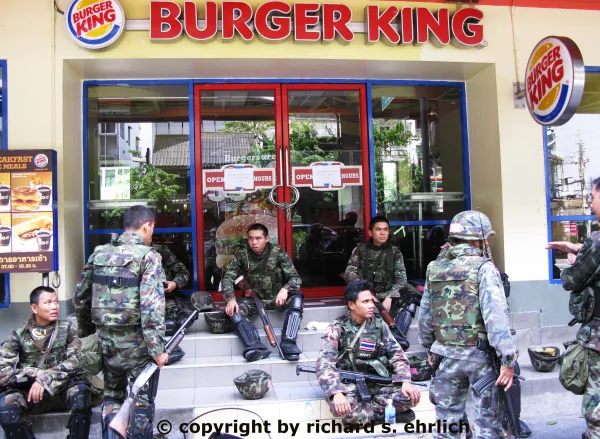
BANGKOK, Thailand -- Army Chief Gen. Apirat Kongsompong has announced
a communist conspiracy is plotting to seize power in Thailand, led by
elderly politicians and academics who had "implanted communist chips"
in their brains.
These secretive Thai communists have allied with Hong Kong's new
generation of protesters and could lure Thai youths to unleash an
insurrection in Bangkok, he warned.
Gen. Apirat's speech came after the military spent more than $480
million in recent purchases of U.S. weaponry including eight attack
reconnaissance helicopters, 50 Hellfire missiles, 60 Stryker infantry
carrier vehicles, 200 Advance Precision Kill Weapon System rockets,
plus .50 caliber machine guns, grenade launchers and other arms and
ammunition.
The general's 90-minute speech at the Royal Thai Army Headquarters on
October 11 was titled "Our Land From a Security Perspective." The
audience of 500 included university students, academics, local leaders
and the media.
While speaking, Gen. Apirat -- who trained in the U.S. -- appeared on
the verge of tears.
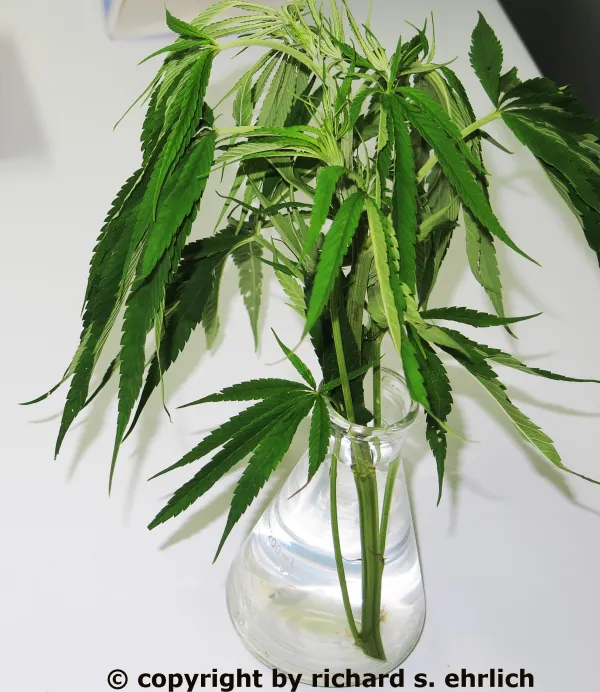
BANGKOK, Thailand -- Thailand has built what's described as the
biggest industrial-scale medical marijuana facility in Southeast Asia
with 12,000 plants, and will soon allow everyone to grow six cannabis
plants "in their back gardens like any other herb."
Recreational use remains illegal with punishments including
imprisonment. Enthusiasts hope the disappearing resistance to
marijuana's medical use will result in looser laws for public
enjoyment and business profits.
Those changes appear to be gaining momentum.
Government officials on September 2 attended a ceremony in northern
Thailand's Chiang Mai where Maejo University researchers planted
12,000 new marijuana sprouts.
The promising shoots are inside a newly built 32,722-square-foot
(3,040-square-meter) greenhouse with controls for temperature,
moisture and light.
Seeds for the 12,000 plants were provided by the government's
Department of Medical Service.
Officials expect the plants will produce medical-grade cannabis
flowers and buds within six months.
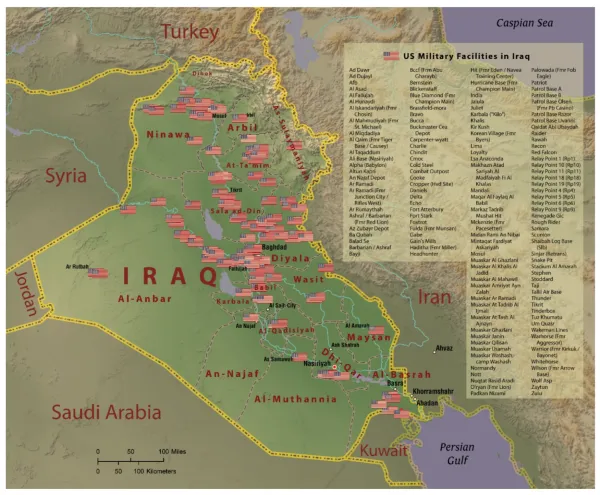
In the years following 2003, the U.S. military dotted Iraq with over 500 military bases, many of them close to Iraqi cities. These cities suffered the impacts of bombs, bullets, chemical and other weapons, but also the environmental damage of open burn pits on U.S. bases, abandoned tanks and trucks, and the storage of weapons on U.S. bases, including depleted uranium weapons. Here’s a map of some of the U.S. bases:
This map and the other illustrations below have been provided by Mozhgan Savabieasfahani, one of the authors of a forthcoming article in the journal Environmental Pollution. The article documents the results of a study undertaken in Nasiriyah near Tallil Air Base. Nasiriyah was bombed by the U.S. military in 2003 and in the early 1990s. Open-air burn pits were used at Tallil Air Base beginning in 2003. See a second map:
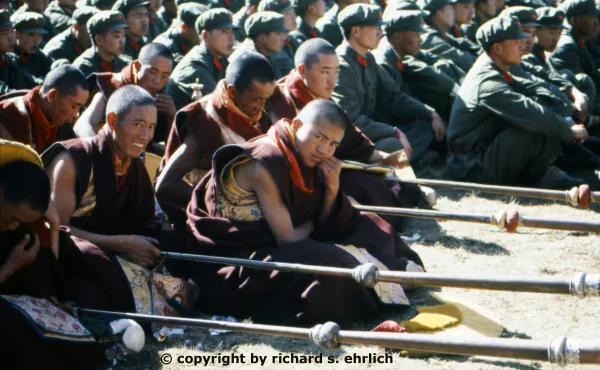
BANGKOK, Thailand -- After destroying much of Tibet's Buddhist
religion and causing the Dalai Lama to flee, the Chinese government is
now teaching Tibetan monks that every "living Buddha" must obey the
law while reincarnating.
"Some 100 Tibetan Buddhist monks attended a training session on
reincarnation for a living Buddha in southwest China's Tibet
Autonomous Region, which includes government regulation on management
of the reincarnation system," Beijing's Global Times recently
reported.
Training sessions began August 23 and lasted one week to 10 days in
Lhasa, capital of Tibet. Lessons included "the history and rituals for
the reincarnation of the living Buddha."
About 100 Tibetan Buddhist monks attended the courses, including monks
from the influential, centuries-old Sera and Drepung monasteries near
Lhasa.
A living Buddha is China's terminology for what Tibetans call a
"tulku". They can include the Dalai Lama, Panchen Lama, and other
senior lamas who have not achieved enlightenment and the nirvana of a
Buddha which ends their rebirths.